Volume 32, Number 7—July 2026
Research
Predictive Approach to Mapping Angiostrongylus cantonensis Nematode Distribution, Canary Islands, Spain
Lucia Anettová , Jan Divíšek, Radovan Coufal, Anna Šipková, Jana Kačmaříková, Michal Horsák, Vojtech Baláž, Elena Izquierdo-Rodriguez, Barbora Červená, Pilar Foronda, and David Modrý
, Jan Divíšek, Radovan Coufal, Anna Šipková, Jana Kačmaříková, Michal Horsák, Vojtech Baláž, Elena Izquierdo-Rodriguez, Barbora Červená, Pilar Foronda, and David Modrý
Figure 1
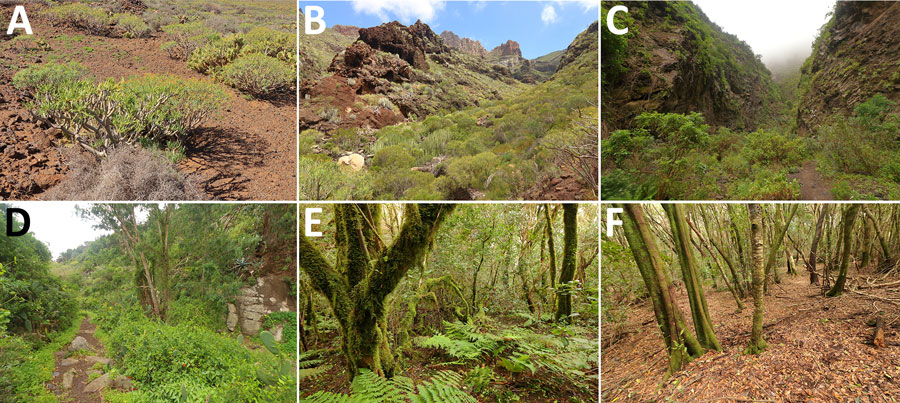
Figure 1. Examples of sampling sites for definitive, intermediate, and paratenic hosts used in a predictive approach to mapping Angiostrongylus cantonensis nematode distribution, Canary Islands, Spain. Hosts were collected and sampled in 2022 on Tenerife. A, B) Xeric vegetation types, including bare volcanic rocks with scattered succulents (A) and sparse xerophytic bushland (B). C, D) Bush vegetation, including continuous bush without tree cover (C) and continuous bush interspersed with isolated trees (D). E, F) Laurel forest in Anaga, Tenerife.
Page created: May 28, 2026
Page updated: June 26, 2026
Page reviewed: June 26, 2026
The conclusions, findings, and opinions expressed by authors contributing to this journal do not necessarily reflect the official position of the U.S. Department of Health and Human Services, the Public Health Service, the Centers for Disease Control and Prevention, or the authors' affiliated institutions. Use of trade names is for identification only and does not imply endorsement by any of the groups named above.