Volume 32, Number 7—July 2026
Research
Predictive Approach to Mapping Angiostrongylus cantonensis Nematode Distribution, Canary Islands, Spain
Lucia Anettová , Jan Divíšek, Radovan Coufal, Anna Šipková, Jana Kačmaříková, Michal Horsák, Vojtech Baláž, Elena Izquierdo-Rodriguez, Barbora Červená, Pilar Foronda, and David Modrý
, Jan Divíšek, Radovan Coufal, Anna Šipková, Jana Kačmaříková, Michal Horsák, Vojtech Baláž, Elena Izquierdo-Rodriguez, Barbora Červená, Pilar Foronda, and David Modrý
Figure 3
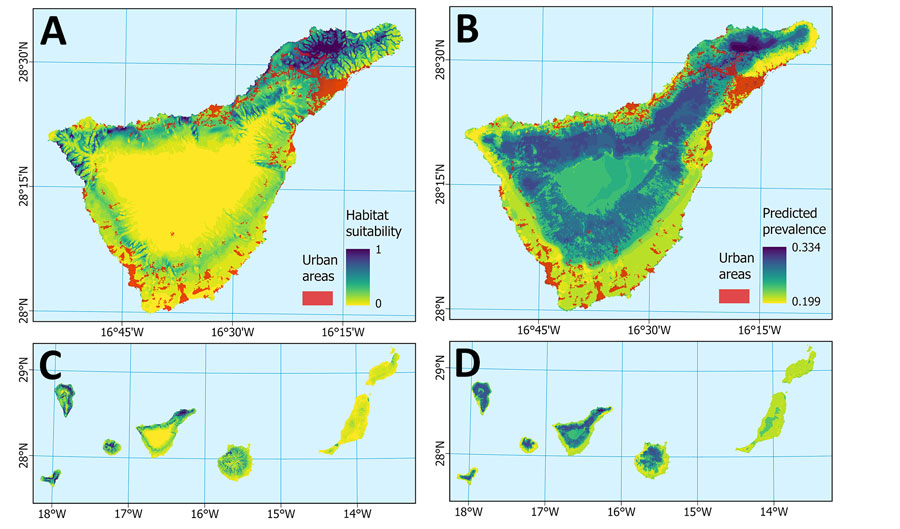
Figure 3. Modeled habitat suitability from a predictive approach to mapping Angiostrongylus cantonensis nematode distribution, Canary Islands, Spain, and prevalence of A. cantonensis across Tenerife and the Canary Islands based on field survey data (2022). A, C) MaxEnt model predicting habitat suitability (probability of occurrence), with overlap of urban areas (CORINE Land Cover, class 1), for Tenerife detail (A) and the Canary Islands archipelago (C). B, D) Boosted regression tree model predicting prevalence in Tenerife (B) and the Canary Islands archipelago (D).
Page created: May 28, 2026
Page updated: June 26, 2026
Page reviewed: June 26, 2026
The conclusions, findings, and opinions expressed by authors contributing to this journal do not necessarily reflect the official position of the U.S. Department of Health and Human Services, the Public Health Service, the Centers for Disease Control and Prevention, or the authors' affiliated institutions. Use of trade names is for identification only and does not imply endorsement by any of the groups named above.