Skip directly to site content Skip directly to page options Skip directly to A-Z link Skip directly to A-Z link Skip directly to A-Z link

Disclaimer: Early release articles are not considered as final versions. Any changes will be reflected in the online version in the month the article is officially released.

Volume 32, Number 7—July 2026

Research Letter

Molecular Confirmation of Autochthonous Taenia saginata Infection, Timor-Leste, 2019

Hanna Jin, Sung-Tae Hong, Merita Antonio Armindo Monteiro, Endang da Silva, Odete da Silva Viegas, Felix dos Santos Lopes, Dong Hee Kim, and Sung Hye KimComments to Author 
Author affiliation: Seoul National University College of Medicine, Jongno-gu, South Korea (H. Jin, S.-H. Hong, D.H. Kim); National Institute of Public Health, Dili, Timor-Leste (M.A. Armindo Monteiro, E. da Silva); Ministry of Health, Dili (O. da Silva Viegas); World Health Organization, Timor-Leste Country Office, Dili (F. dos Santos Lopes); Hanyang University College of Medicine, Seongdong-gu, South Korea (S.H. Kim)

Main Article

Figure 2

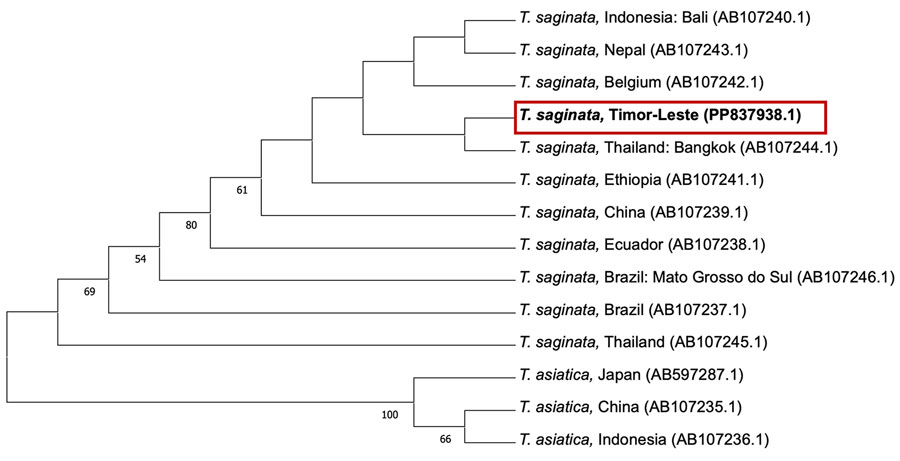
Phylogenetic analysis of the cox1 gene from a child with taeniasis in a study revealing molecular confirmation of autochthonous Taenia saginata infection, Timor-Leste, 2019. Phylogenetic tree of T. saginata and related taxa was based on partial mitochondrial cox1 gene sequences (458 bp). The evolutionary history was inferred by the neighbor-joining method with 1,000 bootstrap replicates; bootstrap values (>50%) are shown at branch nodes. Evolutionary distances computed using Kimura 2-parameter model. Analyses performed in MEGA 11 (https://www.megasoftware.net). The Timor-Leste isolate (GenBank PP837938.1, red box) clusters within the group A clade of T. saginata, distinct from T. asiatica (outgroup) and T. solium lineages. GenBank accession numbers are shown in parentheses.

Figure 2. Phylogenetic analysis of the cox1 gene from a child with taeniasis in a study revealing molecular confirmation of autochthonous Taenia saginata infection, Timor-Leste, 2019. Phylogenetic tree of T. saginata and related taxa was based on partial mitochondrial cox1 gene sequences (458 bp). The evolutionary history was inferred by the neighbor-joining method with 1,000 bootstrap replicates; bootstrap values (>50%) are shown at branch nodes. Evolutionary distances computed using Kimura 2-parameter model. Analyses performed in MEGA 11 (https://www.megasoftware.net). The Timor-Leste isolate (GenBank PP837938.1, red box) clusters within the group A clade of T. saginata, distinct from T. asiatica (outgroup) and T. solium lineages. GenBank accession numbers are shown in parentheses.

Main Article

Page created: June 03, 2026
Page updated: June 23, 2026
Page reviewed: June 23, 2026
The conclusions, findings, and opinions expressed by authors contributing to this journal do not necessarily reflect the official position of the U.S. Department of Health and Human Services, the Public Health Service, the Centers for Disease Control and Prevention, or the authors' affiliated institutions. Use of trade names is for identification only and does not imply endorsement by any of the groups named above.
file_external