Volume 32, Number 7—July 2026
Historical Review
Discovery of Cinchona as Antimalarial, Viceroyalty of Peru, Circa 1630
Jesús Rojas-Jaimes , Stephanie Rodríguez-Gómez, and Guido P. Lombardi
, Stephanie Rodríguez-Gómez, and Guido P. Lombardi
Figure 2
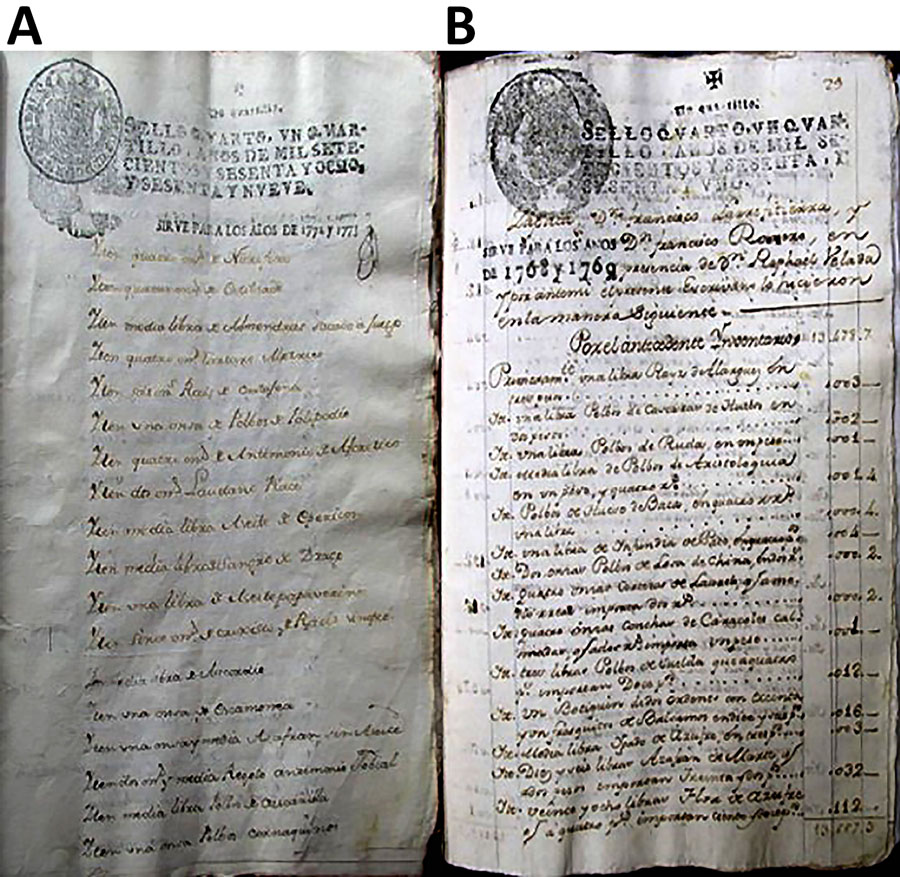
Figure 2. Documents from 1768 in archives of 2 very important locations for the Viceroyalty of Peru (Cuzco and Lima in present-day Peru) referring to “cascarilla powder” and “Loja powder” A) “Cascarilla powder” is mentioned in the Archive of the Colegio Ciencias: File 6, book 1, page 112, Cuzco. 1768–1769 (21). B) Page of the inventory of the apothecary of Saint Paul's College, where “Loja’s powders of cinchona” is mentioned. Source: Velada R. National Archives of Peru, 1768 (22).
References
- Brack A. The Peruvian bark that saved millions of lives. A brief history of cinchona and quinine [in Spanish]. 1st edition. Lima (Peru): Powerful Mining Company; 2021.
- Epiquién MA. Natural bicentennials. Stories of cinchona trees and vicuñas [in Spanish]. 1st edition. Lima (Peru): Black Box Publishing Group; 2021.
- Haggis AW. Fundamental errors in the early history of Cinchona. Bull Hist Med. 1941;10:417–59 https://archive.org/details/b2982381x cited 2026 Jun 8.
- Chakrabarti P. Empire and alternatives: Swietenia febrifuga and the cinchona substitutes. Med Hist. 2010;54:75–94. DOIPubMedGoogle Scholar
- Rieckmann KH. The chequered history of malaria control: are new and better tools the ultimate answer? Ann Trop Med Parasitol. 2006;100:647–62. DOIPubMedGoogle Scholar
- Lowe D. Chloroquine, past and present. Science. 2020 Mar 20 [cited 2026 Apr 10]. https://www.science.org/content/blog-post/chloroquine-past-and-present
- Slater AFG, Cerami A. Inhibition by chloroquine of a novel haem polymerase enzyme activity in malaria trophozoites. Nature. 1992;355:167–9. DOIPubMedGoogle Scholar
- Karle JM, Karle IL, Gerena L, Milhous WK. Stereochemical evaluation of the relative activities of the cinchona alkaloids against Plasmodium falciparum. Antimicrob Agents Chemother. 1992;36:1538–44. DOIPubMedGoogle Scholar
- Laval E. Pharmacy of the Jesuits of Santiago [in Spanish]. 1st edition. Santiago (Chile): Stanley; 1953 [cited 2026 Jun 8]. https://www.memoriachilena.gob.cl/602/w3-article-62244.html
- Ortiz F. Monardes and Fragoso: two 16th-century protobotanists who dealt with New World plants and the implications of their writings on the European introduction of “quina” (cinchona) tree bark. In: Rios M, y Borgtoft H, editors. Use and management of plant resources: proceedings of the Second Ecuadorian Symposium on Ethnobotany and Economic Botany [in Spanish]. First edition. Quito (Ecuador): Abya-Yala; 1997. p. 347–60.
- Calancha A. Moralized chronicle of the order of Saint Augustine in Perú [in Spanish]. 1639 [cited 2026 Jun 8]. https://estudiosindianos.up.edu.pe/en/biblioteca-indiana/coronica-moralizada-del-orden-de-san-agustin-en-el-peru
- Bado S. Anastasis of the bark of Perú, or defense of the china-china [in Latin]. 1663 [cited 2026 Jun 8]. https://archive.org/details/Be.XVII.A.613.2.
- Guerra F. The introduction of Cinchona in the treatment of malaria. Part I. J Trop Med Hyg. 1977;80:112–8.PubMedGoogle Scholar
- Lopez JM, Calero F. On the febrifuge powder of the West Indies (1663) de Gaspar Caldera de Heredia and the introduction of quinine in Europe [in Spanish]. 1st edition. Valencia (Spain): Universidad de Valencia; 1992 [cited 2025 July 27]. https://digital.csic.es/bitstream/10261/90526/1/XXXIX_Pulvere_Febrifugo.pdf
- Cobo B. Works of Father Bernabé Cobo [in Spanish]. 1st edition. Madrid: Atlas Editions; 1964.
- Augusto E. Quinine in Peru [in Spanish]. 1st edition. Tambopata (Peru): Permanent Commission of Quina; 1943.
- Anda Aguirre A. Quinine or cascarilla in Loja [in Spanish]. 1st edition. Loja (Ecuador): Editorial Office of the Private Technical University of Loja; 2002.
- Estrella E. Enlightened science and popular knowledge in the understanding of quinine in the 18th century [in Spanish]. In: Cueto M, editor. Andean knowledge: science and technology in Bolivia, Ecuador, and Peru [in Spanish]. Lima (Peru): Institute of Peruvian Studies; 1995. p. 37–57.
- De Jussieu J. Description of the cinchona tree [in French]. 1st edition. Paris: Company for the Processing of Cinchonas; 1936.
- Arias J. Barks of hope [in Spanish]. 1st edition. Loja (Ecuador): Hernandez Graphics; 2017.
- Archive College of Sciences. File 6, notebook 1, shelves 112 [in Spanish]. Cuzco (Peru). 1768–1769, file 6.
- Velada R. Inventory of the pharmacy of the Saint Paul’s College, made as a result of the expatriation of the Fathers of the Society of Jesus [in Spanish]. Lima (Peru): National Archives of Peru; 1768.
- Santisteban M. A thousand leagues through America. From Lima to Caracas, 1740–1741. Diary of Don Miguel de Santisteban [in Spanish]. Bogotá (Columbia): Bank of the Republic; 1992.
- Cuvi N. Science and imperialism in Latin America: the Chinchona misión and the cooperative agricultural stations [in Spanish]. 1st edition. Barcelona (Spain): Autonomous University of Barcelona; 2009 [cited 2026 Jun 8]. http://www.tdx.cat/TDX-0121110-151121
- García L, Veneros J, Chavez SG, Oliva M, Rojas-Briceño NB. World historical mapping and potential distribution of Cinchona spp. in Peru as a contribution for its restoration and conservation. J Nat Conserv. 2022;70:
126290 . DOIGoogle Scholar - Ireland KB, Kriticos DJ. Why Are plant pathogens under-represented in eco-climatic niche modelling? Int J Pest Manag. 2019;65:207–16. DOIGoogle Scholar
- Griffing SM, Gamboa D, Udhayakumar V. The history of 20th century malaria control in Peru. Malar J. 2013;12:303. DOIPubMedGoogle Scholar
- Ramírez SE. The world upside down: cross-cultural contact and conflict in sixteenth-century Peru. Stanford (California): Stanford University Press; 1996.
- Foster GM. Hippocrates’ Latin American legacy: “hot” and “cold” in contemporary folk medicine. In: Wetherington R, editor. Colloquia in anthropology, volume 2. Dallas: Southern Methodist University, Fort Burgwin Research Center; 1978. p. 3–19.
- Allison MJ, Pezzia A, Gerszten E, Mendoza D. A case of Carrion’s disease associated with human sacrifice from the Huari culture of Southern Peru. Am J Phys Anthropol. 1974;41:295–300. DOIPubMedGoogle Scholar
- Michel M, Skourtanioti E, Pierini F, Guevara EK, Mötsch A, Kocher A, et al. Ancient Plasmodium genomes shed light on the history of human malaria. Nature. 2024;631:125–33. DOIPubMedGoogle Scholar
- Albis MM. The Indians of Andaqui, New Granada. Notes of a traveler (Translated from the Spanish by J.S. Thrasher under the J.M. Vergara y Vergara & E. Delgado supervision). Bull. Am Ethnological Soc. 1855;1:53–72.
- De Carvajal G, Toribio J, editors. Discovery of the Amazon River according to the hitherto unpublished account of the voyage of Francisco de Orellana [in Spanish]. Seville (Spain): E. Rasco Printing House; 1894.
- Simón P. The expedition of Pedro de Ursua & Lope de Aguirre in search of El Dorado and Omagua in 1560–1. Cambridge: Cambridge University Press; 2010. DOIGoogle Scholar
- Cooper P, Guderian R, Paredes W, Daniels R, Perera D, Espinel M, et al. Bartonellosis in Zamora Chinchipe province in Ecuador. Trans R Soc Trop Med Hyg. 1996;90:241–3, 544–6. DOIPubMedGoogle Scholar
- Legua LP. Malaria in Perú [in Spanish]. Heredian Medical Journal 2013;5(3) [cited 2025 Oct 19]. https://revistas.upch.edu.pe/index.php/RMH/article/view/436
- Church WB, Von Hagen AC, Silverman H, Isbell WH, editors. Handbook of South American archaeology. New York: Springer; 2008.
- Austin Alchon S. A pest in the land: New World epidemics in a global perspective. Albuquerque (NM): University of New Mexico Press; 2003.
- Bussmann RW, Sharon D. Traditional medicinal plant use in Loja Province, southern Ecuador. J Ethnobiol Ethnomed. 2006;2:44. DOIPubMedGoogle Scholar
- Aguilar CA, Xolalpa MS. Mexican herbal medicine in the treatment of diabetes [in Spanish]. Science (Mexico). 2002;53:24–35.
- Jaramillo Alvarado. Pío. History of Loja and its province [in Spanish]. 4th edition. Guayaquil (Ecuador): Artes Gráficas Senefelder; 2001.
- Hernadez E. The Piura elite and the independence of Peru: the struggle for continuity in the nascent republic (1750–1824) [in Spanish]. Lima (Peru): University of Piura, Riva–Agüero Institute; 2008.
- Hernádez E. The Sánchez Navarrete and González de Salazar: a powerful family in the port of Paita in the second half of the 18th century [in Spanish]. Complutense Journal of American History. 2008;34:183–207.
- General Archive of the Indies of Seville [in Spanish]. Quito (Ecuador). 246 No. 48. Year 1788. Fol. 9.
- Hernadez E. The Piura elite and the independence of Peru: the struggle for continuity in the nascent republic (1750–1824) [in Spanish]. Lima (Peru): University of Piura, Riva-Agüero Institute; 2008.
- Arias JC. Historic Loja [in Spanish]. First edition. Loja (Ecuador): International Congress of History; 2016 [cited 2024 Dec 23]. https://biblioteca.culturaypatrimonio.gob.ec/cgi-bin/koha/opac-detail.pl?biblionumber=248041
- Departmental Archive of Piura, Cabildo, civil cases, leg. 8 exp. 154 [in Spanish]. 1796.
- General Archive of the Nation. account Books, c15, leg. 177, exp. 880 [in Spanish]. 1796 [cited 2024 Dec 23]. https://fondosdocumentales.agn.gob.pe/index.php.
- Monardes N. First, second, and third parts of the medicinal history of things brought from our West Indies [in Spanish]. First edition. 1574 [cited 2026 Jun 8]. https://estudiosindianos.up.edu.pe/en/biblioteca-indiana/primera-y-segunda-y-tercera-partes-de-la-historia-medicinal-de-las-cosas-que-se-traen-de-nuestras-indias-occidentales-de-nicolas-monardes
- Lefebvre MJM, Degrugillier F, Arnathau C, Fontecha GA, Noya O, Houzé S, et al. Genomic exploration of the journey of Plasmodium vivax in Latin America. PLoS Pathog. 2025;21:
e1012811 . DOIPubMedGoogle Scholar
Page created: June 09, 2026
Page updated: June 26, 2026
Page reviewed: June 26, 2026
The conclusions, findings, and opinions expressed by authors contributing to this journal do not necessarily reflect the official position of the U.S. Department of Health and Human Services, the Public Health Service, the Centers for Disease Control and Prevention, or the authors' affiliated institutions. Use of trade names is for identification only and does not imply endorsement by any of the groups named above.