Volume 32, Number 7—July 2026
Research Letter
Dracunculus sp. PantanalBr Infection in Florida Panthers and Bobcat, Florida, USA
Michael J. Yabsley , Alexander Perez, Kayla B. Garrett, Christopher A. Cleveland, Mark Cunningham, Peter Sebastian, Bambi Clemons, Jeff M. Gruntmeir, and Heather D.S. Walden
, Alexander Perez, Kayla B. Garrett, Christopher A. Cleveland, Mark Cunningham, Peter Sebastian, Bambi Clemons, Jeff M. Gruntmeir, and Heather D.S. Walden
Figure 1
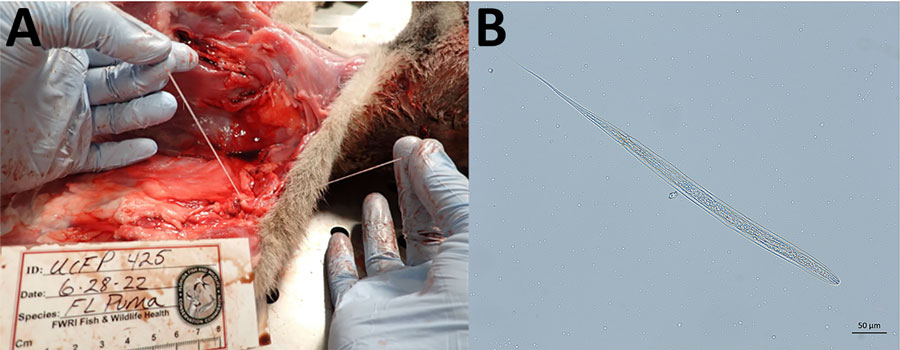
Figure 1. Dracunculus sp. PantanalBR nematode samples collected in investigation of Dracunculus sp. PantanalBr infection in Florida panthers and a bobcat, Florida, USA. A) Female Dracunculus sp. PantanalBR nematode was detected in subcutaneous tissues of a Florida panther (Puma concolor coryi). B) First-stage larvae of female Dracunculus sp. PantanalBR from a Florida panther. Original magnification ×200.
Page created: June 07, 2026
Page updated: June 26, 2026
Page reviewed: June 26, 2026
The conclusions, findings, and opinions expressed by authors contributing to this journal do not necessarily reflect the official position of the U.S. Department of Health and Human Services, the Public Health Service, the Centers for Disease Control and Prevention, or the authors' affiliated institutions. Use of trade names is for identification only and does not imply endorsement by any of the groups named above.