Detection of and Early Genomic Insights into Chikungunya Virus, Bolivia, 2025
Joel Alejandro Chuquimia Valdez
1, Natalia R. Guimarães
1, Vagner Fonseca
1, Cleidy Orellana Mendoza, Sebastián Sasías Martínez, Sara Cândida F. Santos, Gilson Carlos Soares, Mariela Martínez Gómez, Leticia Franco, Lionel Gresh, Jairo Méndez-Rico, Luiz Carlos J. Alcantara
2, Marta Giovanetti
2
, and Leidy Roxana Loayza Mafayle
2
Author affiliation: Centro Nacional de Enfermedades Tropicales, Santa Cruz de la Sierra, Bolivia (J.A.C. Valdez, C.O. Mendoza, S.S. Martinez, L.R. Loayza Mafayle); Fundação Ezequiel Dias, Belo Horizonte, Brazil (N.R. Guimarães, S.C.F. Santos); Instituto René Rachou, Belo Horizonte (N.R. Guimarães, S.C.F. Santos, L.C.J. Alcantara); Universidade do Estado da Bahia, Salvador, Brazil (V. Fonseca); Stellenbosch University, Stellenbosch, South Africa (V. Fonseca); Universidade Federal de Minas Gerais, Belo Horizonte (S.C.F. Santos, G.C. Soares); Pan American Health Organization, Washington, DC, USA (M. Martínez Gómez, L. Franco, L. Gresh, J. Méndez-Rico); Università Campus Bio-Medico di Roma, Rome, Italy (M. Giovanetti); Instituto Oswaldo Cruz, Rio de Janeiro, Brazil (M. Giovanetti).
Main Article
Figure 2
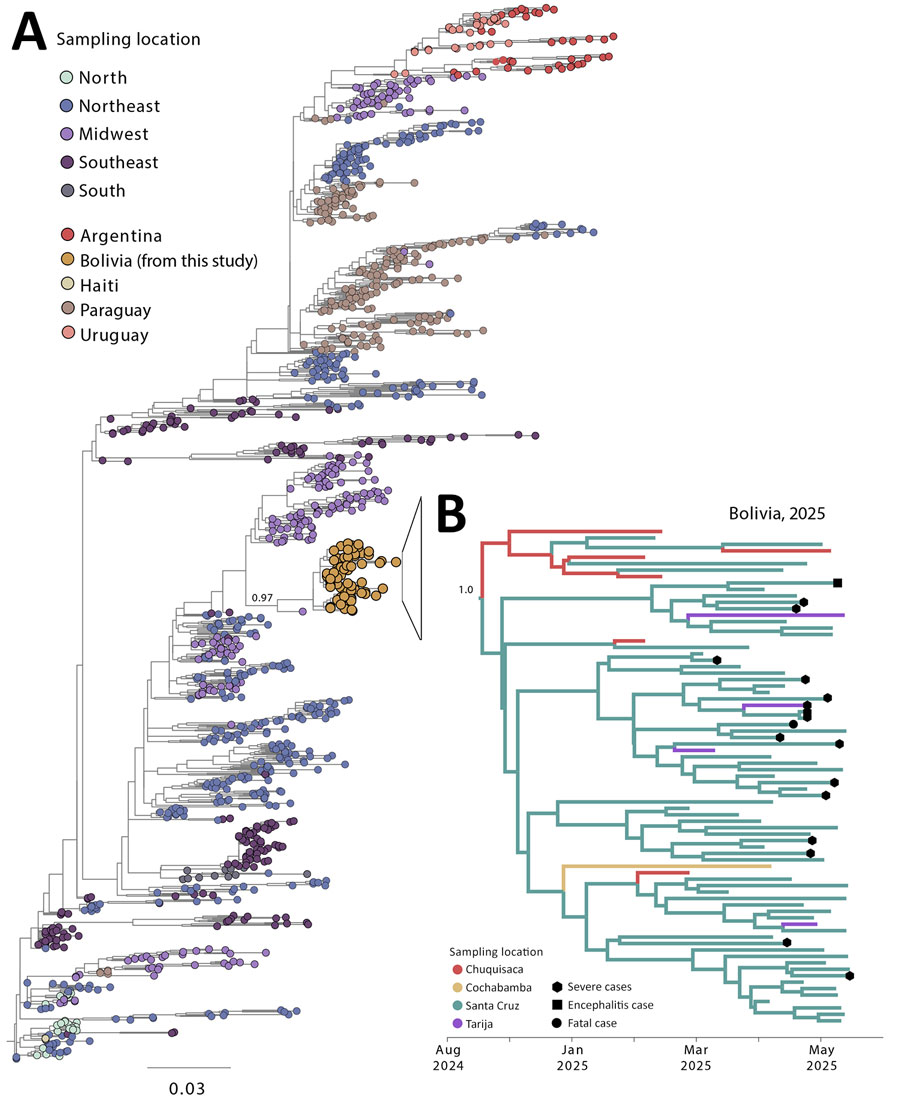
Figure 2. Regional genetic diversity and temporal spread of the chikungunya virus outbreak in Bolivia within the Americas, 2025. A) Phylogenetic tree showing the placement of genomes from Bolivia within the broader diversity across the Americas. Tips are colored according to sampling origin, and sequences from Bolivia are highlighted. The genomes from Bolivia cluster in a well-supported group, consistent with local expansion. B) Time-scaled tree of the Bolivian clade illustrating temporal progression and geographic distribution across departments (Chuquisaca, Cochabamba, Santa Cruz, and Tarija). Symbols indicate severe cases (including 1 encephalitis case and 1 fatal case). Scale bar indicates nucleotide substitutions per site.
Main Article
Page created: May 28, 2026
Page updated: June 26, 2026
Page reviewed: June 26, 2026
The conclusions, findings, and opinions expressed by authors contributing to this journal do not necessarily reflect the official position of the U.S. Department of Health and Human Services, the Public Health Service, the Centers for Disease Control and Prevention, or the authors' affiliated institutions. Use of trade names is for identification only and does not imply endorsement by any of the groups named above.