Volume 32, Number 7—July 2026
Research
Investigation of Donor-Transmitted Strongyloides stercoralis Infections in Solid Organ Transplant Recipients, United States, 2012–2024
Kerry R. Gainor, Dawn Blackburn, Pallavi Annambhotla, Sridhar V. Basavaraju, Katherine E. Bowden, Diana Martin, David A. Baran, Irene Frantzis, Irene D. Lytrivi, Julia Simkowski, Danielle Stanek, Susan P. Montgomery, and Rebecca J. Chancey
Figure
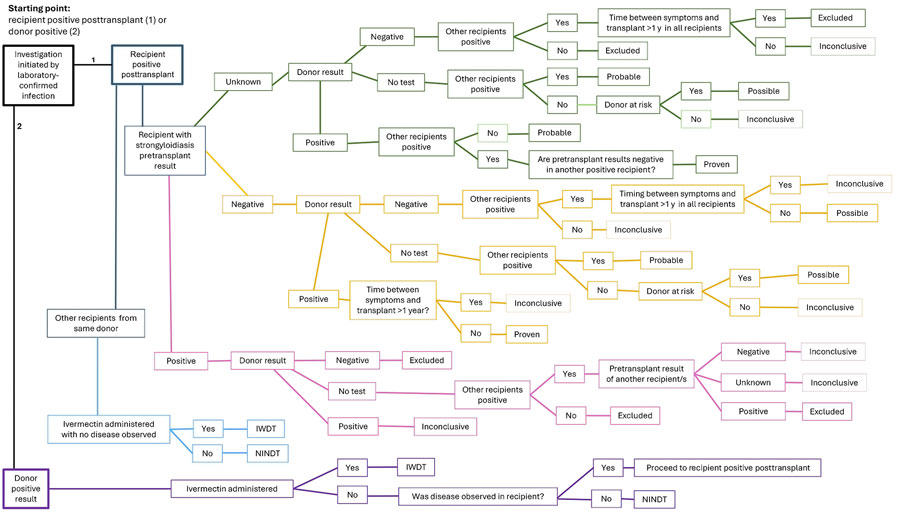
Figure. Case determination algorithm used for analysis in the Centers for Disease Control and Prevention investigations of potential donor-derived strongyloidiasis, United States, 2012–2024. Each investigation begins with a trigger, either recipient positive posttransplant (1) or donor positive (2), and follows the algorithm to a designated case determination based on clinical, laboratory, and epidemiologic data and our case definitions. Determination categories include proven, excluded, NINDT, IWDT, probable, possible, and inconclusive cases. IWDT, intervention without disease transmission; NINDT, no intervention and no disease transmission.
Page created: May 28, 2026
Page updated: June 26, 2026
Page reviewed: June 26, 2026
The conclusions, findings, and opinions expressed by authors contributing to this journal do not necessarily reflect the official position of the U.S. Department of Health and Human Services, the Public Health Service, the Centers for Disease Control and Prevention, or the authors' affiliated institutions. Use of trade names is for identification only and does not imply endorsement by any of the groups named above.