Volume 32, Number 8—August 2026
Dispatch
Isolation of Highly Pathogenic Avian Influenza A(H5N1) Virus from Fetal Bovine Serum, United States, 2025

Figure 1
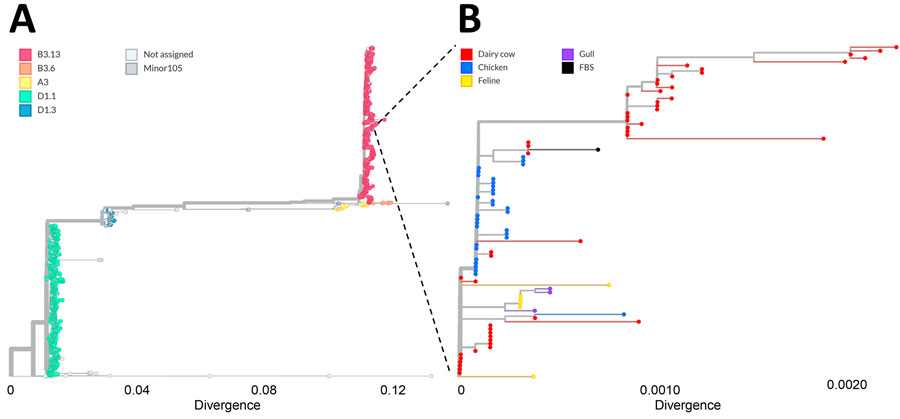
Figure 1. Phylogenetic analysis of complete genomes formed by concatenation of all gene segments, confirming highly pathogenic avian influenza A (H5N1) virus genotype B3.13 isolated from fetal bovine serum (FBS), United States, 2025. A) Tree showing broader phylogeny of H5N1 virus genotypes. B) Closer examination of the virus from FBS sample and closely related virus sequences. Dashed lines indicate the branch in the broader phylogenetic tree where the FBS virus sequence is located. Dataset consisted of 5,094 highly pathogenic avian influenza A(H5N1) virus genomes from samples collected during August 2024–January 2025 in North America, downloaded from the GISAID EpiFlu database (5). Maximum-likelihood phylogenetic inferred with an edge-linked partition model and 1,000 bootstrap replicates using IQ-TREE (6).
References
- Nguyen T-Q, Hutter CR, Markin A, Thomas M, Lantz K, Killian ML, et al. Emergence and interstate spread of highly pathogenic avian influenza A(H5N1) in dairy cattle in the United States. Science. 2025;388:
eadq0900 . DOIPubMedGoogle Scholar - Caserta LC, Frye EA, Butt SL, Laverack M, Nooruzzaman M, Covaleda LM, et al. Spillover of highly pathogenic avian influenza H5N1 virus to dairy cattle. Nature. 2024;634:669–76. DOIPubMedGoogle Scholar
- US Department of Agriculture Animal and Plant Health Inspection Service. USDA, FDA, and CDC share update on HPAI detections in dairy cattle. 2024 [cited 2025 Dec 3]. https://www.aphis.usda.gov/news/agency-announcements/usda-fda-cdc-share-update-hpai-detections-dairy-cattle
- US Department of Agriculture Animal and Plant Health Inspection Service. HPAI confirmed cases in livestock. 2025 [cited 2025 Dec 18]. https://www.aphis.usda.gov/livestock-poultry-disease/avian/avian-influenza/hpai-detections/hpai-confirmed-cases-livestock
- Shu Y, McCauley J. GISAID: Global initiative on sharing all influenza data—from vision to reality. Euro Surveill. 2017;22:30494. DOIPubMedGoogle Scholar
- Minh BQ, Schmidt HA, Chernomor O, Schrempf D, Woodhams MD, von Haeseler A, et al. IQ-TREE 2: new models and efficient methods for phylogenetic inference in the genomic era. Mol Biol Evol. 2020;37:1530–4. DOIPubMedGoogle Scholar
- Halwe NJ, Cool K, Breithaupt A, Schön J, Trujillo JD, Nooruzzaman M, et al. H5N1 clade 2.3.4.4b dynamics in experimentally infected calves and cows. Nature. 2025;637:903–12. DOIPubMedGoogle Scholar
- Facciuolo A, Aubrey L, Barron-Castillo U, Berube N, Norleen C, McCreary S, et al. Dairy cows develop protective immunity against reinfection with bovine H5N1 influenza virus. Nat Microbiol. 2025;10:1366–77. DOIPubMedGoogle Scholar
- Brooks R. Some California veterinarians say virus-hit dairies see more abortions in first-calf heifers and dry cows. Bovine Veterinarian. 2025 Jan 6 [cited 2025 Dec 3]. https://www.bovinevetonline.com/news/industry/california-veterinarians-say-virus-hit-dairies-see-more-abortions-first-calf-heifer
1These first authors contributed equally to this article.