Skip directly to site content Skip directly to page options Skip directly to A-Z link Skip directly to A-Z link Skip directly to A-Z link

Disclaimer: Early release articles are not considered as final versions. Any changes will be reflected in the online version in the month the article is officially released.

Volume 32, Number 8—August 2026

Dispatch

Emergent Vibrio parahaemolyticus Gastroenteritis Outbreaks, New Zealand, 2019–2022

Sarah JefferiesComments to Author , Shevaun Paine, Jing Wang, Xiaoyun Ren, David Winter, Graham C. Fletcher, Anne-Marie Perchec-Merien, and Jackie Wright
Author affiliation: New Zealand Institute for Public Health and Forensic Science, Porirua, Wellington, New Zealand (S. Jefferies, S. Paine, J. Wang, X. Ren, D. Winter, J. Wright); New Zealand Institute for Bioeconomy Science Limited, Auckland, New Zealand (G.C. Fletcher); Ministry for Primary Industries, Wellington (A.-M. Perchec-Merien)

Main Article

Figure 2

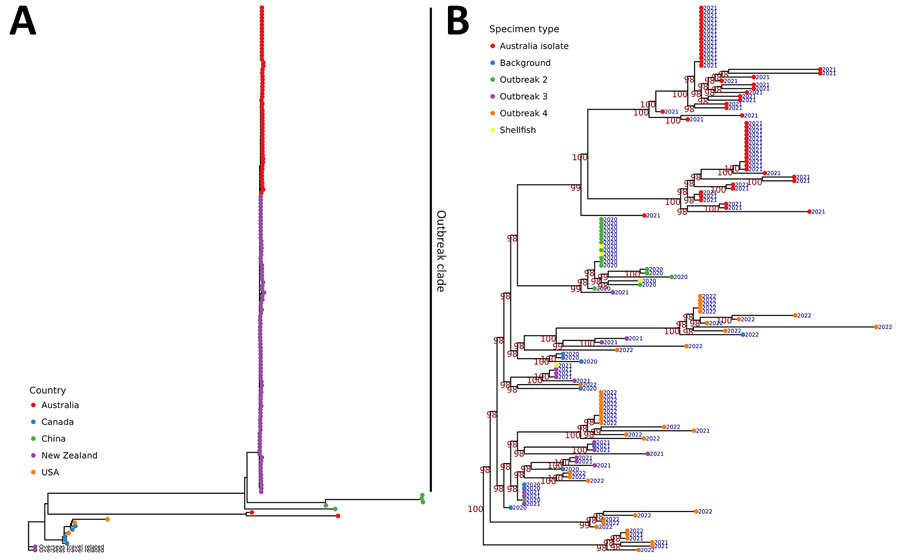
Maximum-likelihood phylogenetic tree of sequence type 50 isolates for study of emergent Vibrio parahaemolyticus gastroenteritis outbreaks, New Zealand, 2019–2022. Tree was constructed using core-genome single-nucleotide polymorphism alignment of all publicly available New Zealand and international V. parahaemolyticus sequence type 50 isolates detected during 1997–April 2022. The New Zealand sequence type 50 outbreak clade, which includes Australia isolates, is indicated. B) Magnification of the New Zealand V. parahaemolyticus sequence type 50 outbreak clade maximum likelihood phylogenetic tree, by specimen type and sample collection year. Bootstrap values calculated from 2,000 trees; only bootstrap values >70% are shown in red.

Figure 2. Maximum-likelihood phylogenetic tree of sequence type 50 isolates for study of emergent Vibrio parahaemolyticus gastroenteritis outbreaks, New Zealand, 2019–2022. Tree was constructed using core-genome single-nucleotide polymorphism alignment of all publicly available New Zealand and international V. parahaemolyticus sequence type 50 isolates detected during 1997–April 2022. The New Zealand sequence type 50 outbreak clade, which includes Australia isolates, is indicated. B) Magnification of the New Zealand V. parahaemolyticus sequence type 50 outbreak clade maximum likelihood phylogenetic tree, by specimen type and sample collection year. Bootstrap values calculated from 2,000 trees; only bootstrap values >70% are shown in red.

Main Article

Page created: July 11, 2026
Page updated: July 15, 2026
Page reviewed: July 15, 2026
The conclusions, findings, and opinions expressed by authors contributing to this journal do not necessarily reflect the official position of the U.S. Department of Health and Human Services, the Public Health Service, the Centers for Disease Control and Prevention, or the authors' affiliated institutions. Use of trade names is for identification only and does not imply endorsement by any of the groups named above.
file_external