Volume 32, Number 8—August 2026
Dispatch
Emergent Vibrio parahaemolyticus Gastroenteritis Outbreaks, New Zealand, 2019–2022

 , Shevaun Paine, Jing Wang, Xiaoyun Ren, David Winter, Graham C. Fletcher, Anne-Marie Perchec-Merien, and Jackie Wright
Cite This Article
Citation for Media
Abstract
We report the Trans-Pacific expansion of Vibrio parahaemolyticus pandemic clone sequence type 36 and emergence of sequence type 50 in Oceania, causing seafoodborne outbreaks in New Zealand. Unusual features of the outbreaks included diversity of the seafood sources and pathogenic strains and timing, occurring in both winter and summer seasons.
Vibrio parahaemolyticus is the most commonly reported cause of bacterial seafoodborne illness worldwide (1). Acute gastroenteritis (AGE) classically occurs within 36 hours of consuming raw or undercooked bivalve molluscan shellfish (e.g., mussels, oysters), which concentrate the thermal-sensitive bacterium through filter-feeding. In many places, including New Zealand, V. parahaemolyticus AGE is a legally notifiable disease prompting public health action for foodborne disease control (2).
V. parahaemolyticus–related illness has demonstrated major epidemiologic shifts over the past decade. Before the 2010s, AGE cases resulting from V. parahaemolyticus ingestion were mostly confined to endemic and outbreak-prone regions, such as Japan, China, and the northwest United States (3–5). However, global environmental changes (rising sea-surface temperatures), microbial genomic diversification, and emergence and increasing expansion of pandemic clone sequence type (ST) 3 and ST36 have led to emergence of V. parahaemolyticus illness in new areas (3,5,6). In 2012, researchers identified ST36, which was endemic to the Pacific Northwest United States, in human infections in northeast regions of the country (5). Outbreaks of V. parahaemolyticus ST36–related illness were subsequently identified in Spain and Peru (3,5).
V. parahaemolyticus AGE has been a rare disease in Australasia and the Pacific Islands. New Zealand (population ≈5 million) has an extensive marine aquaculture industry and deep cultural connections with coastal marine ecology, including those related to indigenous Māori tikanga (cultural practices) (7). We describe emergence of V. parahaemolyticus AGE in Aotearoa New Zealand, including the distinctive epidemiologic features and microbial genomics relevant to outbreak cases.
In response to a surge in clinical notifications in May 2019, we undertook 4 successive multidisciplinary V. parahaemolyticus AGE outbreak investigations (Table). This effort required enhanced epidemiologic investigation, establishment of national V. parahaemolyticus whole-genome sequencing capability (Appendix), and extensive environmental investigations, including food source traceback, testing of implicated seafoods, sea surface temperature measurements, and seafood supply chain inquiries. During January 2019–May 2022, 136 of the 182 cases entered into the national notifiable disease database had viable V. parahaemolyticus isolates referred to the New Zealand Institute for Public Health and Forensic Science: 90 outbreak-related and 46 background isolates (predominantly locally acquired [38/46] owing to COVID-19 border restrictions during the period) (2). We also identified 4 shellfish isolates from outbreak-implicated mussel farms, sampled by the New Zealand Institute for Bioeconomy Science and Ministry for Primary Industries in 2020 and 2021. We subjected all isolates to tdh/trh-toxin gene testing and whole-genome sequencing, comparing New Zealand strains to available international sequences (Appendix).
Figure 1
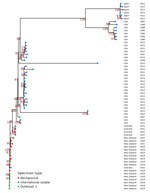
Figure 1. Maximum-likelihood phylogenetic tree of sequence type 36 isolates for study of emergent Vibrio parahaemolyticusgastroenteritis outbreaks, New Zealand, 2019–2022. Tree was constructed using core-genome single-nucleotide polymorphism alignment of all...
Investigations revealed the first V. parahaemolyticus AGE outbreak was caused by pandemic clone ST36, widely distributed to cases through commercially supplied New Zealand green-lipped mussels (Table). This finding represented Trans-Pacific expansion of tdh+/trh+ ST36 to Oceania; New Zealand isolates clustering (<30–50 single-nucleotide polymorphisms [SNPs]) with a Pacific Northwest/northeast USA lineage detected since 2007 (Figure 1). An ST36 infection occurred in April 2019 in a background case and seafood area distinct from the winter outbreak source. The close clustering (<5 SNPs) of this isolate with outbreak isolates and those causing sporadic illness thereafter demonstrated ST36’s high clonality and wide dispersal in New Zealand. Five closely related clinical isolates were also later reported in Australia in 2021.
Figure 2
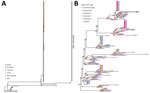
Figure 2. Maximum-likelihood phylogenetic tree of sequence type 50 isolates for study of emergent Vibrio parahaemolyticusgastroenteritis outbreaks, New Zealand, 2019–2022. Tree was constructed using core-genome single-nucleotide polymorphism alignment of all...
Two subsequent outbreaks in winter 2020 and summer 2021, also associated with commercially supplied mussels, represented the emergence of pathogenic tdh+/trh+ ST50 in New Zealand (Table; Figure 2). We noted clinical and mussel-derived outbreak isolates to be closely related to background ST50 infections associated with geographically dispersed seafood growing areas, suggesting a bloom of clonal ST50 in New Zealand’s marine environment in 2020 replaced pandemic ST36 predominance. Internationally, ST50 is relatively uncommon, and New Zealand ST50 was genetically distinct from most international isolates, except those later emerging in an Australia oysterborne outbreak (8). Australia’s 2021 samples formed a monophyletic group, with some closely related to New Zealand samples (Figure 2, panel B). Those results are insufficient to demonstrate dispersal from New Zealand because separate incursions from a common source may have occurred. Nevertheless, the genomic epidemiology illustrates the interconnected nature of international marine ecosystems and emerging risks. Suspected mechanisms for the extensive global dispersal of related clones have included the international shellfish trade and contaminated ballast from cargo ships (5). Environmental conditions associated with aquaculture also may promote the evolution of Vibrio spp. virulence (1). Our findings suggest the need for further research into New Zealand ST50’s emergence.
The occurrence of wintertime outbreaks is unusual when compared with similarly temperate areas overseas (1). Sea surface temperatures >15°C, salinity, and rainfall can affect V. parahaemolyticus abundance and pathogenicity in seafood (1,9,10). Rising seawater temperatures in New Zealand may be contributing to recent trends in seafoodborne illness (11); sea surface temperatures recorded at mussel farms during winter outbreaks averaged 16.3°C in 2019 and 18°C in 2020. Some studies have also suggested higher relative prevalence of pathogenic tdh+/trh+ V. parahaemolyticus during colder temperatures (9,12). We identified a third tdh+/trh+ V. parahaemolyticus type during our investigations, ST199, isolated from cases who had consumed mussels associated with sea surface temperatures <16°C, suggesting this strain may have pathogenic preponderance at lower temperatures. Another hypothesized contributor to the occurrence of winter outbreaks is consumption of raw New Zealand green-lipped mussels as a naturopathic arthritis remedy; however, investigators did not collect information from cases related to reasons for mussel consumption (13).
Outbreaks 3 and 4 occurred during more typical summer months. Outbreak 4 showed diversity with regard to both implicated seafood sources and V. parahaemolyticus strains, and cases became predominantly associated with self-collection of wild shellfish (Table). ST50 from those outbreaks showed multiple distinct subclusters embedded within the wider diversity of historical clinical and environmental isolates (Figure 2, panel B). Outbreak 4 was thus likely driven by a surge of ST50 lineages already established across New Zealand, possibly triggered by an environmental amplification event. The summer of 2021–22 was New Zealand’s fifth warmest recorded summer; daily sea surface temperatures reached 4°C–5°C above average (14).
The apparent mix of pathogen-specific virulence and environmental factors in contributing to the emergence of epidemic V. parahaemolyticus disease is in keeping with experiences reported in Peru associated with El Niño (warmer, wetter) climatic events and arrivals of pandemic Vibrio spp. (3). In that context, the expansion of monitoring of harvest sites could support the early detection of pathogenic V. parahaemolyticus events. In response to New Zealand’s outbreaks, the Ministry for Primary Industries amended national regulations for commercial shellfish growing areas (15).
New Zealand’s experience with V. parahaemolyticus–associated outbreaks also has implications for health equity. Outbreaks disproportionately affected persons of Māori ethnicity (45% of cases and 47% of hospitalizations, but 17% of New Zealand’s population), as well as people of lower socioeconomic status (Table). Supporting Māori and local communities in the safe collection of seafood as a cultural activity and inexpensive food source is critical, including exploring novel methods of environmental monitoring and messaging that highlights the diversity of potentially affected seafoods.
We report Trans-Pacific expansion of pandemic ST36 V. parahaemolyticus to Oceania and emergence of pathogenic ST50, during both cold and warm seasons, associated with distributed musselborne outbreaks, a multisource outbreak of ST50, and uncommon STs affecting varied seafoods. Environmental drivers of Vibrio disease emergence, particularly increasing global climatic changes, require enhanced surveillance, policy, and research responses integrating One Health approaches and tailored local community considerations. Further integrated research should explore virulence, risk factors, and novel methods of environmental monitoring. Our investigations led to greater standardization of local diagnostic practices (initially limited by diverse methodologies, culture-free testing, and incomplete referrals for subtyping), investment in prospective genomic V. parahaemolyticus surveillance, environmental surveillance enhancements, and changes to food safety regulations.
Dr. Jefferies is a public health physician at the New Zealand Institute for Public Health and Forensic Science and clinical leader in infectious disease surveillance and response. She has applied public health research interests spanning emerging respiratory, zoonotic and vaccine preventable diseases, enteric infections, surveillance development, and pandemic prevention, preparedness, and response.
Acknowledgments
We thank New Zealand’s disease notifiers, public health units, food safety investigators, diagnostic laboratory staff, and the New Zealand Microbiology Network for contributions to the surveillance datasets. We carried out analyses at the New Zealand Institute for Public Health and Forensic Science, which is funded by the New Zealand Ministry of Health and the Ministry for Primary Industries. We thank the New Zealand Institute for Public Health and Forensic Science laboratory staff for sample analyses, Joep de Ligt for support establishing sequencing, and the New Zealand Institute for Bioeconomy Science Limited laboratory staff, New Zealand shellfish industry members, and the Cawthron Institute for support during responses.
Ethics approval was not required by the Health and Disability Ethics Committee for this study because all outbreak and surveillance-related analyses were conducted under national public health and food safety legislation and agreements for the purpose of public health protection.
New Zealand Institute for Bioeconomy Science Limited received funding for this investigation from the Ministry for Primary Industries. GCF received funding from the Cawthron Institute’s New Zealand Ministry of Business, Innovation and Employment Seafood Safety Strategic Science Investment Fund to support manuscript preparation. S.J. received funding from New Zealand Institute for Public Health and Forensic Science’s Ministry of Business, Innovation & Employment Strategic Science Investment Fund to support manuscript preparation. Funders had no direct involvement in the preparation of this work.
References
- Koutsoumanis K, Allende A, Alvarez-Ordóñez A, Bolton D, Bover-Cid S, Chemaly M, et al.; EFSA Panel on Biological Hazards (BIOHAZ). Public health aspects of Vibrio spp. related to the consumption of seafood in the EU. EFSA J. 2024;22:
e8896 .PubMedGoogle Scholar - Health New Zealand. Communicable Disease Control Manual. Acute gastroenteritis. Wellington: Health New Zealand; 2012. [cited 2025 Aug 28]. https://www.tewhatuora.govt.nz/for-health-professionals/clinical-guidance/communicable-disease-control-manual
- Abanto M, Gavilan RG, Baker-Austin C, Gonzalez-Escalona N, Martinez-Urtaza J. Global expansion of Pacific Northwest Vibrio parahaemolyticus sequence type 36. Emerg Infect Dis. 2020;26:323–6. DOIPubMedGoogle Scholar
- Hara-Kudo Y, Kumagai S. Impact of seafood regulations for Vibrio parahaemolyticus infection and verification by analyses of seafood contamination and infection. Epidemiol Infect. 2014;142:2237–47. DOIPubMedGoogle Scholar
- Martinez-Urtaza J, van Aerle R, Abanto M, Haendiges J, Myers RA, Trinanes J, et al. Genomic variation and evolution of Vibrio parahaemolyticus ST36 over the course of a transcontinental epidemic expansion. MBio. 2017;8:e01425–17. DOIPubMedGoogle Scholar
- Martinez-Urtaza J, Trinanes J, Abanto M, Lozano-Leon A, Llovo-Taboada J, Garcia-Campello M, et al. Epidemic dynamics of Vibrio parahaemolyticus illness in a hotspot of disease emergence, Galicia, Spain. Emerg Infect Dis. 2018;24:852–9. DOIPubMedGoogle Scholar
- The New Zealand Government. Aquaculture strategy. Wellington: New Zealand Government; 2019.
- Fearnley E, Leong LEX, Centofanti A, Dowsett P, Combs BG, Draper ADK, et al. Vibrio parahaemolyticus foodborne illness associated with oysters, Australia, 2021–2022. Emerg Infect Dis. 2024;30:2271–8. DOIPubMedGoogle Scholar
- Brumfield KD, Chen AJ, Gangwar M, Usmani M, Hasan NA, Jutla AS, et al. Environmental factors influencing occurrence of Vibrio parahaemolyticus and Vibrio vulnificus. Appl Environ Microbiol. 2023;89:
e0030723 . DOIPubMedGoogle Scholar - Julie D, Solen L, Antoine V, Jaufrey C, Annick D, Dominique HH. Ecology of pathogenic and non-pathogenic Vibrio parahaemolyticus on the French Atlantic coast. Effects of temperature, salinity, turbidity and chlorophyll A. Environ Microbiol. 2010;12:929–37. DOIPubMedGoogle Scholar
- Stats NZ. Sea-surface temperature: Data to 2023. Wellington: Stats NZ [cited 2024 Sept 10]. https://www.stats.govt.nz/indicators/sea-surface-temperature-data-to-2023
- Williams TC, Froelich BA, Phippen B, Fowler P, Noble RT, Oliver JD. Different abundance and correlational patterns exist between total and presumed pathogenic Vibrio vulnificus and V. parahaemolyticus in shellfish and waters along the North Carolina coast. FEMS Microbiol Ecol. 2017;93. DOIPubMedGoogle Scholar
- Miller MR, Abshirini M, Wolber FM, Tuterangiwhiu TR, Kruger MC. Greenshell mussel products: A comprehensive review of sustainability, traditional use, and efficacy. Sustainability (Basel). 2023;15:3912. DOIGoogle Scholar
- National Institute of Water and Atmospheric Research. Summer 2021–22: New Zealand’s fifth-warmest summer on record. Wellington: National Institute of Water and Atmospheric Research [cited 2025 Oct 27]. https://niwa.co.nz/climate/summaries/seasonal/summer-2021-22
- Ministry for Primary Industries. Animal products notice: Regulated control scheme—bivalve molluscan shellfish for human consumption. Wellington: Ministry for Primary Industries; 2024 [cited 2025 Oct 20] https://www.mpi.govt.nz/dmsdocument/30282/direct
Figures
Table
Cite This ArticleOriginal Publication Date: July 15, 2026
Table of Contents – Volume 32, Number 8—August 2026
| EID Search Options |
|---|
 Advanced Article Search – Search articles by author and/or keyword.
|
 Articles by Country Search – Search articles by the topic country.
|
 Article Type Search – Search articles by article type and issue.
|
Please use the form below to submit correspondence to the authors or contact them at the following address:
Sarah Jefferies, PHF Science, 34 Kenepuru Dr, Porirua 5022, Wellington, New Zealand
Top