Skip directly to site content Skip directly to page options Skip directly to A-Z link Skip directly to A-Z link Skip directly to A-Z link

Disclaimer: Early release articles are not considered as final versions. Any changes will be reflected in the online version in the month the article is officially released.

Volume 32, Number 8—August 2026

Letter

Doxycycline Resistance and 16S rRNA Mutations in Treponema pallidum

Mathew A. Beale, Michael Marks, Annie Luetkemeyer, Connie Celum, Matthew R. Golden, Lorenzo Giacani, and Nicole A.P. LiebermanComments to Author 
Author affiliation: Wellcome Sanger Institute, Hinxton, UK (M.A. Beale); London School of Hygiene and Tropical Medicine, London, UK (M. Marks); University of California San Francisco, San Francisco, California, USA (A. Luetkemeyer); University of Washington, Seattle, Washington, USA (C. Celum, M.R. Golden, L. Giacani, N.A.P. Lieberman)

Main Article

Figure

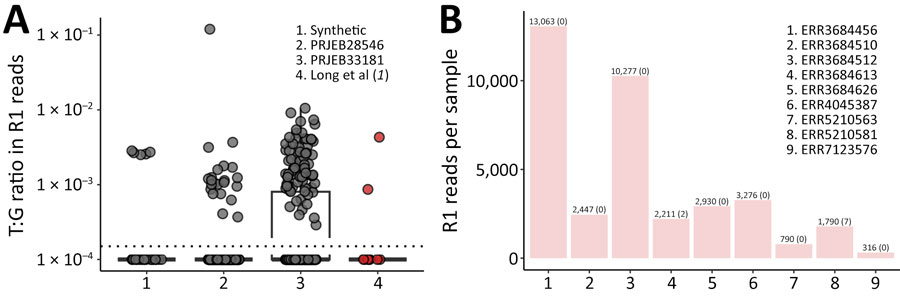
Ratio of G966T to wild-type G alleles among R1 reads of Treponema pallidum. We downloaded raw reads from the European Nucleotide Archive (BioProjects PRJEB28546 and PRJEB33181), which were re-assembled in Long et al. (1) and generated synthetic reads with the error profile of the Illumina HiSeq 2500 (Illumina ART; https://www.niehs.nih.gov/research/resources/software/biostatistics/art) from 29 high-quality T. pallidum assemblies from GenBank using Illumina ART. We removed reads containing host sequences by using kraken 2 (https://github.com/DerrickWood/kraken2), performed quality and adaptor trimming with Trimmomatic version 0.39 (https://github.com/usadellab/trimmomatic), and filtered remaining read pairs to include only reads unambiguously arising from T. pallidum (taxid 160) using the standard kraken 2 16GB database with the default kmer length of 35. We isolated reads containing sequences from either of the rRNA loci by using bbduk (https://sourceforge.net/projects/bbmap) requiring a 21-mer match to the T. pallidum 16S locus sequence with 1 or 0 mismatches. For unambiguous identification and enumeration of the wild-type or G966T variant, R1 reads were grepped for perfect matches to the 51-base sequence centered on nt 966 (bold), equivalent to positions 232265 and 280700 in the SS14 reference sequence chromosome (CP004011): GGTGGAGCATGTGGTTTAATTCGATGATACGCGAGGAACCTTACCCGGGTT (wild-type) and GGTGGAGCATGTGGTTTAATTCGATTATACGCGAGGAACCTTACCCGGGTT (G966T), and the reverse complement of each. A) G:T ratio at rRNA position 966 in samples with >100 R1 reads (n = 622). Each point represents a sample; points below the dotted line contain 0 G966T reads. Boxplots represent medians and interquartile ranges. Samples identified in Long et al. do not have a G966T allele frequency exceeding the technical noise from PCR and sequencing. B) Total R1 reads containing wild-type and mutant sequence in 9 samples identified by Long et al. The total reads are shown for each sample and the number of reads supporting the G966T mutation is shown in parentheses.

Figure. Ratio of G966T to wild-type G alleles among R1 reads of Treponema pallidum. We downloaded raw reads from the European Nucleotide Archive (BioProjects PRJEB28546 and PRJEB33181), which were re-assembled in Long et al. (1) and generated synthetic reads with the error profile of the Illumina HiSeq 2500 (Illumina ART; https://www.niehs.nih.gov/research/resources/software/biostatistics/art) from 29 high-quality T. pallidum assemblies from GenBank using Illumina ART. We removed reads containing host sequences by using kraken 2 (https://github.com/DerrickWood/kraken2), performed quality and adaptor trimming with Trimmomatic version 0.39 (https://github.com/usadellab/trimmomatic), and filtered remaining read pairs to include only reads unambiguously arising from T. pallidum (taxid 160) using the standard kraken 2 16GB database with the default kmer length of 35. We isolated reads containing sequences from either of the rRNA loci by using bbduk (https://sourceforge.net/projects/bbmap) requiring a 21-mer match to the T. pallidum 16S locus sequence with 1 or 0 mismatches. For unambiguous identification and enumeration of the wild-type or G966T variant, R1 reads were grepped for perfect matches to the 51-base sequence centered on nt 966 (bold), equivalent to positions 232265 and 280700 in the SS14 reference sequence chromosome (CP004011): GGTGGAGCATGTGGTTTAATTCGATGATACGCGAGGAACCTTACCCGGGTT (wild-type) and GGTGGAGCATGTGGTTTAATTCGATTATACGCGAGGAACCTTACCCGGGTT (G966T), and the reverse complement of each. A) G:T ratio at rRNA position 966 in samples with >100 R1 reads (n = 622). Each point represents a sample; points below the dotted line contain 0 G966T reads. Boxplots represent medians and interquartile ranges. Samples identified in Long et al. do not have a G966T allele frequency exceeding the technical noise from PCR and sequencing. B) Total R1 reads containing wild-type and mutant sequence in 9 samples identified by Long et al. The total reads are shown for each sample and the number of reads supporting the G966T mutation is shown in parentheses.

Main Article

References
  1. Long  GS, Neale  M, Braukmann  T, Tran  V, Singh  N, Allen  V, et al. Genomic analysis of doxycycline resistance–associated 16S rRNA mutations in Treponema pallidum subspecies pallidum. Emerg Infect Dis. 2026;32:2425. DOIPubMedGoogle Scholar
  2. Beale  MA, Marks  M, Sahi  SK, Tantalo  LC, Nori  AV, French  P, et al. Genomic epidemiology of syphilis reveals independent emergence of macrolide resistance across multiple circulating lineages. Nat Commun. 2019;10:3255. DOIPubMedGoogle Scholar
  3. Chen  W, Šmajs  D, Hu  Y, Ke  W, Pospíšilová  P, Hawley  KL, et al. Analysis of Treponema pallidum strains from China using improved methods for whole-genome sequencing from primary syphilis chancres. J Infect Dis. 2021;223:84853. DOIPubMedGoogle Scholar
  4. Lieberman  NAP, Lin  MJ, Xie  H, Shrestha  L, Nguyen  T, Huang  ML, et al. Treponema pallidum genome sequencing from six continents reveals variability in vaccine candidate genes and dominance of Nichols clade strains in Madagascar. PLoS Negl Trop Dis. 2021;15:e0010063. DOIPubMedGoogle Scholar

Main Article

Page created: July 16, 2026
Page updated: July 16, 2026
Page reviewed: July 16, 2026
The conclusions, findings, and opinions expressed by authors contributing to this journal do not necessarily reflect the official position of the U.S. Department of Health and Human Services, the Public Health Service, the Centers for Disease Control and Prevention, or the authors' affiliated institutions. Use of trade names is for identification only and does not imply endorsement by any of the groups named above.
file_external