Volume 32, Number 8—August 2026
Letter
Doxycycline Resistance and 16S rRNA Mutations in Treponema pallidum
Cite This Article
Citation for Media
To the Editor: We read with interest but also concern the article by Long et al. (1) describing putative doxycycline resistance–associated variants of the Treponema pallidum ribosomal RNA 16S gene. Determining if T. pallidum can become resistant to doxycycline is urgent, given its use for both prevention (i.e., doxy-PEP) and treatment of syphilis, especially amid ongoing shortages of benzathine penicillin G.
Figure
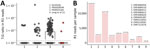
Figure. Ratio of G966T to wild-type G alleles among R1 reads of Treponema pallidum. We downloaded raw reads from the European Nucleotide Archive (BioProjects PRJEB28546 and PRJEB33181), which were...
As the groups that generated most of the sequencing data reanalyzed in Long et al. (1), our analyses were unable to replicate the primary finding of a heterozygous G966T 16S mutation (Escherichia coli numbering) in 9 samples. Using standard pathogen genomics methods (Figure), we did not find the variant in any reanalyzed sample at an allele frequency exceeding background technical noise.
Of note, >98% of publicly available T. pallidum genomes were generated from clinical specimens by metagenomic sequencing using hybrid capture probes. That method retains conserved non–T. pallidum DNA, such as ribosomal operons from other bacteria, in the sample (2,3), and can introduce errors when merging fragmented DNA reads into consensus sequences. Such artifacts may be incorporated into consensus T. pallidum genomes available from public resources such as pubMLST (https://pubmlst.org) or GenBank and misinterpreted as real mutations. Although Long et al. (1) reported filtering for reads arising from Treponema, we and others have shown the necessity of more stringent methods, such as competitive mapping versus related ribosomal sequences (2) or requiring near-identity to known T. pallidum rRNA sequences (4), to avoid inadvertent reporting errors.
The development of doxycycline resistance by T. pallidum could have devastating consequences for the control of syphilis and is being closely monitored by clinicians and scientists. We are encouraged by increasing genomic surveillance of T. pallidum, providing a mechanism for early detection of the emergence of resistance-associated variants.
Acknowledgment
This research was funded in whole, or in part, by the Wellcome Trust (220540/Z/20/A). M.M. is funded by the National Institute of Health and Social Care Research (NIHR304258); the views expressed are those of the author(s) and not necessarily those of the Institute or the Department of Health and Social Care. A.L. and C.C. are funded by the US National Institute of Allergy and Infectious Diseases (R01 AI143439). N.L. is supported by Gates Foundation (INV-072205). M.R.G. has received research support from Hologic and Speedx.

References
- Long GS, Neale M, Braukmann T, Tran V, Singh N, Allen V, et al. Genomic analysis of doxycycline resistance–associated 16S rRNA mutations in Treponema pallidum subspecies pallidum. Emerg Infect Dis. 2026;32:242–5. DOIPubMedGoogle Scholar
- Beale MA, Marks M, Sahi SK, Tantalo LC, Nori AV, French P, et al. Genomic epidemiology of syphilis reveals independent emergence of macrolide resistance across multiple circulating lineages. Nat Commun. 2019;10:3255. DOIPubMedGoogle Scholar
- Chen W, Šmajs D, Hu Y, Ke W, Pospíšilová P, Hawley KL, et al. Analysis of Treponema pallidum strains from China using improved methods for whole-genome sequencing from primary syphilis chancres. J Infect Dis. 2021;223:848–53. DOIPubMedGoogle Scholar
- Lieberman NAP, Lin MJ, Xie H, Shrestha L, Nguyen T, Huang ML, et al. Treponema pallidum genome sequencing from six continents reveals variability in vaccine candidate genes and dominance of Nichols clade strains in Madagascar. PLoS Negl Trop Dis. 2021;15:
e0010063 . DOIPubMedGoogle Scholar
Figure
Cite This ArticleOriginal Publication Date: July 16, 2026
Related Links
Table of Contents – Volume 32, Number 8—August 2026
| EID Search Options |
|---|
 Advanced Article Search – Search articles by author and/or keyword.
|
 Articles by Country Search – Search articles by the topic country.
|
 Article Type Search – Search articles by article type and issue.
|
Please use the form below to submit correspondence to the authors or contact them at the following address:
Nicole Lieberman, University of Washington, 850 Republican St, Seattle, WA 98109, USA
Top