Emergence of Oropouche Virus, Venezuela, 2025
Pierina D’Angelo
1, Lieska Rodríguez
1, Víctor Alarcón, Yoneira Sulbarán, Norca García, Giulianna Antonelli, Marwan Aguilar, Martha Bravo, Zoila C. Moros, Carmen L. Loureiro, Ferdinando Liprandi, José L. Zambrano, Rossana C. Jaspe, and Flor H. Pujol

Author affiliation: Instituto Nacional de Higiene “Rafael Rangel,” Caracas, Venezuela (P. D’Angelo, L. Rodríguez, V. Alarcón, N. García, G. Antonelli, M. Aguilar, M. Bravo); Instituto Venezolano de Investigaciones Científicas, Caracas (Y. Sulbarán, Z.C. Moros, C.L. Loureiro, F. Liprandi, J.L. Zambrano, R.C. Jaspe, F.H. Pujol)
Main Article
Figure 2
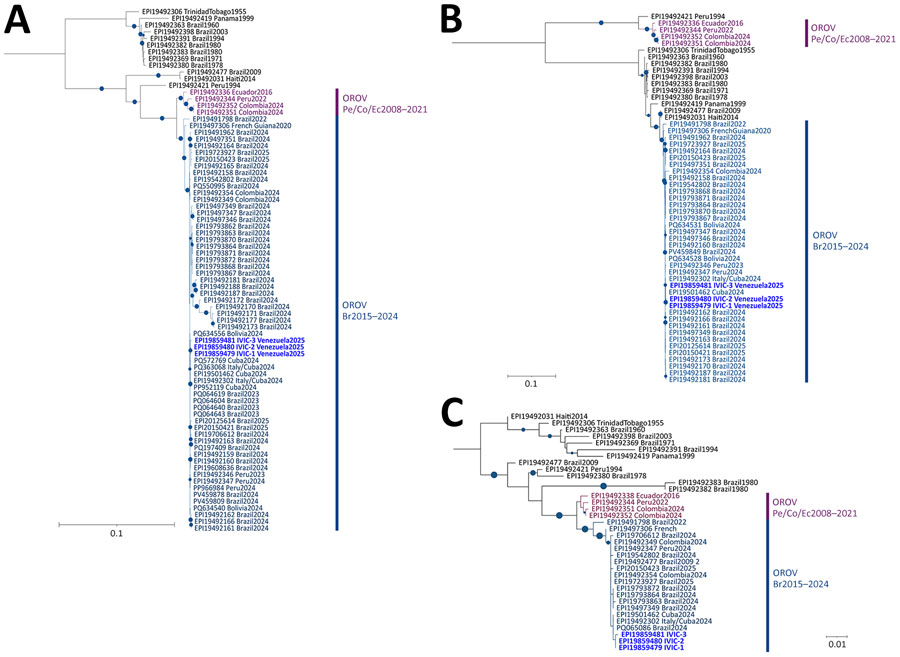
Figure 2. Phylogenetic analysis of OROV cases in Venezuela, 2025. Maximum-likelihood phylogenetic analysis for each genomic segment of the OROV genome: A) large genome segment sequences; B) medium genome segment sequences; C) small genome segment sequences. The isolates are named according to their accession number in GenBank or GISAID (https://www.gisaid.org), including the country and year of collection of each sample. Blue indicates the OROVBR2015–2024 clade and purple the OROVPe/Co/Ec2008–2021 clade. Bold indicates the sequences of the Venezuela isolates. The tree scale indicates the average number of nucleotide substitutions per site. Blue circles indicate bootstrap values >80. OROV, Oropouche virus.
Main Article
Page created: July 31, 2026
Page updated: August 26, 2026
Page reviewed: August 26, 2026
The conclusions, findings, and opinions expressed by authors contributing to this journal do not necessarily reflect the official position of the U.S. Department of Health and Human Services, the Public Health Service, the Centers for Disease Control and Prevention, or the authors' affiliated institutions. Use of trade names is for identification only and does not imply endorsement by any of the groups named above.