Volume 32, Number 9—September 2026
Research Letter
Emergence of Oropouche Virus, Venezuela, 2025


Cite This Article
Citation for Media
Abstract
We describe 5 cases of human Oropouche virus infection detected in rural Venezuela in 2025. All isolates belonged to the OROVBr2015–2024 reassortant lineage linked to the 2024–2025 epidemic. Our results emphasize ongoing transmission, which highlights the need for strengthened surveillance and laboratory capacity in South America.
Oropouche virus (OROV) is an arthropodborne virus and member of the family Peribunyaviridae, genus Orthobunyavirus; the species is Orthobunyavirus oropoucheense. The genome consists of 3 segments of a linear negative-stranded RNA: small, medium, and large (1). Several outbreaks of OROV infection have occurred in the Amazon region since 1960. The largest OROV outbreak has been ongoing since 2022 (1). By February 2025, a total of 9 countries in the Americas reported autochthonous cases of OROV. Meanwhile Canada, Cayman Islands, the United States, Germany, Italy, and Spain also reported 30 imported cases, mostly in travelers returning from Cuba (2).
Figure 1
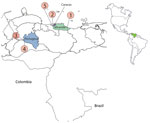
Figure 1. Locations of Oropouche virus cases detected in Venezuela, 2025. The numbers represent the cases detected. The cases were detected in the Portugesa and Miranda states. The first detected Oropouche virus...
The National Institute of Hygiene Rafael Rangel (Caracas, Venezuela) has been detecting OROV by using reverse transcription PCR since 2023. Beginning in 2024, a total of 25% of the samples negative for dengue, chikungunya, and Zika viruses were tested for Mayaro and Oropouche viruses by quantitative reverse transcription PCR (qRT-PCR) (3). During the first trimester of 2025, five samples tested positive for OROV by qRT-PCR in 2 states of Venezuela, Miranda and Portuguesa (Figure 1). After the first case of OROV was detected in January 2025, all the samples negative for the 3 other arboviruses from January–March 2025 were retrospectively tested for Mayaro virus and OROV, which were all negative. This study was approved by the Bioethical Committee of Instituto Venezolano de Investigaciones Científicas (protocol no. CBioEtIVIC-2022–001): written informed consent was obtained in OROV-positive human cases. We described the clinical findings of the 5 patients in accordance with the Pan American Health Organization guidelines (Appendix Table 1) (2). We observed no neurologic compromise in those cases. For the first case, the patient had a possible relapse 3 weeks later, although qRT-PCR was negative. Recurrence seems to be a frequent phenomenon in OROV infection (4).
We collected serum samples 2 or 3 days after the appearance of acute febrile illness. We performed genome sequencing on an Illumina iSeq platform (Illumina, https://www.illumina.com) by using a COVIDSeq library and primers specific for the OROV genome (Appendix Table 2) (2). We assembled genome sequences by using both Genome Detective (https://www.genomedetective.com) and INSaFLU-TELEVIR bioinformatic tools (https://insaflu.insa.pt).
We deposited complete genome sequences into the GISAID database (accession nos. EPI_ISL_19859479–81), and in GenBank (GenBank accession nos. PX494099–101, PX495048–50 and PX495206–8). We aligned sequences by using MAFFT (5) and performed phylogenetic analysis by using IQTree with 1000 bootstrap replicas (Appendix) (6).
Figure 2
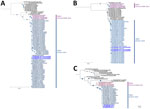
Figure 2. Phylogenetic analysis of OROV cases in Venezuela, 2025. Maximum-likelihood phylogenetic analysis for each genomic segment of the OROV genome: A) large genome segment sequences; B) medium genome segment sequences; C)...
Our phylogenetic analysis of 3 complete viral genome segments revealed that the isolates from Venezuela grouped in the OROVBR2015–2024 clade, a dominant lineage associated with current outbreaks (1). The sequences from Venezuela were related to OROV isolates from Cuba. However, the small segment sequences were also closely related to sequences from Brazil (Figure 2). A large outbreak of OROV occurred in Cuba in 2024, with 626 confirmed cases, and was still ongoing in 2025 (2). Since late 2022, an unprecedented epidemic of OROV infection is still ongoing in Brazil (1,2,7). However, no history of travel outside the country was reported for the cases in Venezuela.
A close relative of OROV, Madre de Dios Virus, was isolated from a monkey (Cebus olivaceus) during an epizootic outbreak in the Eastern region of Venezuela in 2010 (8). Animal reservoirs, such as nonhuman primates and sloths, cannot be excluded in other rural regions of Venezuela and might be involved in a spillover OROV event to humans (9). However, the relatedness of the sequences to the OROVBR2015–2024 clade suggests an introduction from the countries with OROV outbreaks. The 2 cases from Portuguesa state were from close localities, in contrast with the cases from Miranda state. No secondary cases were found among febrile persons in the localities where the OROV positive cases were found. However, secondary asymptomatic cases (10) cannot be ruled out. Epidemiologic surveillance of OROV infection is challenging because of the dengue virus epidemic in Venezuela. Some OROV cases might be underreported because they are misdiagnosed as dengue virus, or because they were asymptomatic (10). Two additional OROV infections were reported in April 2025 in Portuguesa state.
In conclusion, we detected OROV in Venezuela in 2025. Although underreporting of OROV cases cannot be ruled out, the epidemiologic pattern of this viral infection in Venezuela does not appear to be as pervasive compared with other countries such as Brazil and Cuba. We believe continued surveillance in the region is necessary to reduce outbreak risk.
Mrs. D’Angelo is the coordinator of the virology department at the National Institute of Hygiene Rafael Rangel, of the National Polio Laboratory, and a member of the National Committee for Poliovirus Containment in Venezuela. Her research interests include viral genomic surveillance and the detection of emerging and reemerging viral pathogens.
Acknowledgments
We wish to express our gratitude to Gonzalo Bello and Felipe Naveca for advice on the generation and assembly of sequences. We also thank Valeria Bonetti for providing us access to IQTree.
This study was supported by the Ministerio del Poder Popular para la Salud and the Ministerio del Poder Popular de Ciencia, Tecnología e Innovación of Venezuela. We are also thankful for the Pan American Health Organization regional genomic surveillance network for the next-generation sequencing reagents.
References
- Naveca FG, Almeida TAP, Souza V, Nascimento V, Silva D, Nascimento F, et al. Human outbreaks of a novel reassortant Oropouche virus in the Brazilian Amazon region. Nat Med. 2024;30:3509–21. DOIPubMedGoogle Scholar
- Pan American Health Organization/World Health Organization. Oropouche epidemiological update in the Americas region, 11 February 2025. Washington: The Organizations; 2025.
- Naveca FG, Nascimento VAD, Souza VC, Nunes BTD, Rodrigues DSG, Vasconcelos PFDC. Multiplexed reverse transcription real-time polymerase chain reaction for simultaneous detection of Mayaro, Oropouche, and Oropouche-like viruses. Mem Inst Oswaldo Cruz. 2017;112:510–3. DOIPubMedGoogle Scholar
- Pastula DM, Beckham JD, Tyler KL. Oropouche virus: an emerging neuroinvasive arbovirus. Ann Neurol. 2024;97:28–33. DOIPubMedGoogle Scholar
- Katoh K, Rozewicki J, Yamada KD. MAFFT online service: multiple sequence alignment, interactive sequence choice and visualization. Brief Bioinform. 2019;20:1160–6. DOIPubMedGoogle Scholar
- Trifinopoulos J, Nguyen LT, von Haeseler A, Minh BQ. W-IQ-TREE: a fast online phylogenetic tool for maximum likelihood analysis. Nucleic Acids Res. 2016;44(W1):
W232-5 . DOIPubMedGoogle Scholar - Scachetti GC, Forato J, Claro IM, Hua X, Salgado BB, Vieira A, et al. Re-emergence of Oropouche virus between 2023 and 2024 in Brazil: an observational epidemiological study. Lancet Infect Dis. 2025;25:166–75. DOIPubMedGoogle Scholar
- Navarro JC, Giambalvo D, Hernandez R, Auguste AJ, Tesh RB, Weaver SC, et al. Isolation of Madre de Dios virus (Orthobunyavirus; Bunyaviridae), an Oropouche virus species reassortant, from a monkey in Venezuela. Am J Trop Med Hyg. 2016;95:328–38. DOIPubMedGoogle Scholar
- Sciancalepore S, Schneider MC, Kim J, Galan DI, Riviere-Cinnamond A. Presence and multi-species spatial distribution of Oropouche virus in Brazil within the One Health framework. Trop Med Infect Dis. 2022;7:111. DOIPubMedGoogle Scholar
- Manuli ER, Hua X, Scachetti GC, Forato J, Claro IM, Pereira GM, et al. Transmission dynamics of Oropouche virus in Latin America and the Caribbean. Nat Med. 2026;32:1383–92. DOIPubMedGoogle Scholar
Figures
Cite This ArticleOriginal Publication Date: August 20, 2026
1These first authors contributed equally to this article.
Table of Contents – Volume 32, Number 9—September 2026
| EID Search Options |
|---|
 Advanced Article Search – Search articles by author and/or keyword.
|
 Articles by Country Search – Search articles by the topic country.
|
 Article Type Search – Search articles by article type and issue.
|
Please use the form below to submit correspondence to the authors or contact them at the following address:
Flor H. Pujol and Rossana Jaspe, Laboratorio de Virología Molecular, CMBC, IVIC, Apdo 21827, Caracas 1020A, Venezuela
Top