Invasive Wickerhamomyces anomalus Infections among Injecting Drug Users, France, 2012–20241
Maxime Lefranc
2, Adrien Pain
2, Fréderic Dalle, Pierre Baudino, Claudio Plaisant, Taieb Chouaki, Josephine Dorin, Anne-Pauline Bellanger, Julie Bonhomme, Maxime Moniot, Celia Rouges, Françoise Botterel, Gregoire Pasquier, Lilia Hasseine, Estelle Perraud-Cateau, Jean-Pierre Gangneux, Laurence Delhaes, Damien Costa, Juliette Guitard, Alexandre Alanio, Valerie Letscher-Bru, Emilie Guemas, Guillaume Desoubeaux, Karine Boukris-Sitbon, Olivier Lortholary, Fanny Lanternier, Marie Desnos-Ollivier, Sebastien Imbert

, and
WAIT-IV Study Group,3
Author affiliation: CHU Bordeaux, Bordeaux, France (M. Lefranc, P. Baudino, C. Plaisant, L. Delhaes, S. Imbert); Université de Bordeaux, Bordeaux (M. Lefranc, S. Imbert); Institut Pasteur, Paris, France (A. Pain, K. Boukris-Sitbon, O. Lortholary, M. Desnos-Ollivier, F. Lanternier); CHU Dijon, Dijon, France (F. Dalle); CHU Amiens-Picardie, Amiens, France (T. Chouaki); CHU d’Antibes Juan les Pins, Antibes, France (J. Dorin); CHU de Besançon, Besançon, France (A.-P. Bellanger); CHU Caen, Caen, France (J. Bonhomme); CHU Clermont-Ferrand, Clermont-Ferrand, France (M. Moniot); AP-HP Hôpital Cochin, Paris (C. Rouges); CHU Henri Mondor, Créteil, France (F. Botterel); CHU de Montpellier, Montpellier, France (G. Pasquier); CHU Nice, Nice, France (L. Hasseine); CHU Poitiers, Poitiers, France (E. Perraud-Cateau); CHU de Rennes, Rennes, France (J.-P. Gangneux); CHU de Rouen, Rouen, France (D. Costa); Sorbonne Universite, Paris (J. Guitard); Hôpital Saint-Antoine, Paris (J. Guitard); Hôpital Saint-Louis, Paris (A. Alanio); Hôpitaux Universitaires de Strasbourg, Strasbourg, France (V. Letscher-Bru); CHU Toulouse, Toulouse, France (E. Guemas); CHU de Tours, Tours, France (G. Desoubeaux)
Main Article
Figure 2
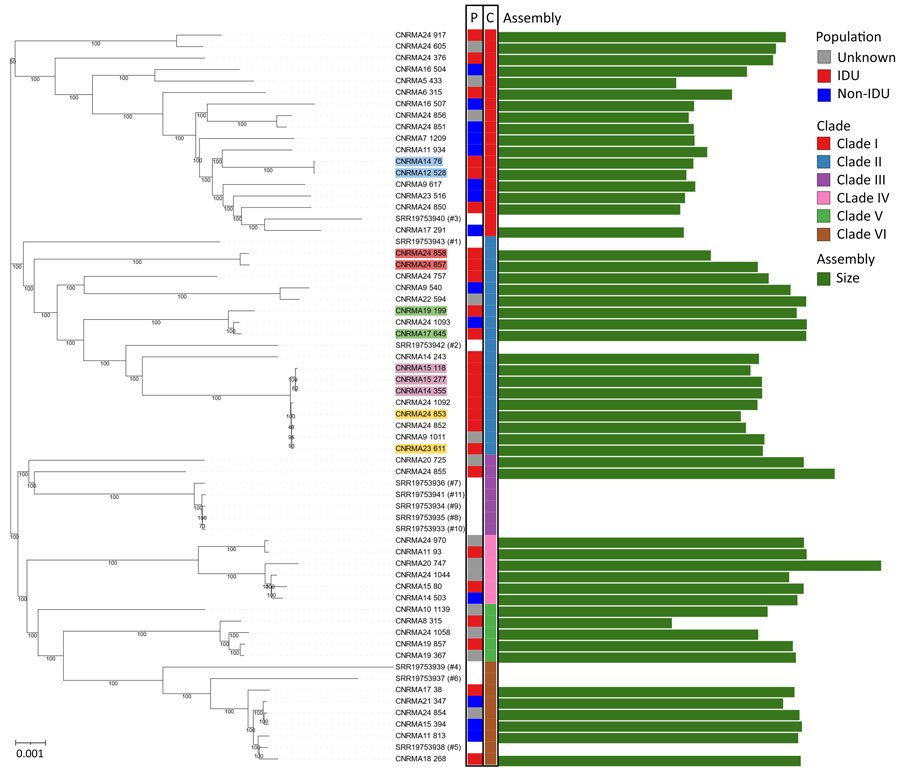
Figure 2. Phylogenetic tree of Wickerhamomyces anomalus isolates in study of invasive W. anomalus infections among injecting drug users, France, 2012–2024. Tree is based on genomewide SNPs from 53 W. anomalus isolates collected in the study and 11 publicly available genomes (isolate names starting with SRR) and was developed by neighbor-joining method. The P column indicates the IDU status of the patient from whom each isolate originated. The C column denotes phylogenetic clade. Matching colored shading on isolate names indicates those isolates belong to the same patient. Green bars represent assembled genome size of 13.9–29.7 Mb. Variation in assembly size reflects levels of genomic heterozygosity: isolates with extensive loss of heterozygosity (clade 1) have smaller assemblies caused by haplotype collapse, whereas highly heterozygous isolates have larger assemblies with uncollapsed haplotypes. Numbers at nodes indicate bootstrap values. Scale bar represents genetic distance (proportion of differing SNPs). IDU, injecting drug use; SNP, single-nucleotide polymorphism.
Main Article
Page created: August 10, 2026
Page updated: August 26, 2026
Page reviewed: August 26, 2026
The conclusions, findings, and opinions expressed by authors contributing to this journal do not necessarily reflect the official position of the U.S. Department of Health and Human Services, the Public Health Service, the Centers for Disease Control and Prevention, or the authors' affiliated institutions. Use of trade names is for identification only and does not imply endorsement by any of the groups named above.