Volume 32, Number 9—September 2026
Research Letter
Outbreak of Brazilian Spotted Fever, Southeastern Brazil, 2018

 , Rodrigo N. Angerami, and Maria R. Donalisio
Cite This Article
Citation for Media
Abstract
Brazilian spotted fever is a severe tickborne rickettsial disease endemic to Brazil. We report the clinical and epidemiological characteristics of an outbreak of 15 cases of Brazilian spotted fever caused by Rickettsia rickettsii in 2018 with high lethality. Our report highlights the need for early diagnosis to avert deaths.
Brazilian spotted fever (BSF) is caused by Rickettsia rickettsii bacteria and transmitted in endemic areas of the interior of São Paulo state, southeastern Brazil, by Amblyomma sculptum ticks. Transmission typically occurs in forested areas along rivers and streams inhabited by capybaras, which are the main host for the tick vector and an amplifier host for Rickettsiae (1–3). We describe a BSF outbreak characterized by a high number of confirmed cases, specific circumstances of transmission, and associated deaths.
Figure
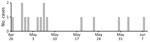
Figure. Temporal distribution of Brazilian spotted fever cases, by date of onset of symptoms, during outbreak in Americana, Brazil, 2018.
An eco-epidemiologic investigation in 2018 in the municipality of Americana, Brazil, identified a cluster of 15 laboratory-confirmed cases of BSF in a periurban area (3) (Appendix Figure). The outbreak lasted 43 days, from April 26, 2018, the date of symptom onset of the index case, to June 7, 2018, when symptom onset occurred in the last reported case (Figure). We applied Brazilian Ministry of Health criteria to confirm each case (4) (Appendix Table 1). This study was approved by the Research Ethics Committee of the Faculty of Medical Sciences of the State University of Campinas (protocol no. 5,474,734).
We noted the most prevalent symptoms in each case included fever, headache, and myalgia. We also observed an increased frequency in symptom severity, including respiratory failure, renal dysfunction, jaundice, neurologic symptoms, shock, and hemodynamic instability at the time of suspicion (Appendix Table 2). There were 11 deaths out of 15 cases. Of note, severe febrile-icteric and hemorrhagic syndromes were prevalent.
The case-patients’ mean age was 37 years (range 2–65 years); 14 were male and 1 female, and 6 were persons of color (Table). The case-patients had a median of 3 (range 1–4) medical consultations before hospitalization, indicating diagnostic delay. The 12 patients who were hospitalized had a median of 4 (range 2–11) days from symptom onset to hospitalization. Among the hospitalized patients who survived, the length of hospital stay was 10–14 (median 12) days. Among patients with fatal outcomes, the median duration from symptom onset to death was 6 days (range 4–10 days), whereas the median time between hospitalization and death was 1 day (range 1–5 days).
Most patients were working-age adults (20–59 years), although the inclusion of children is notable. Previous studies suggest severe manifestations and mortality reaching 80% in children (5–7). We found that the low frequency of widespread skin rashes (5 of 15 in general, 1 of 6 in patients of color), a clinical clue for BSF suspicion even in cases that already showed signs of severity, might have contributed to late suspicion with a consequent high mortality rate.
Survivors sought care during the first 3 days of symptoms and received doxycycline at median day 3 (range 2–4) compared with day 6 (range 4–9) for nonsurvivors. Time from onset to hospitalization was also shorter among survivors (3 vs. 5 days). We found that early identification of the disease during the prodromal phase, especially when associated with nonspecific clinical symptoms and a history of exposure to tick habitats, ideally by day 3 of symptom onset, can provide an opportunity for immediate outpatient treatment with oral antimicrobial drugs to avoid hospitalization (4).
During the investigation, the municipal epidemiologic surveillance team gathered information from patients and family members. Eight patients reported the occurrence of tick bites. All patients had a history of engaging in outdoor leisure activities (e.g., fishing, hiking) <15 days before symptom onset in a waterside forest area located at the confluence of the Atibaia and Jaguari Rivers. An acarological survey that applied a CO2 trap technique conducted at 10 sites in this area on June 14, 2018, collected 403 A. sculptum ticks (277 larvae, 110 nymphs, and 16 adults) and 82 A. dubitatum ticks (30 larvae, 49 nymphs, and 3 adults). We did not test ticks for R. rickettsii bacteria.
Unlike what we observed in this outbreak, in endemic areas of BSF where A. sculptum ticks are the vector, cases typically concentrate during July– November, when nymphs, the main life stage involved in transmitting R. rickettsii to humans, are most abundant in the environment (2,4,8). High infestation by immature stages (larvae and nymphs) of the vector in the environment and high turnover of capybaras susceptible to infection are factors that possibly enabled the occurrence of this outbreak outside the expected epidemiologic pattern, instead during the seasonal peak of larval abundance (8).
Even though this region has a long history of BSF endemicity, during this outbreak, the alerts were not timely enough for healthcare professionals in the region. We noted delays in clinical suspicion and diagnosis of BSF in most patients who died, highlighting that BSF remains a relevant public health challenge for health services and that early diagnosis is necessary to avert deaths.
Mr. Brasil is a doctoral student in the postgraduate program in public health at the State University of Campinas, Brazil. His research interests include entomology and zoonoses in public health.
Acknowledgment
We would like to thank the Americana Municipal Health Department for supporting this study.
References
- Labruna MB. Ecology of rickettsia in South America. Ann N Y Acad Sci. 2009;1166:156–66. DOIPubMedGoogle Scholar
- Foley J, López-Pérez AM, Álvarez-Hernández G, Labruna MB, Angerami RN, Zazueta OE, et al. A wolf at the door: the ecology, epidemiology, and emergence of community- and urban-level Rocky Mountain spotted fever in the Americas. Am J Vet Res. 2025;86:1–12. DOIPubMedGoogle Scholar
- Brasil J, Soares S, Brites-Neto J. Clinical and epidemiological aspects of a cluster of Brazilian spotted fever, which occurred in the city of Americana, São Paulo, Brazil, 2018. Journal of Health & Biological Sciences. 2020;8:1–5. DOIGoogle Scholar
- Brazilian Ministry of Health. Spotted fever in Brazil: epidemiology, clinical manifestations and environment, 2022 [cited 2026 Jan 11]. https://www.gov.br/saude/pt-br/centrais-de-conteudo/publicacoes/svsa/febre-maculosa/febre-maculosa-aspactos-epidemiologicos-clinicos-e-ambientais.pdf
- Chiang L, Ramchandar N, Aramkul J, Fireizen Y, Beatty ME, Monroe M, et al. Rocky Mountain spotted fever in children along the US‒Mexico border, 2017–2023. Emerg Infect Dis. 2024;30:2288–93. DOIPubMedGoogle Scholar
- de Oliveira SV, Willemann MCA, Gazeta GS, Angerami RN, Gurgel-Gonçalves R. Predictive factors for fatal tick-borne spotted fever in Brazil. Zoonoses Public Health. 2017;64:e44–50. DOIPubMedGoogle Scholar
- Nogueira Angerami R, Oliveira Morais E, Katz G, Jacintho da Silva L. Brazilian spotted fever in the paediatric age-segment in the State of São Paulo, southeastern Brazil, 2003–2006. Clin Microbiol Infect. 2009;15(Suppl 2):205–6. DOIPubMedGoogle Scholar
- Brasil J, Pinter A, Angerami RN, Donalisio MR. Spatial and temporal distribution of Brazilian spotted fever in an endemic area: epidemiological profile of a zoonosis in constant adaptation to anthropogenic actions. Rev Bras Epidemiol. 2026;29:
e260020 . DOIPubMedGoogle Scholar
Figure
Table
Cite This ArticleOriginal Publication Date: August 17, 2026
Table of Contents – Volume 32, Number 9—September 2026
| EID Search Options |
|---|
 Advanced Article Search – Search articles by author and/or keyword.
|
 Articles by Country Search – Search articles by the topic country.
|
 Article Type Search – Search articles by article type and issue.
|
Please use the form below to submit correspondence to the authors or contact them at the following address:
Jardel Brasil, Health Surveillance Unit, Av. Paschoal Ardito, 1221, Americana, Brazil
Top