Volume 32, Number 9—September 2026
Research Letter
Pediatric Tuberculosis Care Outcomes in a Tertiary Care Center, France, 2014–2024

 , Luc Panetta, Florence Ader, Antoine Ouziel, Yves Gillet, and Côme Horvat
Cite This Article
Citation for Media
Abstract
We evaluated pediatric tuberculosis treatment outcomes in a tertiary care center in France during 2014–2024 by using updated World Health Organization definitions. Among 123 children, 60.9% were successfully treated. Unfavorable outcomes reflected suboptimal adherence, dosing errors, and incomplete follow-up, highlighting the need for implementation and evaluation of optimized care processes.
Pediatric tuberculosis (TB) remains a major global health concern; an estimated 1.2 million new cases and 174,300 deaths were reported in 2024 (1). Treatment regimens are well-standardized and updated by the World Health Organization (WHO) (2). However, research and implementation efforts predominantly focus on high-incidence countries. Data from pediatric cohorts in high-income, low-incidence settings remain scarce, reporting overall success rates around 90% (3,4), but provide very limited insights into the quality of care, treatment pathways, and potential barriers. We describe TB treatment outcomes in a tertiary pediatric center in France over a 10-year period by using the updated WHO treatment–outcome definitions as a standardized framework.
We conducted a retrospective cohort study at a tertiary pediatric hospital in Lyon, France, including all patients <18 years of age treated for TB during January 1, 2014–December 31, 2024. TB diagnosis was consistent with WHO guidelines (2). To achieve comprehensive case identification, we cross-matched 4 institutional databases, including microbiology, pharmacy, administrative records, and pediatric infectious disease consultations, and then conducted a systematic manual review of each medical record.
We collected data on demographics, signs and symptoms, treatment, and outcomes by using standardized definitions (2,5–7). We classified treatment outcomes according to WHO definitions as favorable (cured or treatment completed) or unfavorable (treatment failure, lost to follow-up, or death) (Appendix Table) (8). To further elucidate the care process, we captured secondary analytic outcomes. Those outcomes included dosing adequacy, assessed according to WHO-recommended weight-based drug dosages and, when available, therapeutic drug monitoring for rifampin or isoniazid; treatment nonadherence (intake <80% or treatment interruption for >2 consecutive weeks (6); follow-up nonadherence (any missed scheduled visit); microbiological failure; treatment prolongation; modification of the initial regimen (excluding adaptations on the basis of drug susceptibility); and treatment-related adverse events (7).
Figure
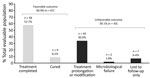
Figure. Distribution of pediatric tuberculosis care outcomes in a tertiary care center, France, 2014–2024. Light gray bars indicate favorable outcomes and black bars unfavorable outcomes, as defined by the World Health...
Among 123 children with TB, 13 were not evaluated according to WHO outcome definitions because they were transferred to another facility. Of the 110 evaluable children, 67 (60.9%) had favorable treatment outcomes and 43 (39.1%) had unfavorable treatment outcomes, including 34 with treatment failures, 9 who were lost to follow-up, and 2 with documented microbiological failure (Figure). Treatment failure was related to radiological failure (32.6%, n = 14), clinical failure (16.3%, n = 7), or treatment nonadherence or underdosing (23.3%, n = 10). Underdosing was documented in 28 (25.4%) children, 11 (10%) with subtherapeutic drug concentrations and 17 (15.5%) with subrecommended weight-based dosing. Overdosing was documented in only 1 child. Therapeutic nonadherence was reported in 17 (15.5%) children, and follow-up nonadherence was reported in 67 (60.9%) children. Thirteen (11.8%) children experienced adverse events, including hepatotoxicity (8.2%, n = 9), agranulocytosis (2.7%, n = 3), peripheral neuropathy (0.9%, n = 1), and optic toxicity under ethambutol (0.9%, n =1). Nearly half of the adverse events (46%, n = 6) led to permanent discontinuation of the implicated drug.
Of the 110 evaluable children, the median age was 5 years; 61 (55.5%) were male and 49 (45.5%) female (Table). Malnutrition was documented in 10 (9.1%) children, and 4 (3.6%) children were co-infected with HIV. Isolated thoracic disease was documented in 78 (70.9%) children, including 50 children with severe forms of the disease. Extrapulmonary TB was reported in 32 (29.1%) children. We obtained microbiological confirmation from 58 (52.7%) children and documented index cases in 43 (39.1%) children. Five (4.5%) TB strains were resistant: 3 resistant to isoniazid, 1 resistant to ethambutol, and 1 multidrug-resistant. Most (57.3%, n = 63) children were treated with the standard 6–month regimen; only 1 received the 4–month regimen, and 13 (11.8%) children with severe disease required prolonged treatment for 9–12 months (2).
By using standardized WHO definitions in a high-income, low-incidence setting, we found nearly 40% of children had unfavorable treatment outcomes. Care-process gaps were frequent: 1 in 4 children were underdosed, treatment nonadherence was documented in 1 in 6 children, and ≈66% of children had suboptimal follow-up attendance. Those findings underscore that many unfavorable outcomes reflect elements of care that can be improved rather than intrinsic disease severity or care access.
Our results are in striking contrast with reported success rates ≈90% in similar settings, largely on the basis of heterogeneous or earlier outcome definitions (3,4), highlighting how updated WHO definitions go beyond death or microbiological failure to capture suboptimal treatment processes. Furthermore, the low relevance of the cured category, because of limited microbiological documentation in children (9), reinforces the value of treatment completed as a more meaningful indicator in pediatric TB.
Although the retrospective and single-center design of our study limits its generalizability, its decade-long timespan, exhaustive case identification, and rigorous application of standardized WHO definitions strengthen our findings. Similar concerns have been raised in other high-income settings, where organizational models of TB care have influenced treatment outcomes (10).
In conclusion, applying updated WHO definitions revealed a high proportion of unfavorable outcomes in a high-income, low-incidence setting. This revelation supports the implementation and evaluation of optimized care processes focused on treatment adherence, accurate weight-based drug dosing, and structured follow-up.
Dr. Franco is a pediatric resident at Hospices Civils de Lyon, France, pursuing specialization in pediatric infectious diseases. Her research interests include pediatric tuberculosis.
Acknowledgments
We are thankful to Oana Dumitrescu for her support with laboratory database extraction; the Department of Medical Information, particularly Balthazar Ntab, and Philippe Reix for administrative database support and data access agreement; and the hospital pharmacy team, including Elise Galoustian-Estéphani, Pauline Rascle, and Laura Delpech, for their assistance with pharmacy data extraction.
This study was approved by the local ethics committee, complied with data protection regulations in France, and was registered on ClinicalTrials.gov (trial no. NCT07357844).
References
- World Health Organization. Global tuberculosis report 2025 [cited 2025 Dec 9]. https://iris.who.int/server/api/core/bitstreams/e97dd6f4-b567-4396-8680-717bac6869a9/content
- World Health Organization. WHO operational handbook on tuberculosis. Module 5: management of tuberculosis in children and adolescents. 1st edition. Geneva: The Organization; 2022.
- Gafar F, Van’t Boveneind-Vrubleuskaya N, Akkerman OW, Wilffert B, Alffenaar JC. Nationwide analysis of treatment outcomes in children and adolescents routinely treated for tuberculosis in the Netherlands. Eur Respir J. 2019;54:
1901402 . DOIPubMedGoogle Scholar - Abubakar I, Laundy MT, French CE, Shingadia D. Epidemiology and treatment outcome of childhood tuberculosis in England and Wales: 1999–2006. Arch Dis Child. 2008;93:1017–21. DOIPubMedGoogle Scholar
- World Health Organization. WHO child growth standards: length/height-for-age, weight-for-age, weight-for-length, weight-for-height and body mass index-for-age: methods and development. [cited 2025 Jul 26]. https://www.who.int/publications/i/item/924154693X
- National Cancer Institute. PRO-CTCAE measurement system terminology [cited 2025 Jul 23]. https://evs.nci.nih.gov/ftp1/CTCAE/About.html
- World Health Organization. WHO consolidated operational handbook on tuberculosis. Module 4 treatment and care. Geneva: The Organization; 2025.
- Gupta N, Kashyap B, Dewan P, Hyanki P, Singh NP. Clinical spectrum of pediatric tuberculosis: a microbiological correlation from a tertiary care center. J Trop Pediatr. 2019;65:130–8. DOIPubMedGoogle Scholar
- Guido G, Di Gennaro F, Cavallin F, Pisaturo M, Onorato L, Zimmerhofer F, et al. Team-based, hybrid, or standard of care? Organizational models of tuberculosis care on tuberculosis outcomes in eleven Italian hospital. Clin Microbiol Infect. 2025;31:2033–40. DOIPubMedGoogle Scholar
Figure
Table
Cite This ArticleTable of Contents – Volume 32, Number 9—September 2026
| EID Search Options |
|---|
 Advanced Article Search – Search articles by author and/or keyword.
|
 Articles by Country Search – Search articles by the topic country.
|
 Article Type Search – Search articles by article type and issue.
|
Please use the form below to submit correspondence to the authors or contact them at the following address:
Diane Franco, Equipe Mobile d’Infectiologie Pédiatrique & Urgences Pédiatriques, Hôpital Femme Mère Enfant, Hospices Civils de Lyon, 59 Boulevard, Pinel 69500 Bron, France
Top