Skip directly to site content Skip directly to page options Skip directly to A-Z link Skip directly to A-Z link Skip directly to A-Z link

Disclaimer: Early release articles are not considered as final versions. Any changes will be reflected in the online version in the month the article is officially released.

Volume 32, Number 9—September 2026

Dispatch

Genomic and Epidemiologic Insights into Ongoing Measles Outbreak, Israel, 2025–2026

Efrat Bucris1, Neta S. Zuckerman1, Tal Levin, Yara Kanaaneh, Oran Erster, Victoria Indenbaum, Keren Friedman, Danit Sofer, Eli Schwartz, Elena Chernin, Or Kriger, Rana Shibli, Sharon Elroi Prais, Zohar Mor, Nitza Abramson, Michal Savion, Naama Nuss, Ady Cohen Golan, Eva Avramovich, Dror Yakir, Liora Guy David, Efrat Rorman, Yaniv LustigComments to Author , and National Measles Working Group,2
Author affiliation: Central Virology Laboratory, Public Health Services, Ministry of Health and Sheba Medical Center, Ramat-Gan, Israel (E. Bucris, N.S. Zuckerman, T. Levin, Y. Kanaaneh, O. Erster, V. Indenbaum, K. Friedman, D. Sofer, Y. Lustig); Gray Faculty of Medicine, Tel-Aviv University, Tel-Aviv, Israel (N.S. Zuckerman, Y. Lustig); The Center for Geographic Medicine and Tropical Diseases, The Chaim Sheba Medical Center, Tel Hashomer, Israel (E. Schwartz); Ministry of Health Division of Epidemiology, Jerusalem, Israel (E. Chernin, O. Kriger, R. Shibli, S.E. Prais); Health Intelligence, Ministry of Health, Jerusalem (S.E. Prais, D. Yakir, L.G. David); Program for Public Health, Ashkelon Academic College, Ashkelon, Israel (Z. Mor); Jerusalem Department of Health, Ministry of Health, Jerusalem (Z. Mor, N. Abramson); Tel Aviv Department of Health, Ministry of Health, Tel-Aviv (M. Savion, N. Nuss); Central District Health Bureau, Ramla, Israel (A.C. Golan, E. Avramovich); Ministry of Health Department of Laboratories, Jerusalem (E. Rorman)

Main Article

Figure 1

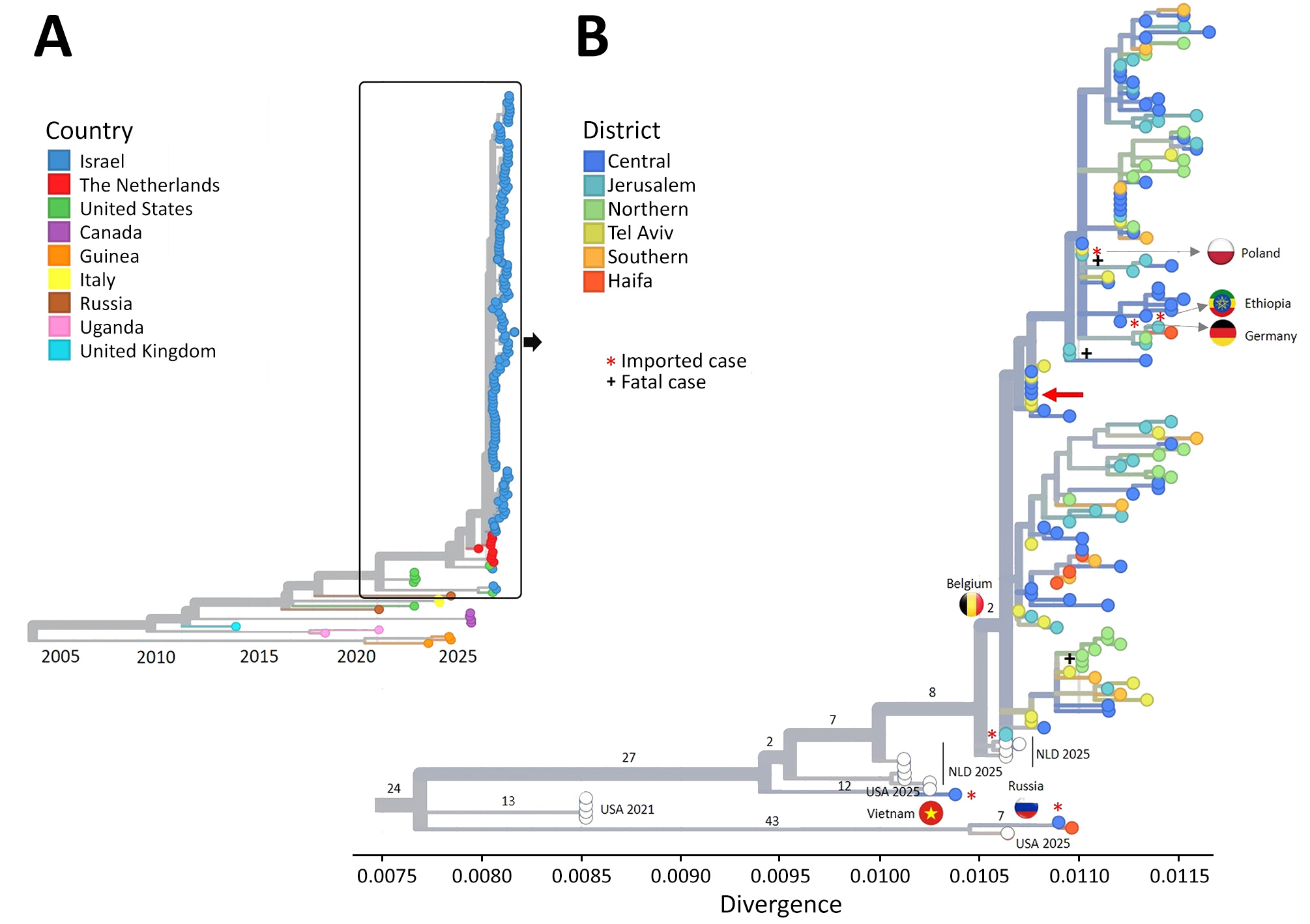
Phylogenetic analysis from investigation of genomic and epidemiologic insights into ongoing measles outbreak, Israel, 2025–2026. Phylogenetic tree including 132 sequences from Israel collected during April 2025–February 2026 and 29 global sequences from 2020–2025 available in the National Center for Biotechnology Information (Appendix) Tree was constructed using the Nextrain Augur pipeline under the generalized time reversible substitution model, and visualized with Auspice (10). A) Time-resolved phylogenetic tree including Israel and global sequences. B) Divergence tree highlighting the Israel clusters and indicating the district of origin for each sample; branch lengths and the x-axis represent genetic divergence, whereas numbers along branches indicate inferred nucleotide substitutions relative to the parental node. Asterisks (*) denote cases with documented travel around the time of measles identification; country flags indicate the reported travel destination when known. Plus signs (+) denote fatal cases in children. Red arrow denotes the epidemiologically linked case related to the initial importation from Belgium.

Figure 1. Phylogenetic analysis from investigation of genomic and epidemiologic insights into ongoing measles outbreak, Israel, 2025–2026. Phylogenetic tree including 132 sequences from Israel collected during April 2025–February 2026 and 29 global sequences from 2020–2025 available in the National Center for Biotechnology Information (Appendix) Tree was constructed using the Nextrain Augur pipeline under the generalized time reversible substitution model, and visualized with Auspice (10). A) Time-resolved phylogenetic tree including Israel and global sequences. B) Divergence tree highlighting the Israel clusters and indicating the district of origin for each sample; branch lengths and the x-axis represent genetic divergence, whereas numbers along branches indicate inferred nucleotide substitutions relative to the parental node. Asterisks (*) denote cases with documented travel around the time of measles identification; country flags indicate the reported travel destination when known. Plus signs (+) denote fatal cases in children. Red arrow denotes the epidemiologically linked case related to the initial importation from Belgium.

Main Article

References
  1. Do  LAH, Mulholland  K. Measles 2025. N Engl J Med. 2025;393:244758. DOIPubMedGoogle Scholar
  2. Hewitt  GL, Obeid  A, Fischer  PR. Measles outbreaks in the United States in 2025: practice, policy, and the canary in the coalmine. New Microbes New Infect. 2025;65:101591. DOIPubMedGoogle Scholar
  3. Ong  T, Thuy  CT, Tam  NH, Nga  LH, Uyen  NTV, Lan  TTT, et al. Detection of immunity gap before measles outbreak, Ho Chi Minh City, Vietnam, 2024. Emerg Infect Dis. 2025;31:205962. DOIPubMedGoogle Scholar
  4. Mokhlis  FE, Hrimech  A, Fourtassi  M, El Bairi  K. The measles outbreak in Morocco: a failure of scientific communication and training on evidence-based medicine. J Evid Based Med. 2025;18:e70048. DOIPubMedGoogle Scholar
  5. Indenbaum  V, Bucris  E, Friedman  K, Kushnir  T, Eliyahu  H, Azar  R, et al. Measles sequencing: lessons learned from a large-scale outbreak. Viruses. 2025;17:913. DOIPubMedGoogle Scholar
  6. Bucris  E, Indenbaum  V, Levin  T, Kanaaneh  Y, Friedman  K, Kushnir  T, et al. Rapid molecular epidemiology investigations into two recent measles outbreaks in Israel detected from October 2023 to January 2024. Euro Surveill. 2024;29:2400202. DOIPubMedGoogle Scholar
  7. Stein-Zamir  C, Levine  H. The measles outbreak in Israel in 2018–19: lessons for COVID-19 pandemic. Hum Vaccin Immunother. 2021;17:20859. DOIPubMedGoogle Scholar
  8. Anis  E, Haas  EJ, Indenbaum  V, Singer  SR, Warshavsky  B, Rishpon  S, et al. A prolonged, nationwide measles outbreak despite very high vaccination coverage in Israel, 2018–19. J Infect. 2021;83:67885. DOIPubMedGoogle Scholar
  9. Penedos  AR, Myers  R, Hadef  B, Aladin  F, Brown  KE. Assessment of the utility of whole genome sequencing of measles virus in the characterisation of outbreaks. PLoS One. 2015;10:e0143081. DOIPubMedGoogle Scholar
  10. Hadfield  J, Megill  C, Bell  SM, Huddleston  J, Potter  B, Callender  C, et al. Nextstrain: real-time tracking of pathogen evolution. Bioinformatics. 2018;34:41213. DOIPubMedGoogle Scholar

Main Article

1These authors contributed equally to this manuscript.

2Group members are listed at the end of the article.

Page created: July 24, 2026
Page updated: July 24, 2026
Page reviewed: July 24, 2026
The conclusions, findings, and opinions expressed by authors contributing to this journal do not necessarily reflect the official position of the U.S. Department of Health and Human Services, the Public Health Service, the Centers for Disease Control and Prevention, or the authors' affiliated institutions. Use of trade names is for identification only and does not imply endorsement by any of the groups named above.
file_external