Volume 32, Number 9—September 2026
Dispatch
Case Report and Retrospective Review of Acanthamoeba Encephalitis and Chronic Lymphocytic Leukemia, United States

 , Julia C. Haston, Erin Imada, Jennifer Kasten, Cederic Pimentel, and Jeffrey M. Collins
Cite This Article
Citation for Media
Abstract
We describe a case of Acanthamoeba encephalitis with chronic lymphocytic leukemia (CLL) in the United States and summarize the Free-Living Ameba database to highlight CLL as the most common underlying malignancy for Acanthamoeba infections. CLL patients are more likely to have improved survival and nondisseminated cutaneous disease than those with other cancers.
Acanthamoeba is a free-living amoeba (FLA) transmitted via inhalation or direct contact with the eyes or skin (1) that can cause keratitis and granulomatous amebic encephalitis (GAE) (2). GAE occurs most often in immunocompromised patients; risk factors include hematologic malignancy and immunosuppressive drugs (2). Chronic lymphocytic leukemia (CLL), the most common leukemia (3), can lead to immune dysfunction from immunosuppressive treatments and hypogammaglobulinemia, as well as impairments in complement activity, cell-mediated immunity, and neutrophil function (4). The 5-year risk for severe infections in CLL is as high as 57% when IgG levels are low (5). Ibrutinib, a Bruton tyrosine-kinase inhibitor (6), is an immunomodulatory drug used for CLL treatment that increases the risk for invasive infections up to 11.4% during the first year of treatment through innate immune system impairment (7–9). We report a case of Acanthamoeba GAE in a patient with CLL managed with ibrutinib. Using a retrospective analysis of data from the Centers for Disease Control and Prevention (CDC) Free-Living Ameba database (Appendix), we sought to determine the frequency of Acanthamoeba infections among patients with CLL and to compare clinical characteristics with those of patients without CLL.
Figure
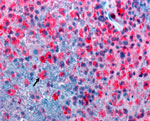
Figure. Acanthamoeba immunoassay from study of Acanthamoebaencephalitis and chronic lymphocytic leukemia, United States. Arrow indicates free-living amebic trophozoites of small to medium size that have rare double-walled cysts...
A 71-year-old man with CLL who was receiving ibrutinib sought care for fever, encephalopathy, and focal right-sided weakness. Neuroimaging showed a rapidly enlarging left frontal lesion with surrounding edema; test results for bacterial, viral, and parasitic pathogens were unremarkable (Appendix Table). Brain biopsy demonstrated necrosis, inflammation, and rare Periodic acid-Schiff–positive organisms (Figure). CDC testing confirmed Acanthamoeba infection. Despite initiation of azithromycin, sulfadiazine, flucytosine, fluconazole, and miltefosine, the patient died 23 days after symptom onset.
To further investigate the possible role of CLL in this patient’s course, we examined all US cases of Acanthamoeba infection reported to the CDC FLA database during 1956–2023 (Appendix). This activity was reviewed by CDC, deemed not research, and was conducted consistent with applicable federal law and CDC policy (see e.g., 45 C.F.R. part 46, 21 C.F.R. part 56; 42 U.S.C. §241(d); 5 U.S.C. §552a; 44 U.S.C. §3501 et seq.).
The mean age of diagnosis was 48 years for all case-patients with Acanthamoeba infection and 68 years in the CLL subgroup (Table). Among the 16 Acanthamoeba cases in CLL patients with known sex, 14 occurred in male patients and 2 in female patients, compared with 118 male patients and 173 female patients in cases without CLL. Fifty-six patients had >1 malignancy at the time of Acanthamoeba diagnosis: 16 had CLL alone, 1 had CLL and non-Hodgkin lymphoma, and 30 had >1 non-CLL hematologic malignancy (5 with acute lymphoblastic leukemia, 7 with acute myeloid leukemia, 2 with chronic myeloid leukemia, and 13 with lymphoma). Twelve had >1 nonhematologic malignancy.
Of 17 patients with CLL, 8 had central nervous system (CNS) involvement, including 3 with GAE alone and 5 with GAE and disseminated disease. In comparison, CNS involvement was seen among 24 of 31 with non-CLL hematologic malignancies and 11 out of 12 of those with non-hematologic malignancies. Nine of 17 CLL patients had non-CNS Acanthamoeba infections: 5 with cutaneous disease, 1 with rhinosinusitis, and 3 with non-CNS disseminated disease.
Of the 17 CLL cases, 8 survived, 3 died, and 6 had an unknown survival status. The 3 patients with CLL who died all had GAE, whereas 1 of 8 survivors had GAE. Among patients with a non-CLL malignancy and known survival outcome (n = 33), 2 patients survived and 31 died. Neither of the 2 non-CLL survivors had GAE; GAE was present in 28 of 31 non-CLL patients who died. Acanthamoeba infection in patients with CLL was associated with lower odds for death than non-CLL malignancies (odds ratio [OR] 0.03 [95% CI 0.003–0.18]; p<0.0001); that OR was likely a result of the lower frequency of GAE among CLL patients. GAE was associated with markedly greater odds of death in patients with any type of cancer (OR 68.6 [95% CI 9.0–2,075.9]; p<0.0001).
We investigated the frequency of CLL among patients with Acanthamoeba infection and its effect on survival. CLL was the most prevalent malignancy among patients with Acanthamoeba infection. Of note, a lower number of Acanthamoeba cases occurred in persons with hematologic malignancies that are generally associated with a higher risk for opportunistic infections, including acute myeloid leukemia and acute lymphoblastic leukemia. Those findings suggest that unique immune impairments in CLL might predispose to disease from Acanthamoeba. Potential mechanisms include hypogammaglobulinemia and neutropenia (10), which could potentially be mitigated by immunoglobulin replacement. Our case study demonstrated that, although GAE most often has a subacute clinical course, it can have a rapid onset and progression. In addition, we showed that CLL and ibrutinib exposure could be important risk factors for disease caused by Acanthamoeba.
The clinical course and mortality rate of nonkeratitis Acanthamoeba infections depend on the organ system involved. GAE has the highest mortality rate, exceeding 90%, whereas death from cutaneous Acanthamoeba infection or rhinosinusitis is less common (11). We found that patients with CLL had significantly higher odds of survival compared with patients who had other hematologic malignancies or solid tumors; that result was partially explained by the relatively high proportion of Acanthamoeba infections in CLL patients without CNS involvement. In our study, 53% of patients with CLL had non-CNS Acanthamoeba infections, whereas 30% of the overall cohort of patients had non-CNS Acanthamoeba infections (Table). Previous studies have reported lower mortality rates among those who did not have CNS involvement (2). The older age in the CLL group likely reflected the higher median age, 64 years, at CLL diagnosis (12). Patients with CLL are predominantly male (66%–69%) (12), which is similar to the overall sex distribution among Acanthamoeba cases in the FLA database.
Including the patient in our report, of the 18 reported patients with CLL, >4 patients have been treated with ibrutinib since it was introduced to the US market in 2012. Similar to our case, 2 other cases describe a more acute course, in which death occurred 4–14 days after the patients initially sought care at the hospital (13,14). That finding was unusual because GAE is typically considered a subacute to chronic form of encephalitis (2). Given the small number of cases reported, it is unclear whether the more acute clinical course can be attributed to CLL or immunosuppressive treatment. Further monitoring could determine whether ibrutinib may increase the risk for Acanthamoeba infection or death.
Our cross-sectional analysis of US disease surveillance data had limitations. For patients with a cancer diagnosis, detailed clinical and laboratory data, as well as treatment history and survival time, were not routinely collected in the CDC FLA database. In addition, information on the method of Acanthamoeba diagnosis, treatment, and time to death after diagnosis was not generally available. Last, the CDC FLA database includes Acanthamoeba cases from the United States only, which limited generalizability of our results.
Since 1956, a total of 18 Acanthamoeba infections have been identified in patients with CLL, including the case we reported here. CLL is the most common malignancy among patients with invasive Acanthamoeba infections. CLL patients with Acanthamoeba infections had lower rates than patients with other malignancies, which could be attributed to a greater likelihood of cutaneous disease and lower rates of CNS involvement. Further monitoring can elucidate the clinical factors and treatments mediating the association between CLL and Acanthamoeba infection.
Dr. Persico is a fourth-year neurology resident at Emory University School of Medicine and part of the editorial board for the journal Neurology: Resident and Fellow Section. His primary research interests include drug discovery and targeted therapies in neuro-oncology and complications of cancer and cancer therapies.
Acknowledgments
We express our gratitude to the patient’s family for their willingness to consent to share their medical case.
The authors received no financial support for the research, authorship, or publication of this article.
References
- Visvesvara GS, Moura H, Schuster FL. Pathogenic and opportunistic free-living amoebae: Acanthamoeba spp., Balamuthia mandrillaris, Naegleria fowleri, and Sappinia diploidea. FEMS Immunol Med Microbiol. 2007;50:1–26. DOIPubMedGoogle Scholar
- Haston JC, O’Laughlin K, Matteson K, Roy S, Qvarnstrom Y, Ali IKM, et al. The epidemiology and clinical features of non-keratitis Acanthamoeba infections in the United States, 1956–2020. Open Forum Infect Dis. 2023;10:
ofac682 . DOIPubMedGoogle Scholar - Fedele PL, Opat S. Chronic lymphocytic leukemia: time to care for the survivors. J Clin Oncol. 2024;42:2005–11. DOIPubMedGoogle Scholar
- Morrison VA. Management of infectious complications in patients with chronic lymphocytic leukemia. Hematology (Am Soc Hematol Educ Program). 2007;2007:332–8. DOIPubMedGoogle Scholar
- Molica S, Levato D, Levato L. Infections in chronic lymphocytic leukemia. Analysis of incidence as a function of length of follow-up. Haematologica. 1993;78:374–7.PubMedGoogle Scholar
- Cameron F, Sanford M. Ibrutinib: first global approval. Drugs. 2014;74:263–71. DOIPubMedGoogle Scholar
- Fiorcari S, Maffei R, Vallerini D, Scarfò L, Barozzi P, Maccaferri M, et al. BTK inhibition impairs the innate response against fungal infection in patients with chronic lymphocytic leukemia. Front Immunol. 2020;11:2158. DOIPubMedGoogle Scholar
- Stephens DM, Byrd JC. How I manage ibrutinib intolerance and complications in patients with chronic lymphocytic leukemia. Blood. 2019;133:1298–307. DOIPubMedGoogle Scholar
- Varughese T, Taur Y, Cohen N, Palomba ML, Seo SK, Hohl TM, et al. Serious infections in patients receiving ibrutinib for treatment of lymphoid cancer. Clin Infect Dis. 2018;67:687–92. DOIPubMedGoogle Scholar
- Bloch KC, Schuster FL. Inability to make a premortem diagnosis of Acanthamoeba species infection in a patient with fatal granulomatous amebic encephalitis. J Clin Microbiol. 2005;43:3003–6. DOIPubMedGoogle Scholar
- Siddiqui R, Khan NA. Biology and pathogenesis of Acanthamoeba. Parasit Vectors. 2012;5:6. DOIPubMedGoogle Scholar
- Shanafelt TD, Rabe KG, Kay NE, Zent CS, Jelinek DF, Reinalda MS, et al. Age at diagnosis and the utility of prognostic testing in patients with chronic lymphocytic leukemia. Cancer. 2010;116:4777–87. DOIPubMedGoogle Scholar
- Crothers JW, Hsu L, Marty FM. Fulminant Acanthamoeba castellanii encephalitis in an ibrutinib-treated patient. Open Forum Infect Dis. 2020;7:
ofaa025 . DOIPubMedGoogle Scholar - Voshtina E, Huang H, Raj R, Atallah E. Amebic encephalitis in a patient with chronic lymphocytic leukemia on ibrutinib therapy. Case Rep Hematol. 2018;2018:
6514604 . DOIPubMedGoogle Scholar
Figure
Table
Cite This ArticleOriginal Publication Date: August 18, 2026
Table of Contents – Volume 32, Number 9—September 2026
| EID Search Options |
|---|
 Advanced Article Search – Search articles by author and/or keyword.
|
 Articles by Country Search – Search articles by the topic country.
|
 Article Type Search – Search articles by article type and issue.
|
Please use the form below to submit correspondence to the authors or contact them at the following address:
Michele Persico, Emory University, 12 Executive Park Dr NE, 5th Fl, Atlanta, GA, 30329, USA
Top