Volume 32, Number 9—September 2026
Research Letter
Powassan Virus in Ixodes scapularis Tick Populations, Illinois, USA, 2025
Aurora Marguccio, Lance E. Jones, Brian Wilm, Arif Ciloglu, Valeria Trivellone, Millon Blackshear, Tomas Rodriguez, April Holmes, Samantha Kerr, Chang-Hyun Kim, and Chris M. Stone
Figure 2
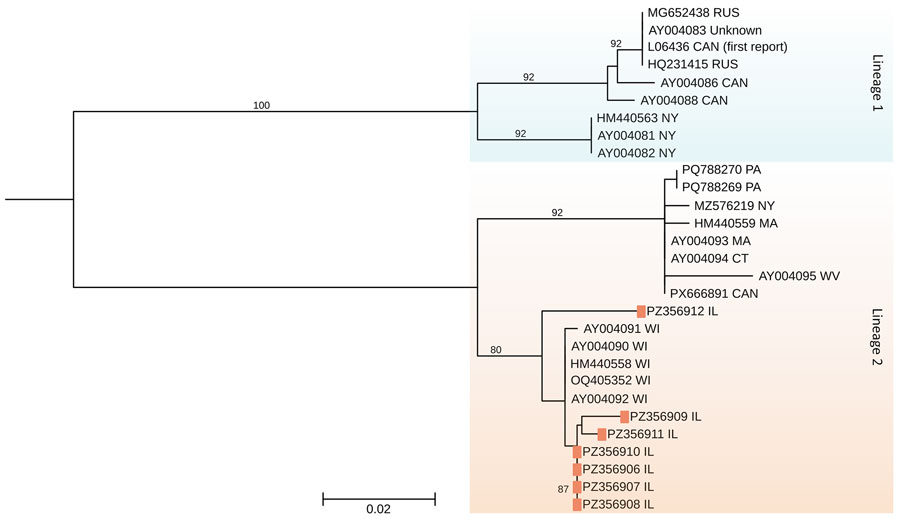
Figure 2. Maximum-likelihood phylogenetic tree of Powassan 3′ untranslated region created for study of Powassan virus in Ixodes scapularis tick populations, Illinois, USA, 2025. Branch lengths estimated using Hasegawa-Kishino-Yano substitution model with a gamma-distributed rate variation across 4 site categories. Bootstrap values >80% (1,000 replicates) are shown. Orange squares indicate samples from this study, clustering within lineage II together with samples previously detected in Wisconsin, USA. CAN, Canada; RUS, Russia.
Page created: July 21, 2026
Page updated: August 26, 2026
Page reviewed: August 26, 2026
The conclusions, findings, and opinions expressed by authors contributing to this journal do not necessarily reflect the official position of the U.S. Department of Health and Human Services, the Public Health Service, the Centers for Disease Control and Prevention, or the authors' affiliated institutions. Use of trade names is for identification only and does not imply endorsement by any of the groups named above.