Volume 32, Number 9—September 2026
Research Letter
Powassan Virus in Ixodes scapularis Tick Populations, Illinois, USA, 2025


Cite This Article
Citation for Media
Abstract
Powassan virus is a tickborne flavivirus that can cause severe encephalitis in humans. After the first known human case in Illinois, USA, we detected Powassan virus in adult Ixodes scapularis ticks collected from 2 sites in northern Illinois during 2025. Phylogenetic analysis confirmed the virus as Powassan virus lineage II.
Powassan virus (POWV; Flaviviridae: Orthoflavivirus) is a member of the tick-borne encephalitis serocomplex of flaviviruses and, although rare, poses a serious public health risk. Common symptoms include encephalitis and meningitis. Infection often results in considerable sequelae and, in ≈10% of cases, can be fatal (1). Reports have documented the distribution of POWV in the United States through case reports and studies of ticks and vertebrate hosts (1–3). US regions with cases of recorded POWV include those in the mid-Atlantic, Northeast, and Midwest, and the past decade has seen a consistent rise in human cases (4).
POWV consists of 2 clinically indistinguishable lineages: lineage I (POWV prototype) and lineage II (deer tick virus [DTV]) (5,6). Lineage I is maintained predominantly in an enzootic cycle involving Ixodes cookei ticks and woodchucks (Marmota monax), whereas lineage II is maintained in a cycle involving Ixodes scapularis ticks and white-footed mice (Peromyscus leucopus) (1). The first case of POWV in Illinois occurred in 2025, involving a resident from Tazewell County, although exposure may have occurred out of state (7). In response, we expanded our tick surveillance to assess the presence and distribution of POWV in I. scapularis tick populations in central and northwestern counties in Illinois and determine the phylogenetic lineages of detected strains.
Figure 1
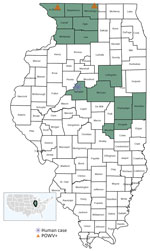
Figure 1. Geographic information from study of Powassan virus (POWV) in Ixodes scapularis tick populations, Illinois, USA, 2025. Green shading shows counties in Illinois where I. scapularistick active...
We performed tick drags during October and November 2025 in 14 Illinois counties (Figure 1). We selected outdoor recreational areas containing woodland habitats as sampling locations. Within each county, 1 or 2 sites were visited 1–3 times, with at least five 150-m transects per visit. We used a 1-m2 white cloth drag attached to a wooden dowel for collection, according to previously established methods (8), and placed ticks in vials containing 85% ethanol. We sampled a total of 21 sites across 14 counties for I. scapularis ticks. We identified ticks according to species, life stage, and sex by light microscopy and then placed them in RNAlater solution (Thermo Fisher Scientific, https://www.thermofisher.com) and stored at −80°C until processing.
We extracted nucleic acids individually from ticks using the MagMAX Viral/Pathogen Ultra Nucleic Acid Isolation kit (Thermo Fisher Scientific) after crushing each specimen on liquid nitrogen. We screened extracts for POWV RNA presence by quantitative reverse transcription PCR (qRT-PCR) using an existing primer and probe set (9). We then reverse transcribed the extracts of qRT-PCR–positive samples (quantification cycle values <37) using the PrimeScript 1st strand cDNA Synthesis Kit (Takara Bio USA, https://www.takarabio.com) and amplified using an existing primer set (5). We slightly modified the reverse primer (5′-AGCGGGTGTTT TTCCGAGTCACWCA-3′) to detect both POWV lineage I and lineage II. When direct PCR failed, we ran a nested PCR using nested primer pairs POWVUTR-NestSeqF (5′-AGCATGACTGAACAGTCAAAAGA-3′) and POWVUTR-NestSeqR (5′-TTGTCAGGCTATCTGTGCC-3′). Amplicons were Sanger sequenced at the University of Illinois Urbana-Champaign Roy J. Carver Biotechnology Center (Champaign, Illinois, USA). We queried consensus sequences ranging 446–519 bp against the National Center for Biotechnology Information BLAST search tool (https://blast.ncbi.nlm.nih.gov). We considered only samples confirmed by both qRT-PCR and sequencing to be positive.
We generated sequence alignments using MAFFT (https://mafft.cbrc.jp/alignment/software) and a maximum-likelihood phylogenetic tree using IQ-TREE software (https://iqtree.github.io) with 1,000 bootstrap replicates for branch support. Phylogenetic reconstruction incorporated reference strains from various US states and localities in Canada and Russia (Appendix Table 1).
Figure 2
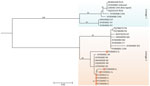
Figure 2. Maximum-likelihood phylogenetic tree of Powassan 3′ untranslated region created for study of Powassan virus in Ixodes scapularistick populations, Illinois, USA, 2025. Branch lengths estimated using Hasegawa-Kishino-Yano substitution model...
All collected ticks were adult I. scapularis, with the exception of a single I. scapularis nymph and a single Dermacentor albipictus male tick. We established density data for the female ticks collected (Appendix Table 2). We detected POWV in I. scapularis adults at single sites in Jo Daviess and Winnebago counties. The ticks determined to be positive for POWV (confirmed by sequencing) included 1 female and 2 male ticks from Winnebago collected on October 23, two male ticks from the same site collected on October 31, and 2 male ticks collected from a site in Jo Daviess on October 30. The prevalence of infection for adult I. scapularis ticks was 0.059 (Wilson CI 0.025–0.13) in Winnebago and 0.064 (Wilson CI 0.018–0.207) in Jo Daviess. POWV lineage I and lineage II reference strains were recovered as monophyletic clades (Figure 2), and the Illinois field samples clustered within lineage II. Within the DTV branch, we detected a cluster consisting of primarily northeastern United States samples, whereas Illinois samples clustered together with Wisconsin sequences.
Finding POWV-positive I. scapularis ticks in Illinois has relevance for healthcare providers, who may need to consider POWV exposure in establishing diagnoses, and also for health officials in crafting public health messaging to include such information as duration of tick attachment required for POWV transmission (9). The locations where we detected POWV-positive ticks were close to the Wisconsin border, where foci of POWV have previously been described (1). Of note, the prevalence in the positive counties was higher than that reported from a stable focus in Wisconsin, where the prevalence was 1.3% (10). An important question we pondered is whether POWV has been present, undetected, in Illinois for longer than the recent emergence our findings suggest. Increased surveillance and genomic analysis may elucidate POWV prevalence and phylogeographic history in this area of ongoing I. scapularis tick expansion.
Ms. Marguccio is a laboratory technician at the University of Illinois Urbana-Champaign. Her research interests include the evolutionary relationships among arboviruses and how human activity shapes patterns of disease ecology.
Acknowledgment
Our investigation was supported through an agreement with the Illinois Department of Public Health. Points of view or opinions expressed in this document are those of the authors and do not necessarily represent the official position or policies of the Illinois Department of Public Health. The Illinois Natural History Survey Medical Entomology Lab (Prairie Research Institute) is additionally supported through the State of Illinois Used Tire Management and Emergency Public Health Funds.
References
- Ebel GD. Update on Powassan virus: emergence of a North American tick-borne flavivirus. Annu Rev Entomol. 2010;55:95–110. DOIPubMedGoogle Scholar
- Khan M, Beckham JD, Piquet AL, Tyler KL, Pastula DM. An overview of Powassan virus disease. Neurohospitalist. 2019;9:181–2. DOIPubMedGoogle Scholar
- Hermance ME, Thangamani S. Powassan virus: an emerging arbovirus of public health concern in North America. Vector Borne Zoonotic Dis. 2017;17:453–62. DOIPubMedGoogle Scholar
- Centers for Disease Control and Prevention. 2025. Powassan virus—historic data (2004–2024) [cited 2026 Jun 3]. https://www.cdc.gov/powassan/data-maps/historic-data.html
- Ebel GD, Spielman A, Telford SR. Phylogeny of North American Powassan virus. J Gen Virol. 2001;82:1657–65. DOIPubMedGoogle Scholar
- Beasley DWC, Suderman MT, Holbrook MR, Barrett ADT. Nucleotide sequencing and serological evidence that the recently recognized deer tick virus is a genotype of Powassan virus. Virus Res. 2001;79:81–9. DOIPubMedGoogle Scholar
- Illinois Department of Public Health. IDPH reminds Illinois residents to take precautions against tick bites. 2025 [cited 2026 Jun 3]. https://dph.illinois.gov/resource-center/news/2025/september/release-20250922.html
- Tuten HC, Burkhalter KL, Noel KR, Hernandez EJ, Yates S, Wojnowski K, et al. Heartland virus in humans and ticks, Illinois, USA, 2018–2019. Emerg Infect Dis. 2020;26:1548–52. DOIPubMedGoogle Scholar
- Ebel GD, Kramer LD. Short report: duration of tick attachment required for transmission of Powassan virus by deer ticks. Am J Trop Med Hyg. 2004;71:268–71. DOIPubMedGoogle Scholar
- Brackney DE, Nofchissey RA, Fitzpatrick KA, Brown IK, Ebel GD. Stable prevalence of Powassan virus in Ixodes scapularis in a northern Wisconsin focus. Am J Trop Med Hyg. 2008;79:971–3. DOIPubMedGoogle Scholar
Figures
Cite This ArticleTable of Contents – Volume 32, Number 9—September 2026
| EID Search Options |
|---|
 Advanced Article Search – Search articles by author and/or keyword.
|
 Articles by Country Search – Search articles by the topic country.
|
 Article Type Search – Search articles by article type and issue.
|
Please use the form below to submit correspondence to the authors or contact them at the following address:
Chris M. Stone, Illinois Natural History Survey, Prairie Research Institute, University of Illinois Urbana-Champaign, 1816 South Oak St, Champaign IL 61820, USA
Top