Volume 20, Number 12—December 2014
Dispatch
Molecular Epidemiology of Influenza A(H1N1)pdm09 Virus among Humans and Swine, Sri Lanka


Cite This Article
Citation for Media
Abstract
After multiple discrete introductions of influenza A(H1N1)pdm09 virus into Sri Lanka, the virus was transmitted among humans, then swine. The spread of virus between geographically distant swine farms is consistent with virus dispersal associated with a vehicle used for swine transportation, although this remains unproven.
The first known transmission of influenza A(H1N1)pdm09 virus to humans from swine was in 2009. As the virus spread among humans worldwide, it was transmitted from humans to swine repeatedly (1), changing the global genetic landscape of swine influenza viruses. We previously reported the spillover of H1N1pdm from humans to swine and absence of North American triple reassortant, classical, and European avian-like swine viruses in swine herds in Sri Lanka during August 2009–May 2012 (2). Here, we extend these studies through August 2013 with the analysis of paired nasal and tracheal swab samples collected from 4,683 animals and serum samples from 3,351 animals (Technical Appendix Table 1) and comprehensively analyze full genomes of viruses isolated from samples from 26 swine (11 isolated in 2009, 4 in 2010, and 11 in 2011) and 35 humans (6 isolated in 2009, 17 in 2010, 9 in 2011, and 3 in 2012) and 2 publicly available hemagglutinin sequences of human H1N1pdm viruses from Sri Lanka. Sequences generated in this study are available in GenBank (KJ856002–KJ856446).
To understand the molecular epidemiology and spatial and temporal dynamics of spillover events, we compared our data with full-genome sequences of H1N1pdm available in public databases as of August 28, 2013. These include all available full genome sequences from swine H1N1pdm viruses (n = 82), all human H1N1pdm viruses from outside of the USA (n = 957), and 100 randomly selected full genome sequences from 1,500 human H1N1pdm sequences from the United States. Reassorted swine or human viruses containing H1N1pdm virus genes were excluded from this analysis. Our final dataset included the full genomes of 35 human and 26 swine samples from Sri Lanka and a global sample of 1,057 human and 82 swine virus sequences.
The single breakpoint recombination and genetic algorithm for recombination detection methods (3) excluded the presence of reassortants in our dataset; hence, we used concatenated genomes of 8 gene segments for all subsequent analyses. We conducted multiple-sequence alignment using MUSCLE (4) and optimized the sum of all of the pairs of characters manually. Phylogenetic trees and bootstrap supports were estimated by using the GTR+I+I" nucleotide substitution model as identified by using JModeltest (5) and the maximum likelihood method in RaXML (6). We inferred dates of introduction of major Sri Lankan human and swine lineages using the relaxed clock method under a Bayesian Markov chain Monte Carlo approach (BEAST v1.7) (7).
Figure 1
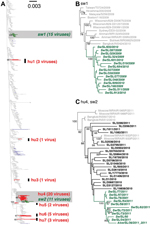
Figure 1. Phylogenetic relationships of influenza A H1N1pdm viruses isolated from human and swine during 2009–2012 in Sri Lanka. (A) Maximum likelihood tree generated from a concatenated dataset of 8 gene segment sequences...
Figure 2

Figure 2. Phylogeny and divergence times of the concatenated whole genome of 2 swine pandemic influenza A(H1N1) (H1N1pdm) virus clusters (sw 1 and 2) detected in Sri Lanka (A,B) and distribution of swine...
Figure 1 illustrates independent introductions of at least 8 H1N1pdm sublineages into Sri Lanka during 2009–2012. Six of these were exclusively detected in humans: hu1 (2009), hu2 (2009), hu3 (2009), hu5 (2010/11), hu6 (2011), and hu7 (2011). One was exclusively from swine (sw1; 2009/10) and 1 sublineage was detected in both humans (hu4; 2011) and swine (sw2; 2011) (Figures 1, 2). Similar multiple discrete introductions of human H1N1pdm viruses have been reported in the United Kingdom and India (8,9).
In Sri Lanka, swine H1N1pdm clusters sw1 (2009/10) and sw2 (2011) were genetically distinct from each other and from other swine viruses isolated globally, indicating 2 separate introductions to local swine that circulated among swine for 11 and 4 months, respectively, for each cluster. The sw1 and sw2 lineages did not appear to establish long-term sustained transmission within pigs. However, the reduced surveillance of farms during the period 2012–2013 (Technical Appendix Table 1) means that this conclusion has to be qualified in regard to the sw2 lineage. We did not identify ancestors of sw1 in Sri Lanka, however sw2 appears to have been directly derived from hu4, which included the majority of the human viruses (20/35) sequenced from Sri Lanka. The lack of identification of a human ancestor for sw1 may be related to insufficient human influenza genomic data obtained from Sri Lanka during 2009–2010 (Figures 1, 2). Although the 11 sw2 viruses were isolated from pigs on farms A, C, and G, which were separated by >25 km from each other (Table, Figure 2), they form a monophyletic clade with no human isolates within this cluster. Even though the paucity of human viruses sampled is a limitation in this study, the data suggest a single introduction of human viruses into swine followed by transmission within and between swine farms for >4 months (Figure 2).
To clarify transmission patterns between affected swine farms in Sri Lanka, we obtained contact patterns by interviewing pig farmers using a structured questionnaire (Technical Appendix) with approval from the Ethics Review Committee, Faculty of Medicine, Ragama, Sri Lanka. There was no evidence of movement of persons or fomites between farms. However, during the peak demand period (November–December) of each year that surveillance was performed, a common truck owned by farm M (Table), driven by a single driver and an assistant, provided transportation from multiple farms to the abattoir, including from affected farms A, C, and G (Table). On some occasions, animals taken to the abattoir for slaughter were returned to the farm. Pools of water or body fluids were often noted within this truck, and it is possible that viable swine influenza viruses may have survived for varying periods. We did not test these fluids from the common transportation truck for influenza viruses; this is also a limitation of the study.
Of the 15 farms on which the common truck was used, swine on 3 (20%) were infected by a sw2 clade virus; on 2 farms on which the common truck was not used, no swine were infected. This association was not statistically significant (p = 1.0), however, given the small numbers of farms investigated. Our findings are consistent with dispersal of sw2 clade viruses in association with the truck to infect multiple farms that were geographically distant, but this remains unproven. It was previously documented that influenza viruses can remain viable for prolonged periods of time in water at a temperature of ≈28°C (comparable ambient temperature in the Western Province, Sri Lanka) (10) and are reported to survive longer periods on nonporous surfaces (11). Influenza virus has been detected in air samples from rooms of experimentally infected pigs (12) and in the exhaust air samples collected up to 1 mile away from the index farm (13), indicating the possibility of aerosol transmission for some distance. Notably, studies of the swine populations in the United States have demonstrated spatial dissemination of swine influenza viruses of human origin to match long-distance swine movements (14).
Despite widespread inter-farm transmission of sw1 and sw2, our results show that only animals on farm C were infected in both spillover events. Farms A and G, on which swine were infected by sw2 in 2011, appeared not to have had infected swine during 2009–2010, as shown by both virus isolation and serologic testing (Technical Appendix Table 1). Maternally derived antibodies transferred through colostrum from dams infected during 2009–2011 may have provided passive protection to offspring born in 2010–2011. On swine farms in Sri Lanka, female swine are used for breeding for ≈2–3 years. In experimental challenge, maternally derived antibodies provided some protection against disease, but not complete protection from infection (15).
This study demonstrates natural independent spillover events of H1N1pdm influenza viruses from humans to swine. H1N1pdm viruses appear to be spread by multiple, discrete introductions to swine, after which clonal expansion occurs within the swine. The spread of such virus lineages across multiple farms is consistent with virus dispersal by breaches of external biosecurity measures, including the manner of swine transportation, although this remains unproven given the small sample size. Unlike classical swine influenza, North American triple reassortant, and European avian swine viruses that have persistently circulated among swine for several decades in other countries (15), H1N1pdm does not appear to establish long-term lineages in swine in the absence of further reassortment. This observation requires confirmation in other geographic settings.
Dr Perera, formerly a postdoctoral research assistant in the School of Public Health, The University of Hong Kong, is senior lecturer in Department of Medical Microbiology at University of Kelaniya, Sri Lanka. His research focuses on the ecology and evolution of influenza viruses and emerging viral infections.
Acknowledgments
We acknowledge the excellent technical assistance of T.Y Lung, G.D.W.S. Gunathilaka and Preethimala Liyanage.
This research was supported by contracts HHSN266200700005C and HHSN272201400006C from the National Institute of Allergy and Infectious Disease, National Institutes of Health, Department of Health and Human Services, USA; an Area of Excellence Scheme of the University Grants Committee [AoE/M-12/06] of the Hong Kong Special Administrative Region Government; PhD studentship from The University of Hong Kong, Ministry of Education Academic Research Fund grant (MOE2011-T2-2-049); the Duke-NUS Signature Research Program, Agency of Science, Technology and Research, Singapore, the Ministry of Health, Singapore; and the Melbourne WHO Collaborating Centre for Reference and Research on Influenza, Department of Health, Australia.
References
- Vijaykrishna D, Poon LL, Zhu HC, Ma SK, Li OT, Cheung CL, Reassortment of pandemic H1N1/2009 influenza A virus in swine. Science. 2010;328:1529. DOIPubMedGoogle Scholar
- Perera HK, Wickramasinghe G, Cheung CL, Nishiura H, Smith DK, Poon LL, Swine influenza in Sri Lanka. Emerg Infect Dis. 2013;19:481–4. DOIPubMedGoogle Scholar
- Pond SLK, Frost SDW, Muse SV. HyPhy: hypothesis testing using phylogenies. Bioinformatics. 2005;21:676–9. DOIPubMedGoogle Scholar
- Edgar RC. MUSCLE: A multiple sequence alignment method with reduced time and space complexity. BMC Bioinformatics. 2004;5:113. DOIPubMedGoogle Scholar
- Posada D. jModelTest: phylogenetic model averaging. Mol Biol Evol. 2008;25:1253–6. DOIPubMedGoogle Scholar
- Stamatakis A. RAxML-VI-HPC: maximum likelihood-based phylogenetic analyses with thousands of taxa and mixed models. Bioinformatics. 2006;22:2688–90. DOIPubMedGoogle Scholar
- Drummond AJ, Suchard MA, Xie D, Rambaut A. Bayesian phylogenetics with BEAUti and the BEAST 1.7. Mol Biol Evol. 2012;29:1969–73. DOIPubMedGoogle Scholar
- Baillie GJ, Galiano M, Agapow PM, Myers R, Chiam R, Gall A, Evolutionary dynamics of local pandemic H1N1/2009 influenza virus lineages revealed by whole-genome analysis. J Virol. 2012;86:11–8. DOIPubMedGoogle Scholar
- Sharma S, Joshi G, Dash PK, Thomas M, Athmaram TN, Kumar JS, Molecular epidemiology and complete genome characterization of H1N1pdm virus from India. PLoS ONE. 2013;8:e56364. DOIPubMedGoogle Scholar
- Stallknecht DE, Kearney MT, Shane SM, Zwank PJ. Effects of pH, temperature, and salinity on persistence of avian influenza viruses in water. Avian Dis. 1990;34:412–8. DOIPubMedGoogle Scholar
- Bean B, Moore BM, Sterner B, Peterson LR, Gerding DN, Balfour HH Jr. Survival of influenza viruses on environmental surfaces. J Infect Dis. 1982;146:47–51. DOIPubMedGoogle Scholar
- . Corzo CA, Romagosa A, Dee S, Gramer M, Morrison RB, Torremorell M. Relationship between airborne detection of influenza A virus and the number of infected. Vet J. 2013;196:171–175.DOIPubMedGoogle Scholar
- Torremorell M, Allerson M, Corzo C, Diaz A, Gramer M. Transmission of Influenza A Virus in Pigs. Transbound Emerg Dis. 2012;59(Suppls1):68–84. DOIPubMedGoogle Scholar
- Nelson MI, Lemey P, Tan Y, Vincent A, Lam TT, Detmer S, Spatial dynamics of human-origin H1 influenza A virus in North American swine. PLoS Pathog. 2011;7:e1002077. DOIPubMedGoogle Scholar
- Loeffen WL, Heinen PP, Bianchi AT, Hunneman WA, Verheijden JH. Effect of maternally derived antibodies on the clinical signs and immune response in pigs after primary and secondary infection with an influenza H1N1 virus. Vet Immunol Immunopathol. 2003;92:23–35. DOIPubMedGoogle Scholar
Figures
Table
Cite This ArticleTable of Contents – Volume 20, Number 12—December 2014
| EID Search Options |
|---|
 Advanced Article Search – Search articles by author and/or keyword.
|
 Articles by Country Search – Search articles by the topic country.
|
 Article Type Search – Search articles by article type and issue.
|
Please use the form below to submit correspondence to the authors or contact them at the following address:
Malik Peiris, School of Public Health, 21, Sassoon Road, University of Hong Kong, Pokfulam, Hong Kong, China
Top