Volume 32, Number 1—January 2026
Dispatch
Presence or Emergence of Canine Leishmaniasis, Malawi
Boniface Chikufenji, Kyoko Hayashida , Yasuyuki Goto, Tatsuki Sugi, Chizu Sanjoba, Chrispin Njala, Inga McDermott, Frederic Lohr, Dagmar Mayer, Shohei Ogata, Masahiro Kajihara, Naganori Nao, Ryo Nakao, Laston Chimaliro, Donales Kapira, Janelisa Musaya, Junya Yamagishi, and Elisha Chatanga
, Yasuyuki Goto, Tatsuki Sugi, Chizu Sanjoba, Chrispin Njala, Inga McDermott, Frederic Lohr, Dagmar Mayer, Shohei Ogata, Masahiro Kajihara, Naganori Nao, Ryo Nakao, Laston Chimaliro, Donales Kapira, Janelisa Musaya, Junya Yamagishi, and Elisha Chatanga
Figure 1
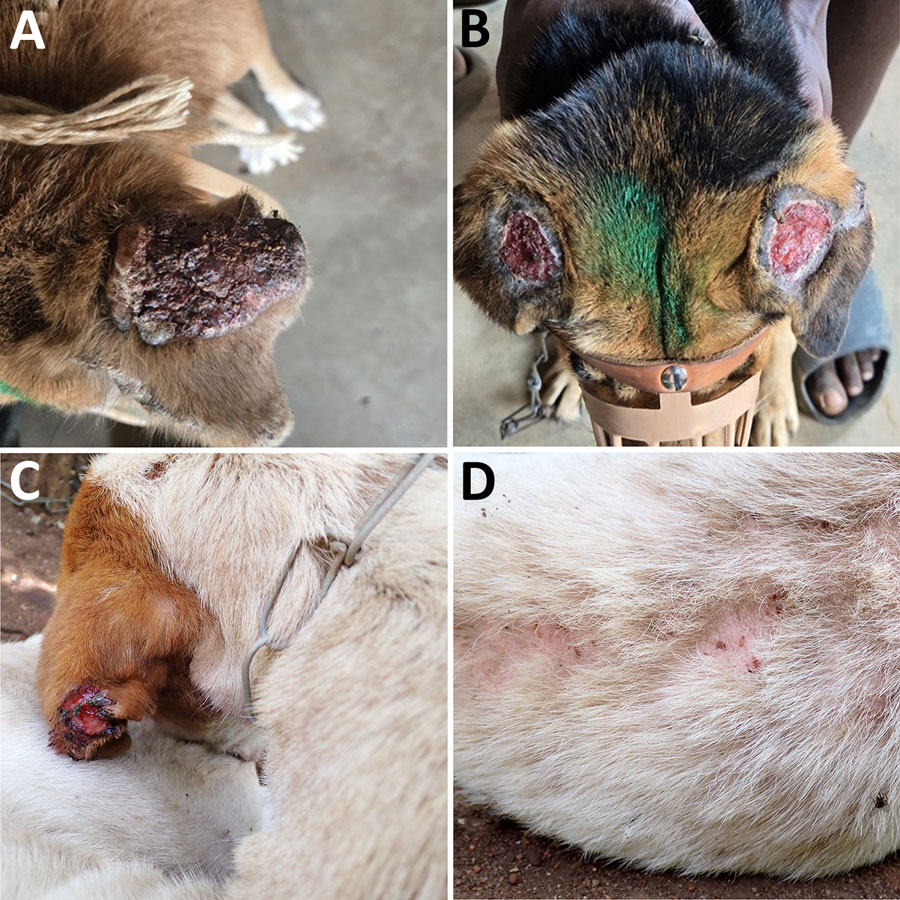
Figure 1. Clinical manifestations of Leishmania infantum‒infected dogs in Mchinji, Nkhotakota, and Zomba districts in a study of canine leishmaniasis, Malawi. A) Severely crusted, thickened dark surface pinna (24MWD_C073). B) Bilateral ulcerative lesions on the ears with an exposed tissue (24MWD_C110). C, D) Unilateral ulcerative lesions on the ears and alopecia with severe thinning of the fur (24MWD_C040).
Page created: December 31, 2025
Page updated: January 29, 2026
Page reviewed: January 29, 2026
The conclusions, findings, and opinions expressed by authors contributing to this journal do not necessarily reflect the official position of the U.S. Department of Health and Human Services, the Public Health Service, the Centers for Disease Control and Prevention, or the authors' affiliated institutions. Use of trade names is for identification only and does not imply endorsement by any of the groups named above.