Disclaimer: Early release articles are not considered as final versions. Any changes will be reflected in the online version in the month the article is officially released.
Volume 32, Number 10—October 2026
Research Letter
Cocirculation of Human Monkeypox Virus Clade 1b with Varicella Zoster Virus, Uganda
 , Alfred Ssekagiri, Hamidah S. Namagembe, Stella E. Nabirye, Ronald Kiiza, Danstan Kabuuka, Stephen Balinandi, Tom Lutalo, John Kayiwa, Henry Kyobe Bosa, Robert Downing, Michael G. Berg, Mary A. Rodgers, Gavin A. Cloherty, Pontiano Kaleebu, and Deogratius Ssemwanga
Figure 1
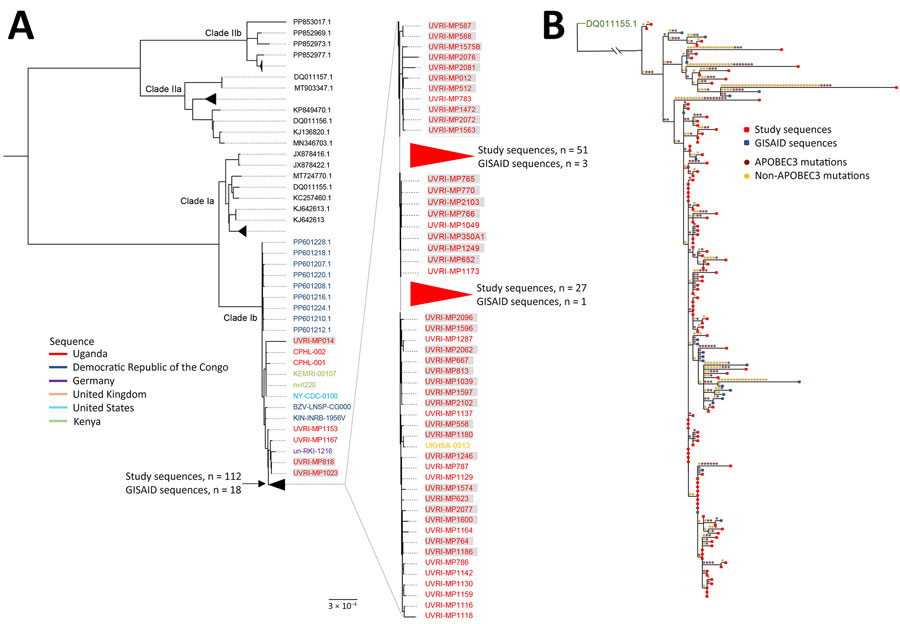
Figure 1. Phylogenetic and mutational characterization of Uganda monkeypox virus (MPXV) strains in study of cocirculation of human MPXV clade 1b with varicella-zoster virus, Uganda. A) Maximum-likelihood phylogenetic tree of MPXV sequences generated with 1,000 bootstrap resampling. Tree includes 115 new sequences from Uganda (highlighted with a gray rectangular background) and 37 clade 1B reference sequences retrieved from GenBank and GISAID (https://www.gisaid.org) (accession numbers provided). Highly similar sequences have been collapsed (denoted by triangle). Scale bar indicates number of nucleotide substitutions per site. B) New (n = 115; red squares) and previously reported (n = 22; blue squares) Uganda sequences were aligned, and Squirrel software was used to infer the maximum-likelihood phylogeny and map APOBEC (brown circle) and non-APOBEC (yellow circle) mutation events. The number of unique mutations from this study and shared mutations distinct from the DQ011155.1 clade I archetype are listed.