Skip directly to site content Skip directly to page options Skip directly to A-Z link Skip directly to A-Z link Skip directly to A-Z link

Disclaimer: Early release articles are not considered as final versions. Any changes will be reflected in the online version in the month the article is officially released.

Volume 32, Number 10—October 2026

Research Letter

Cocirculation of Human Monkeypox Virus Clade 1b with Varicella Zoster Virus, Uganda

Nicholas BbosaComments to Author , Alfred Ssekagiri, Hamidah S. Namagembe, Stella E. Nabirye, Ronald Kiiza, Danstan Kabuuka, Stephen Balinandi, Tom Lutalo, John Kayiwa, Henry Kyobe Bosa, Robert Downing, Michael G. Berg, Mary A. Rodgers, Gavin A. Cloherty, Pontiano Kaleebu, and Deogratius Ssemwanga
Author affiliation: Uganda Virus Research Institute, Entebbe, Uganda (N. Bbosa, A. Ssekagiri, S.E. Nabirye, D. Kabuuka, S. Balinandi, T. Lutalo, J. Kayiwa, R. Downing, P. Kaleebu, D. Ssemwanga); Medical Research Council/Uganda Virus Research Institute and London School of Hygiene and Tropical Medicine Uganda Research Unit, Entebbe (N. Bbosa, H.S. Namagembe, R. Kiiza, P. Kaleebu, D. Ssemwanga); Abbott Pandemic Defense Coalition, Abbott Park, Illinois, USA (N. Bbosa, M.G. Berg, M.A. Rodgers, G.A. Cloherty); Uganda Ministry of Health, Kampala, Uganda (H.K. Bosa); Uganda People’s Defence Forces, Kampala (H.K. Bosa); Makerere University Lung Institute, Kampala (H.K. Bosa); Abbott Diagnostics, Abbott Park (M.G. Berg, M.A. Rodgers, G.A. Cloherty)

Main Article

Figure 2

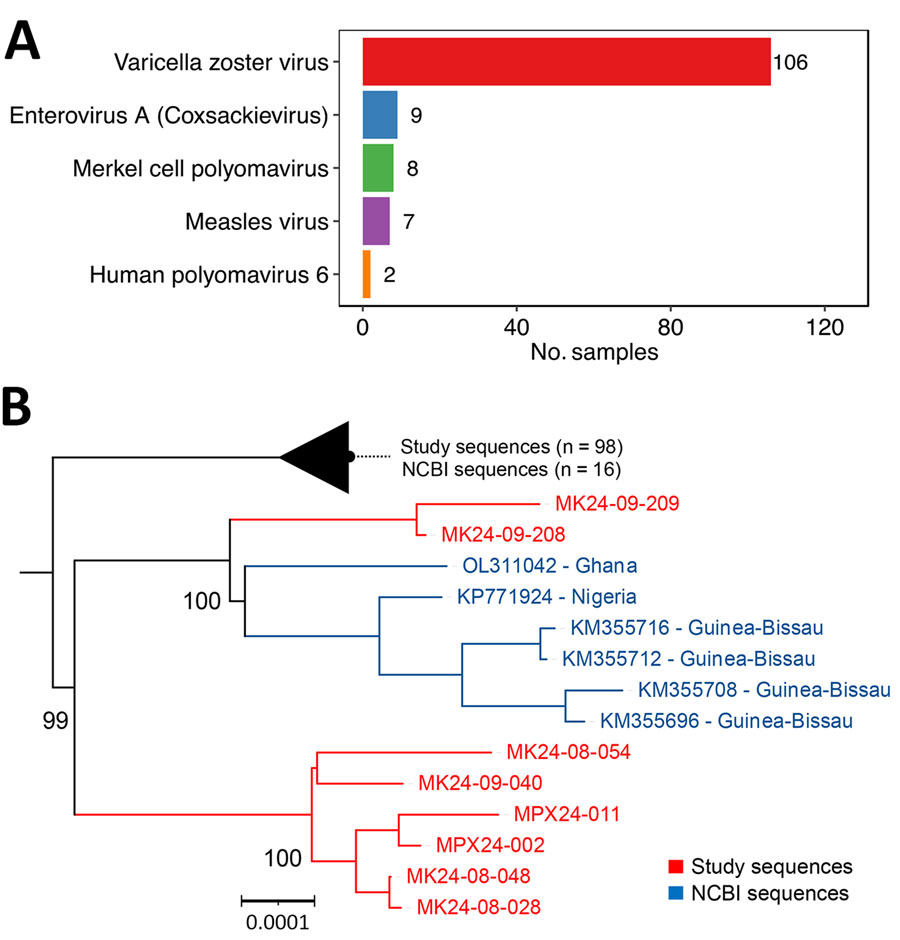
Distribution of viral pathogens and phylogenetic analysis in study of cocirculation of human monkeypox virus clade 1b with varicella-zoster virus, Uganda. A) Viral pathogens detected in monkeypox virus–negative samples by metagenomic next-generation sequencing. Bar plot shows the number of samples in which viruses were identified with a genome coverage >80%. B) Maximum-likelihood phylogenetic tree of varicella-zoster virus sequences. The tree includes 106 high-coverage genome sequences (>80% genome coverage) generated in this study and other publicly available complete genomes from NCBI (accession numbers provided). Most sequences have been collapsed into the triangle at the top, which contains 98 varicella zoster virus sequences generated in this study and 16 publicly available Uganda genomes, together forming a single well-supported clade. Sequences shown individually are those resolving outside that clade: 8 study sequences from Uganda (red), which form 2 distinct lineages, and the 6 publicly available genomes from Ghana, Nigeria and Guinea-Bissau (blue) that are their closest relatives. NCBI, National Center for Biotechnology Information.

Figure 2. Distribution of viral pathogens and phylogenetic analysis in study of cocirculation of human monkeypox virus clade 1b with varicella-zoster virus, Uganda. A) Viral pathogens detected in monkeypox virus–negative samples by metagenomic next-generation sequencing. Bar plot shows the number of samples in which viruses were identified with a genome coverage >80%. B) Maximum-likelihood phylogenetic tree of varicella-zoster virus sequences. The tree includes 106 high-coverage genome sequences (>80% genome coverage) generated in this study and other publicly available complete genomes from NCBI (accession numbers provided). Most sequences have been collapsed into the triangle at the top, which contains 98 varicella zoster virus sequences generated in this study and 16 publicly available Uganda genomes, together forming a single well-supported clade. Sequences shown individually are those resolving outside that clade: 8 study sequences from Uganda (red), which form 2 distinct lineages, and the 6 publicly available genomes from Ghana, Nigeria and Guinea-Bissau (blue) that are their closest relatives. NCBI, National Center for Biotechnology Information.

Main Article

Page created: August 13, 2026
Page updated: September 21, 2026
Page reviewed: September 21, 2026
The conclusions, findings, and opinions expressed by authors contributing to this journal do not necessarily reflect the official position of the U.S. Department of Health and Human Services, the Public Health Service, the Centers for Disease Control and Prevention, or the authors' affiliated institutions. Use of trade names is for identification only and does not imply endorsement by any of the groups named above.
file_external