Volume 32, Number 10—October 2026
Dispatch
Emergence of Macrolide-Resistant Bordetella pertussis, Peru, 2025
Eduardo Juscamayta-López , Faviola Valdivia, Carmen Rodríguez-Cueva, Helen Horna, Yaneth Quispe, María Pía Soto, Segundo Torres, Victor Fiestas Solórzano, Martin Yagui, Vlademir Vicente Cantarelli, Efrain Montilla-Escudero, Víctor Silva, and Ana Raquel Da Costa
, Faviola Valdivia, Carmen Rodríguez-Cueva, Helen Horna, Yaneth Quispe, María Pía Soto, Segundo Torres, Victor Fiestas Solórzano, Martin Yagui, Vlademir Vicente Cantarelli, Efrain Montilla-Escudero, Víctor Silva, and Ana Raquel Da Costa
Figure 1
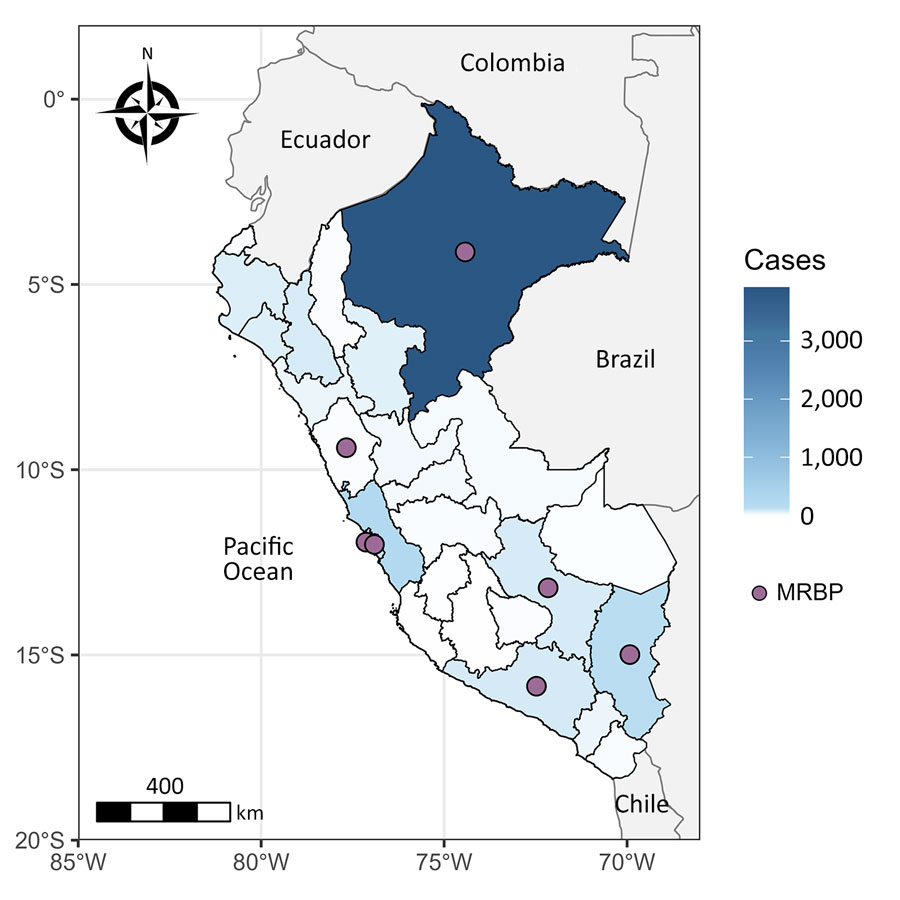
Figure 1. Geographic distribution of confirmed pertussis cases and MRBP cases in Peru, 2025. Regional shading shows cumulative confirmed pertussis cases since epidemiologic week 53 of 2025; darker blue indicates higher case counts. Purple circles indicate regions where patients carrying B. pertussis strains with the macrolide resistance–associated A2047G mutation were detected. MRBP, macrolide-resistant Bordetella pertussis.
Page created: July 21, 2026
Page updated: September 28, 2026
Page reviewed: September 28, 2026
The conclusions, findings, and opinions expressed by authors contributing to this journal do not necessarily reflect the official position of the U.S. Department of Health and Human Services, the Public Health Service, the Centers for Disease Control and Prevention, or the authors' affiliated institutions. Use of trade names is for identification only and does not imply endorsement by any of the groups named above.