Volume 32, Number 10—October 2026
Dispatch
Emergence of Macrolide-Resistant Bordetella pertussis, Peru, 2025

 , Faviola Valdivia, Carmen Rodríguez-Cueva, Helen Horna, Yaneth Quispe, María Pía Soto, Segundo Torres, Victor Fiestas Solórzano, Martin Yagui, Vlademir Vicente Cantarelli, Efrain Montilla-Escudero, Víctor Silva, and Ana Raquel Da Costa
Cite This Article
Citation for Media
Abstract
We report the emergence of macrolide-resistant Bordetella pertussis during a pertussis outbreak in Peru. Among 68 cases, 31% carried the A2047G gene mutation, conferring resistance to macrolides. Whole-genome sequencing revealed 2 genetically distinct groups, indicating multiple introductions into Peru. Our findings support strengthening surveillance for macrolide-resistant pertussis to inform control strategies.
The bacterium Bordetella pertussis is the causative agent of pertussis, a highly contagious respiratory infection, which poses the greatest risk for severe illness and death in infants (1). Despite widespread vaccination, there is a global resurgence of pertussis and a large increase in cases reported after the COVID-19 pandemic (2). The pertussis resurgence is likely multifactorial, including declining vaccination coverage, improved diagnostic capacity, waning immunity, and the evolutionary adaptation of B. pertussis bacteria (3).
Macrolide antimicrobial drugs are the first-line pertussis treatment because of their effectiveness in reducing bacterial carriage and transmission, curtailing the duration of symptoms, and lowering the risk for infant death (4). However, macrolide-resistant B. pertussis (MRBP), primarily associated with the A2047G mutation in 23S rRNA genes, has emerged globally (5). The highest prevalence of MRBP has been reported in China (6), whereas reports of MRBP from Latin America remain scarce (7).
In 2025, the Peruvian Ministry of Health reported the largest pertussis outbreak in decades in the country. Although precisely defining the onset of the outbreak is challenging, surveillance data suggest that transmission intensified in 2024. National incidence increased from 3.9 cases/1 million inhabitants in 2023 to 7.4 cases/1 million inhabitants in 2024 and reached 57.5 cases/1 million inhabitants by August 2025 (8). A cumulative total of 4,976 cases (Appendix Figure) and 76 deaths were recorded by the end of 2025. The effects were concentrated in the Loreto region, which accounted for 3,922 cases and 57 deaths, disproportionately affecting Indigenous communities in Datem del Marañón, where pertussis vaccine coverage remains suboptimal (9,10).
Peru’s national immunization schedule includes 3 primary doses of the pentavalent diphtheria–tetanus–whole cell pertussis–hepatitis B–Hemophilus influenzae type b vaccine (DTwP-HepB-Hib) at 2, 4, and 6 months of age, followed by DTwP boosters at 18 months and 4 years of age, and tetanus–diphtheria–acellular pertussis vaccination during pregnancy, recommended at 20–36 weeks of gestation. To determine B. pertussis transmission dynamics in Peru, we detected and characterized MRBP from B. pertussis–positive swab samples.
Figure 1
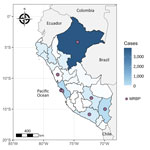
Figure 1. Geographic distribution of confirmed pertussis cases and MRBP cases in Peru, 2025. Regional shading shows cumulative confirmed pertussis cases since epidemiologic week 53 of 2025; darker blue indicates higher case...
In early 2025, we screened for MRBP in B. pertussis–positive nasopharyngeal swab samples from 68 patients (11) (median 3 months of age; range 1 month–39 years of age) by using direct PCR (Appendix Table 1) targeting the A2047G mutation in the 23S rRNA genes. We detected the A2047G mutation in 21 (31%) of 68 samples. Patients infected with MRBP were significantly younger (median 3.6 vs 36.1 months of age; p = 0.007) than patients infected with macrolide-susceptible B. pertussis strains. However, we observed no significant differences in patient sex or vaccination status between the 2 groups (Appendix Table 2). Most MRBP infections were in infants <6 months of age (62%). Among the 16 patients with available treatment information, 14 (88%) received azithromycin. MRBP cases were distributed across multiple regions, including Lima (n = 11), Cusco (n = 4), Arequipa (n = 3), Ancash (n = 1), Loreto (n = 1), and Puno (n = 1) (Table; Figure 1; Appendix Table 2).
From the 68 B. pertussis–positive samples, we obtained 7 culture-positive B. pertussis isolates, all of which were MRBP: 6 collected in 2025 and 1 in late 2024 (isolate no. tf518-24). We performed phenotypic susceptibility testing by using established methods (12). All 7 isolates were resistant to all antimicrobial drugs tested, with no zones of inhibition for erythromycin or azithromycin.
We performed whole-genome sequencing on all 7 MRBP strains (Appendix). All sequenced isolates were assigned to sequence type 2 (ST2) and clonal complex ST2. Six isolates shared the virulence-associated allelic profile ptxP3/ptxA1/ptxB1/ptxC4/fhaB1/fim2-1/fim3-1, whereas 1 isolate (tf098–25) carried the closely related ptxP29 promoter allele but retained the remaining alleles of this profile. We identified the prn150 allele in all sequenced isolates (Appendix), which is a genetic marker of the emerging MR-MT28 lineage (8). We did not identify any inactivating mutations in the ptx operon or fhaB, but 3 isolates (tf518-24, tf120-25, and tf098-25) had IS481-mediated prn disruption, consistent with a pertactin-deficient genotype (Appendix).
Figure 2
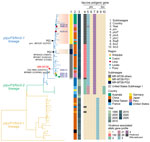
Figure 2. Maximum-likelihood phylogenetic tree of Bordetella pertussisisolates on the basis of genome-wide single-nucleotide polymorphism analysis, showing macrolide-resistant isolates from Peru within the emerging MR-MT28 lineage (red text) among globally...
Expanded whole-genome single-nucleotide polymorphism phylogenetic analysis incorporating globally representative MRBP genomes placed all isolates from Peru within the recently emerged MR-MT28 lineage. That expanded analysis also detected previously identified genetic markers, including the A2047G mutation, the prn150 allele, and the BP0685 G1959A substitution (8). The 7 MRBP isolates from Peru did not form a single monophyletic cluster. Three isolates (tf518-24, tf120-25, and tf098-25) clustered within the phylogenetic group 1 (PG1) sublineage and had IS481-mediated prn disruption, whereas the remaining 4 isolates clustered with the MR-MT28-other group and retained an intact prn coding sequence despite carrying the prn150 allele (Figure 2; Appendix).
We described the emergence of MRBP during the ongoing 2025 pertussis outbreak in Peru and documented circulation of the emerging MR-MT28 lineage in Latin America. Genomic analyses identified >2 genetically distinct MR-MT28 sublineages, including PG1-associated pertactin-deficient isolates, consistent with the ongoing international diversification and dissemination of this lineage.
Consistent with recent global genomic analyses, the close phylogenetic relationship between the 7 isolates from Peru and contemporary MR-MT28 strains is consistent with the ongoing international dissemination and diversification of this lineage (5,13). The presence of 2 genetically distinct MR-MT28 groups circulating in Peru suggests multiple international introductions of MRBP into Peru, rather than a single transmission event.
Pertactin-deficient isolates have predominantly been reported in countries using acellular pertussis vaccines, where loss of pertactin is considered an adaptive response to vaccine-induced immune pressure (5,13). Although Peru continues to use a whole-cell pertussis vaccine, 3 PG1 sublineage isolates had IS481-mediated prn disruption, suggesting introduction of an established pertactin-deficient MR-MT28 sublineage, rather than independent emergence under local vaccine-driven selection. Of note, 1 of those isolates (tf518-24) was recovered from an infant who received 2 doses of the pentavalent vaccine, indicating that a pertactin-deficient MR-MT28 strain was identified in a partially vaccinated infant.
We found that most patients with MRBP received azithromycin for treatment, which raises concerns about the effectiveness of macrolides as first-line therapy in Peru. Although B. pertussis has remained susceptible to sulfamethoxazole/trimethoprim in vitro (14) and possibly to other antimicrobial drugs (15), clinical evidence supporting alternative regimens is limited, underscoring the need for urgent clinical and epidemiologic studies.
A key limitation of our study is the lack of systematically collected clinical data linked to genomic findings within the current surveillance system, which precludes assessment of differences in disease severity and outcomes between macrolide-resistant and macrolide-susceptible B. pertussis infections during this outbreak. Addressing that gap will be critical to define the clinical impact of macrolide resistance and to inform evidence-based treatment strategies in high-prevalence settings.
Our findings underscore the urgent need to strengthen genomic surveillance and diagnostic capacity for B. pertussis to enable early detection of resistant strains and inform timely prevention and control strategies. In addition, reassessing empiric treatment recommendations and prioritizing prospective studies to evaluate the clinical effect of macrolide antimicrobial drug resistance will be critical to guide evidence-based public health responses.
Dr. Juscamayta-López is a molecular epidemiologist at the Instituto Nacional de Salud, Peru. His research integrates whole-genome sequencing with phenotypic data to investigate the evolution, transmission, and antimicrobial resistance of respiratory bacterial pathogens.
Acknowledgments
We thank the American Society for Microbiology for supporting the strengthening of Bordetella pertussis antimicrobial resistance surveillance at the Instituto Nacional de Salud, Peru.
The assembled genome sequences generated in this study have been deposited into GenBank (BioProject accession PRJNA1332808; genome accession nos. JBRFKX000000000–JBRFLD000000000 [tf048-25–tf518-24].)
This study was supported in part by the US Centers for Disease Control and Prevention’s Antimicrobial Resistance Solutions Initiative through the Global Antimicrobial Resistance Laboratory and Response Network (cooperative agreement no. 6 NU3HCK000011-03-01).
References
- World Health Organization. Pertussis vaccines: WHO position paper—September 2015. Wkly Epidemiol Rec. 2015;90:433–58.PubMedGoogle Scholar
- World Health Organization. Pertussis reported cases and incidence. Geneva: The Organization; 2025 [cited 2025 Sep 21]. https://immunizationdata.who.int/global/wiise-detail-page/pertussis-reported-cases-and-incidence
- Sheng Y, Ma S, Zhou Q, Xu J. Pertussis resurgence: epidemiological trends, pathogenic mechanisms, and preventive strategies. Front Immunol. 2025;16:
1618883 . DOIPubMedGoogle Scholar - Ivaska L, Barkoff AM, Mertsola J, He Q. Macrolide resistance in Bordetella pertussis: current situation and future challenges. Antibiotics (Basel). 2022;11:1570. DOIPubMedGoogle Scholar
- Zhang H, Kang Z, Zhang Y, Yang Y, Li H, Wang N, et al. Evolutionary dynamics and global spread of macrolide-resistant Bordetella pertussis during the post-pandemic pertussis resurgence. J Infect. 2026;92:
106718 . DOIPubMedGoogle Scholar - Feng Y, Chiu CH, Heininger U, Hozbor DF, Tan TQ, von König CW. Emerging macrolide resistance in Bordetella pertussis in mainland China: findings and warning from the global pertussis initiative. Lancet Reg Health West Pac. 2021;8:
100098 . DOIPubMedGoogle Scholar - Bolstering pertussis surveillance in Latin America. Washington: American Society for Microbiology; 2024 [cited 2025 Sep 21]. https://asm.org/articles/2024/november/bolstering-pertussis-surveillance-in-latin-america
- Celis-Salinas JC, Ramírez-García EA, Fiestas Solórzano VE, Casapía-Morales M. Twenty-five years of pertussis outbreaks in the Peruvian Amazon: a call to strengthen equity in vaccination and control. Lancet Reg Health Am. 2025;51:
101255 . DOIPubMedGoogle Scholar - Health Situation Room of Peru. EW 37—2025. Lima: CDC MINSA; 2025 [cited 2025 Jul 3]. https://www.dge.gob.pe/portalnuevo/sala-de-situacion.
- Immunization Information Dashboard. Peru 2018–2025. Lima: MINSA [cited 2025 Jul 3]. https://www.minsa.gob.pe/reunis
- Tatti KM, Sparks KN, Boney KO, Tondella ML. Novel multitarget real-time PCR assay for rapid detection of Bordetella species in clinical specimens. J Clin Microbiol. 2011;49:4059–66. DOIPubMedGoogle Scholar
- Hill BC, Baker CN, Tenover FC. A simplified method for testing Bordetella pertussis for resistance to erythromycin and other antimicrobial agents. J Clin Microbiol. 2000;38:1151–5. DOIPubMedGoogle Scholar
- Fu P, Yan G, Li Y, Xie L, Ke Y, Qiu S, et al. Pertussis upsurge, age shift and vaccine escape post-COVID-19 caused by ptxP3 macrolide-resistant Bordetella pertussis MT28 clone in China. Clin Microbiol Infect. 2024;30:1439–46. DOIPubMedGoogle Scholar
- Hu Y, Zhai X, Yuan L, Du Q, Yao K. Phenotypic diversity of Bordetella pertussis against trimethoprim/sulphamethoxazole in vitro tests. Diagn Microbiol Infect Dis. 2025;111:
116597 . DOIPubMedGoogle Scholar - Hua CZ, Wang HJ, Zhang Z, Tao XF, Li JP, Mi YM, et al. In vitro activity and clinical efficacy of macrolides, cefoperazone-sulbactam and piperacillin/piperacillin-tazobactam against Bordetella pertussis and the clinical manifestations in pertussis patients due to these isolates: a single-centre study in Zhejiang Province, China. J Glob Antimicrob Resist. 2019;18:47–51. DOIPubMedGoogle Scholar
Figures
Table
Cite This ArticleOriginal Publication Date: September 16, 2026
Table of Contents – Volume 32, Number 10—October 2026
| EID Search Options |
|---|
 Advanced Article Search – Search articles by author and/or keyword.
|
 Articles by Country Search – Search articles by the topic country.
|
 Article Type Search – Search articles by article type and issue.
|
Please use the form below to submit correspondence to the authors or contact them at the following address:
Eduardo Juscamayta-López, Instituto Nacional de Salud, Jiron Capac Yupanqui 1400, Jesus Maria, Lima, Lima 11, Peru
Top