Volume 32, Number 10—October 2026
Research
Genomic Epidemiology of Salmonella enterica Serovar Hadar Strain Linked to Poultry-Associated Salmonellosis Outbreaks, United States

Figure
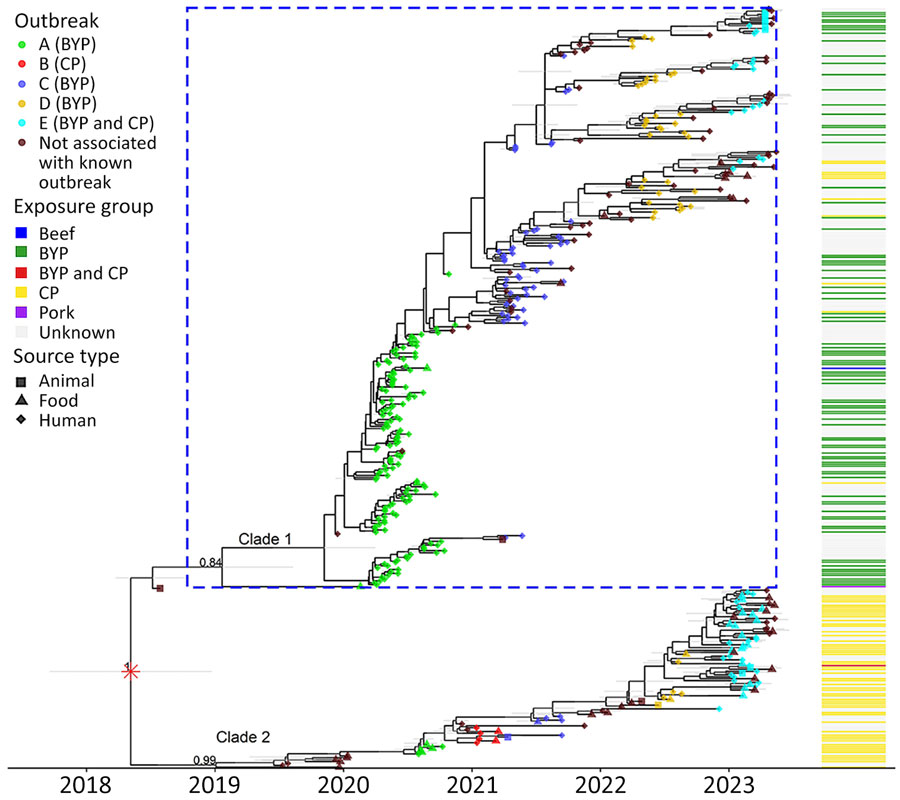
Figure. Maximum clade credibility tree of 404 persistent Salmonella Hadar REPTDK01 genomes from study of Salmonella enterica serovar Hadar strain linked to poultry-associated salmonellosis outbreaks, United States. Genomes subsampled from multistate poultry-associated outbreaks and routine surveillance revealed 2 distinct clades corresponding to separate epidemiologic linkages. The tree was generated using BEAST2 (https://www.beast2.org). Isolate tips are aligned to isolation dates and color-coded by outbreak and vehicle. Colored shape indicates source type. Red asterisk marks the most recent common ancestor, estimated to have emerged in early 2018. Posterior support values are shown for the most recent common ancestors of the 404 REPTDK01 genomes (tree root), clade 1, and clade 2. Gray horizontal bars indicate 95% highest posterior density interval for node heights. Column at right of tree indicates exposure group based on patient-related exposures and isolate metadata. Blue dashed box contains data for clade 1, comprising 308 isolates with diverse epidemiologic links to beef, pork, CP, and BYP. Isolates within clade 1 differ by a median of 8 hqSNPs (hqSNP range 0–33), and a median of 4 allele cgMLST differences (allele range 0–16). Clade 2 includes 95 isolates predominantly linked to CP; those isolates differ by a median of 6 hqSNPs (hqSNP range 0–24) or a median of 3 alleles (allele range 0–14). The full subset contains 404 isolates that differ by a median of 9 hqSNPs (hqSNP range 0–40) or 5 alleles (allele range: 0–21). BYP, backyard poultry; cgMLST, core genome multilocus sequence typing; CP, commercial poultry; hqSNP, high-quality single-nucleotide polymorphism.