Disclaimer: Early release articles are not considered as final versions. Any changes will be reflected in the online version in the month the article is officially released.
Volume 32, Number 10—October 2026
Research
Human Myiasis Resulting from Reemergence of Cochliomyia hominivorax Screwworm, Mexico, 2025–2026
Oscar Manuel Delgado-Cuellar, Clemente Mosso-González, Jorge Castañeda-Gómez, Farah Zamira Vera-Maloof, Karla Reyna Navarro-Fuentes, Edgar Sebastián Mejía-Navarro, and Héctor Armando Rincón-León
Figure 1
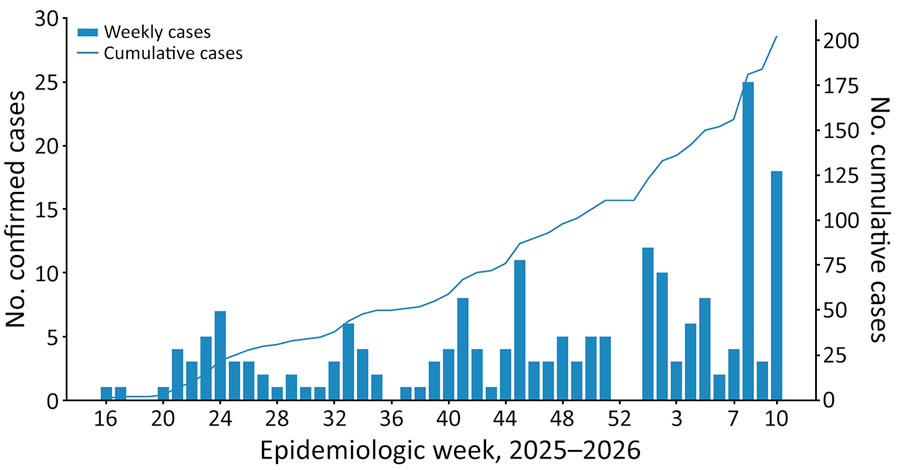
Figure 1. Confirmed human New World screwworm myiasis cases resulting from reemergence of Cochliomyia hominivorax screwworm, by epidemiologic week and cumulative, Mexico, April 13, 2025–March 14, 2026. Data were obtained from official epidemiologic bulletins of the Directorate General of Epidemiology, Ministry of Health (14–16).
References
- Venegas-Montero DP, Alfaro-Vellanero MJ, Rojas-Araya D, Calderón-Arguedas Ó, Vargas-Castro CM, Baldioceda-Villarreal A, et al. Case report: re-emergence of Cochliomyia hominivorax in Costa Rica: report of a human myiasis case 23 years after elimination. Am J Trop Med Hyg. 2024;111:1020–3. DOIPubMedGoogle Scholar
- Organización Mundial de Sanidad Animal. 3.1.14. Miasis por Cochliomyia hominivorax y miasis por Chrysomya bezziana. In: Manual Terrestre de la OIE 2019. Paris: OMSA (Organización Mundial de Sanidad Animal); 2019. p. 1–11 [cited 2026 Mar 8]. https://www.woah.org/fileadmin/Home/esp/Health_standards/tahm/3.01.14_SCREWW.pdf
- Thomas DB, Chen AC. Age distribution of adult female screwworms (Diptera: Calliphoridae) captured on sentinel animals in the coastal lowlands of Guatemala. J Econ Entomol. 1990;83:1422–9. DOIPubMedGoogle Scholar
- Gutierrez AP, Ponti L, Arias PA. Deconstructing the eradication of New World screwworm in North America: retrospective analysis and climate warming effects. Med Vet Entomol. 2019;33:282–95. DOIPubMedGoogle Scholar
- Rahn JJ, Barger GL. Weather conditions and screwworm activity. 1973 [cited 2026 Jun 19]. https://agris.fao.org/search/en/providers/122535/records/65ddecfa0f3e94b9e5c771c8
- de Barros GP, Bricarello PA. Myiasis by Cochliomyia hominivorax (Coquerel, 1858): a neglected zoonosis in Brazil. Open J Vet Med. 2020;10:80–91. DOIGoogle Scholar
- Akhoundi M, Mathieu A, Hannachi W, Nasrallah J, Quezel G, Blaizot R, et al. Morphological and molecular characterizations of Cochliomyia hominivorax (Diptera: Calliphoridae) larvae responsible for wound myiasis in French Guiana. Diagnostics (Basel). 2023;13:2575. DOIPubMedGoogle Scholar
- Licona LA, Laud PM, Argueta RF. Anorectal myiasis caused by Cochliomyia hominivorax in a septic tank worker. Cureus. 2025;17:
e90842 . DOIPubMedGoogle Scholar - Servicio Nacional de Sanidad, Inocuidad y Calidad Agroalimentaria. Miasis por Gusano Barrenador [cited 2026 Jun 19]. http://www.gob.mx/senasica/documentos/miasis-por-gusano-barrenador?state=published
- Secretaría de Salud. Aviso Epidemiológico por Caso humano confirmado de miasis por Cochliomyia hominivorax. Sistema Nacional de Vigilancia Epidemiológica [cited 2026 Jun 19]. http://www.gob.mx/salud/documentos/aviso-epidemiologico-por-caso-humano-confirmado-de-miasis-por-cochliomyia-hominivorax
- Valdez-Espinoza UM, Fadda LA, Marques R, Osorio-Olvera L, Jiménez-García D, Lira-Noriega A. The reemergence of the New World screwworm and its potential distribution in North America. Sci Rep. 2025;15:23819. DOIPubMedGoogle Scholar
- Zaldivar-Gomez A, Gomez-Vazquez JP, Iniesta-Valencia AJ, Figueroa-Martínez LG, Rico-Chávez O. Estimation the reinvasion of New World screwworm (Cochliomyia hominivorax) in Central America: the role of animal movement in disease dispersal and control measures. Vet Parasitol Reg Stud Reports. 2025;59:
101220 . DOIPubMedGoogle Scholar - Secretaría de Salud. Boletín Epidemiológico Sistema Nacional de Vigilancia Epidemiológica Sistema Único de Información. Edición del 12 de enero de 2026. México: Dirección General de Epidemiología; 2026 [cited 2026 Jun 4]. https://www.gob.mx/salud/documentos/boletinepidemiologico-sistema-nacional-de-vigilancia-epidemiologica-sistema-unico-de-informacion-387843
- Secretaría de Salud. Boletín Epidemiológico Sistema Nacional de Vigilancia Epidemiológica Sistema Único de Información. Semana Epidemiológica 21 (Edición del 2 de junio de 2026). México: Dirección General de Epidemiología; 2026 [cited 2026 Jun 4]. https://www.gob.mx/salud/documentos/boletinepidemiologico-sistema-nacional-de-vigilancia-epidemiologica-sistema-unico-de-informacion-417103
- Secretaría de Salud. Boletín Epidemiológico. Sistema Nacional de Vigilancia Epidemiológica, Sistema Único de Información. Número 10, volumen 43, Semana 10 (Del 8 al 14 de marzo de 2026). México: Dirección General de Epidemiología; 2026 [cited 2026 Jun 4]. https://www.gob.mx/cms/uploads/attachment/file/1068893/Boletin-1026.pdf
- Secretaría de Salud. Gobierno de México. Ciudad de México, México, 2026. Situación actual de miasis (Cochliomyia hominivorax) en el humano: México; 2026 [cited 2026 Jun 1]. https://www.gob.mx/salud/documentos/situacion-actual-de-miasis-cochliomyia-hominivorax-en-el-humano-mexico-2026
- Nacional de Sanidad S, Inocuidad y Calidad A. Informe de casos acumulados de Gusano Barrenador del Ganado en México del 20/11/2024 al 06/06/2026. Edición del 6 de junio de 2026 [Internet]. México: Comisión México-Estados Unidos para la Prevención de la Fiebre Aftosa y otras Enfermedades Exóticas de los Animales (CPA); 2026 [cited 2026 Jun 9]. https://app.powerbi.com/view?r=eyJrIjoiMjkzMzAzMzUtZmRlNi00ZTMzLTk1NDEtNjkzZTEwNzZjZGFlIiwidCI6ImM1OWRjNTZhLTkzZWMtNGIwNy1iNzFkLTQzYzg0NDkyNTcxOCIsImMiOjR9
- Secretaría de Agricultura y Desarrollo Rural. Gobierno de México. 2015. Ganadería bovina y sus derivados [cited 2026 Jun 9]. https://www.gob.mx/agricultura/articulos/ganaderia-bovina-y-sus-derivados
- Comité Estatal de Información Estadística y Geográfica. CEIEG Chiapas. 2021. Datos geográficos del Estado de Chiapas [cited 2026 Jun 9]. https://www.ceieg.chiapas.gob.mx/info-geografica
- Kuria SK, Oyedeji AO. Human myiasis cases originating and reported in Africa for the last two decades (1998–2018): a review. Acta Trop. 2020;210:
105590 . DOIGoogle Scholar - Rivera JIR, Rivera MER, Figueroa JMM, Plaza JPB, Sagbay ZVP, Aspiazu DAT. Caracterización clínica de los pacientes ingresados por miasis en el Hospital del Niño Dr. Francisco de Icaza Bustamante, Guayaquil, Ecuador. Rev Cubana Med Trop. 2020;72:1–11.
- Batista-da-Silva JA, Moya-Borja GE, Queiroz MMC. Factors of susceptibility of human myiasis caused by the New World screw-worm, Cochliomyia hominivorax in São Gonçalo, Rio de Janeiro, Brazil. J Insect Sci. 2011;11:14. DOIPubMedGoogle Scholar
- do Nascimento EMF, de Oliveira JB, Paes MJ, Lobo AP, da Silva ALA, dos Santos Júnior ER, et al. Miíases humanas por Cochliomyia hominivorax (Coquerel, 1858) (Diptera, Calliphoridae) em hospitais públicos na cidade do Recife, Pernambuco, Brasil. Entomol Vectores. 2005;12:37–51. DOIGoogle Scholar
- Hernández-Molina O, Peña-Fernández PG. Miasis por gusano barrenador en Humanos. In: III JC UCCM (Jornada Científica de la Universidad de Ciencias Médicas de Camagüey). 2025 [cited 2026 Jun 19]. https://jcuccm.sld.cu/index.php/jcuccm/2025/paper/view/587/0
- Ye X, Wang Y, Zou Y, Tu J, Tang W, Yu R, et al. Associations of socioeconomic status with infectious diseases mediated by lifestyle, environmental pollution and chronic comorbidities: a comprehensive evaluation based on UK Biobank. Infect Dis Poverty. 2023;12:5. DOIPubMedGoogle Scholar
- Rodrigues FT, Aguiar VM, Lessa CS. Diabetic foot ulcers with myiasis: a potential route for resistance gene dissemination for enterococci? Rev Soc Bras Med Trop. 2018;51:879–879. DOIPubMedGoogle Scholar
- Olea MS, Centeno N, Aybar CAV, Ortega ES, Galante GB, Olea L, et al. First report of myiasis caused by Cochliomyia hominivorax (Diptera: Calliphoridae) in a diabetic foot ulcer patient in Argentina. Korean J Parasitol. 2014;52:89–92. DOIPubMedGoogle Scholar
- Calvopiña M, Jordan-Guarnizo E, Galeas C, Rodriguez-Hidalgo R. Severe oral myiasis in an elderly man with epilepsy caused by the New World screwworm (Cochliomyia hominivorax) in subtropical Ecuador. Am J Trop Med Hyg. 2026;114:1180–3. DOIPubMedGoogle Scholar
Page created: August 05, 2026
Page updated: August 05, 2026
Page reviewed: August 05, 2026
The conclusions, findings, and opinions expressed by authors contributing to this journal do not necessarily reflect the official position of the U.S. Department of Health and Human Services, the Public Health Service, the Centers for Disease Control and Prevention, or the authors' affiliated institutions. Use of trade names is for identification only and does not imply endorsement by any of the groups named above.