Disclaimer: Early release articles are not considered as final versions. Any changes will be reflected in the online version in the month the article is officially released.
Volume 32, Number 11—November 2026
Dispatch
Differentiating Avian and Seasonal Influenza Viruses in Wastewater by Digital PCR

Suggested citation for this article
Abstract
Highly pathogenic avian influenza A(H5Nx) viruses, particularly clade 2.3.4.4b, pose substantial global health risks. We combined and piloted 2 duplex reverse transcription digital PCRs to discriminate between avian and seasonal influenza viruses in wastewater. This approach enabled rapid, strain-specific detection to reduce ambiguity in environmental surveillance for influenza viruses.
Highly pathogenic avian influenza (HPAI) A(H5Nx) viruses, particularly clade 2.3.4.4b, continue to circulate widely among wild and domestic birds, with recurrent spillover into mammalian species and sporadic infections in humans. The extensive geographic distribution and persistent circulation of clade 2.3.4.4b, together with its predominance among HPAI A(H5) viruses currently circulating in Europe, support its continued relevance for animal and public health surveillance (1–4).
Wastewater and environmental surveillance (WES) provides a population-level complement to clinical, veterinary, and wildlife surveillance and is increasingly integrated into the monitoring framework in Europe (5). WES has been widely used for SARS-CoV-2 and has also been applied to influenza A and B viruses (6,7).
WES typically relies on PCR-based methods to detect and quantify pathogens. Similar to other pathogens, influenza RNA concentrations in wastewater might vary according to shedding patterns, sewer inputs, matrix characteristics, and the relative contributions of human and animal sources (6). Differences in laboratory methods and reporting further complicates interpretation, underscoring the necessity of considering assay sensitivity and specificity when comparing results across studies (8).
The matrix gene is the preferred molecular target for the screening of influenza A viruses (9) because it is conserved across seasonal human and animal influenza strains, but broad reactivity limits strain discrimination in mixed environmental samples. For instance, the influenza A component of the Centers for Disease Control and Prevention (CDC) influenza SARS-CoV-2 (Flu SC2) multiplex assay, developed for clinical respiratory specimens and real-time PCR (10) and adapted for reverse transcription digital PCR (RT-dPCR) analysis of wastewater (11), can detect both seasonal human and avian influenza A signals (12).
Several wastewater assays were designed to detect H5 viruses (13–15). Those assays are useful for broad H5 virus screening but might require further characterization to distinguish between HPAI H5N1 clade 2.3.4.4b, another H5 lineage, or low pathogenicity avian influenza. A clade-specific assay can provide additional epidemiologic resolution and help prioritize follow-up across animal and human surveillance.
We previously developed the European Commission’s Joint Research Centre (JRC) RT-PCRs targeting the hemagglutinin (HA) and matrix protein (MP) genes. The JRC-HA assay targets a conserved HA region in HPAI H5N1 clade 2.3.4.4b and the JRC-MP assay targets the conserved matrix gene for broader detection of influenza A (12) (Appendix). We evaluated a dual-duplex RT-dPCR approach combining the CDC influenza A and B assay components with the JRC-HA and JRC-MP assay to discriminate between avian and seasonal human influenza viruses in wastewater.
Figure 1
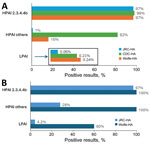
Figure 1. In silico comparative analysis of wastewater assays used to detect avian and seasonal influenza viruses in wastewater. A) Predicted detection of HA gene sequences from LPAI viruses, HPAI viruses other...
We first performed a comparative in silico analysis of the publicly available primer and probe sequences from 3 H5 assays (13–15), and the JRC-HA and JRC-MP assays (12) (Figure 1). The predicted detection of HPAI H5 clade 2.3.4.4b was broadly comparable across the assays, but the JRC-HA assay revealed greater discrimination against non-2.3.4.4b HPAI clades (Figure 1, panel A). The JRC-HA and JRC-MP assays had the lowest predicted cross-reactivity with low pathogenicity avian influenza H5 annotated sequences (Figure 1, panels A, B).
Figure 2
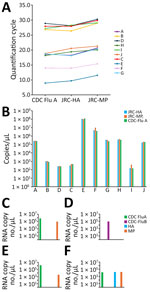
Figure 2. Analytical evaluation of JRC-HA and JRC-MP RT-PCRs against recent highly pathogenic avian influenza (HPAI) H5N1 clade 2.3.4.4b isolates for differentiating avian and human influenza A viruses from wastewater samples. A) Quantification...
Then, we evaluated the JRC-HA and JRC-MP duplex assay by using HPAI H5N1 clade 2.3.4.4b viruses collected from wild birds and poultry in northern Italy during October–December 2025 (Appendix). Sequence alignment revealed high conservation across the primer and probe binding regions for both assays, indicating that recent viral evolution had not substantially affected assay inclusivity. Nevertheless, we identified 2 substitutions within the JRC-HA probe-binding region in 3 samples (Appendix Figure 1). In silico PCR predicted amplification (data not shown), and both quantitative reverse transcription PCR and RT-dPCR detected influenza A in all 10 samples, including samples with low viral concentrations (Figure 2, panels A, B). For samples H, I, and J, lowering the JRC-HA RT-dPCR annealing temperature from 60°C to 56.4°C improved partition separation (Appendix Figure 2). At the revised annealing temperature, in silico analysis indicated that stable primer-dimer formation was unlikely, and assay specificity was not affected (Figure 2, panels C–F). The limit of detection was 5 copies/reaction, consistent with previous results (12). The CDC influenza B assay failed to detect the target in any of the 10 samples analyzed, whereas the CDC influenza A assay detected the target in all 10 samples with comparable performance to that of the JRC-HA and JRC-MP assays (Figure 2, panels A, B). Such broad detection is useful for confirming the presence of influenza virus; however, it does not permit discrimination between avian and seasonal human influenza A viruses in mixed specimens such as wastewater samples collected during periods of seasonal influenza circulation.
Figure 3
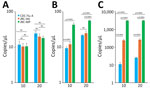
Figure 3. Detection of influenza A and highly pathogenic avian influenza (HPAI) A(H5N1) in simulated wastewater samples by using reverse transcription digital PCR. A) Copy numbers of influenza A virus in wastewater...
To improve discrimination between avian and seasonal human influenza in wastewater samples, we evaluated the influenza A and B components of the CDC Flu SC2 multiplex assay together with the JRC-HA and JRC-MP duplex assay. We performed the 2 duplex assays separately, according to the conditions described previously (12) (Appendix). Because HPAI H5N1 clade 2.3.4.4b–positive wastewater samples were unavailable, we added defined amounts of avian and seasonal human influenza A RNA to RNA extracts from influenza-negative wastewater samples (Figure 3). We evaluated the 2 duplex assays under 3 simulated co-circulation scenarios.
In the first scenario, we added only HPAI H5N1 clade 2.3.4.4b RNA to the wastewater samples. The JRC-HA, JRC-MP, and CDC influenza A assays produced comparable viral RNA copy numbers, indicating detection near the analytical limits of the JRC assays (Figure 3, panel A). For the second scenario, we combined low concentrations (10 or 20 copies/µL) of HPAI H5N1 clade 2.3.4.4b RNA and seasonal influenza A RNA (35 copies/µL) to simulate periods of low seasonal influenza activity or low avian influenza prevalence. The JRC-HA and JRC-MP assays selectively detected HPAI H5N1 clade 2.3.4.4b RNA, whereas the CDC influenza A assay detected both avian and seasonal human influenza A RNA without distinction (Figure 3, panel B).
In the third scenario, we added low concentrations (10 or 20 copies/µL) of HPAI H5N1 clade 2.3.4.4b RNA to a high concentration (3,500 copies/µL) of seasonal influenza A background, representing a possible early stage of HPAI detection during peak seasonal influenza activity. The JRC-HA assay detected HPAI H5N1 RNA without cross-reactivity, whereas the JRC-MP detected both avian and seasonal human influenza A RNA, but yielded lower copy number estimates than the CDC influenza A assay (Figure 3, panel C). Together, our results suggest that JRC-HA identifies and discriminates HPAI H5N1 clade 2.3.4.4b, whereas JRC-MP provided complementary detection but might lack specificity during high seasonal influenza A circulation.
Figure 4
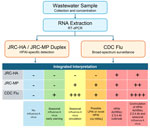
Figure 4. Interpretation of dual duplex RT-dPCR results for differentiating avian and seasonal influenza A viruses in wastewater. Extracted RNA from wastewater samples is analyzed by using the JRC-HA and JRC-MP duplex...
We propose the complementary use of CDC Flu SC2 and JRC-HA and JRC-MP duplex assays in a dual-duplex approach (Figure 4). The influenza A and B components of the CDC Flu SC2 multiplex assay are useful for routine communitywide surveillance of influenza A and B, ensuring continuity of the current public health reporting system. The JRC-HA and JRC-MP duplex assay, after the CDC Flu SC2 duplex, is used to specifically identify the occurrence of HPAI H5N1 clade 2.3.4.4b virus in a population, providing an early-warning capability that is effective in the presence of seasonal influenza backgrounds.
We evaluated our dual duplex RT-dPCR by using animal-derived viral material and spiked wastewater RNA extracts, rather than confirmed HPAI-positive wastewater samples. Further field evaluation will be useful to assess performance under naturally occurring conditions and in different wastewater matrices. Because influenza viruses evolve rapidly, periodic sequence-based evaluations, followed by experimental validation and assay updates when necessary, will be required to maintain assay performance as new H5 clades emerge.
A clade-specific wastewater result would not by itself determine a different public health response from a broad H5-positive result. However, it could reduce ambiguity, prioritize confirmatory testing, and enable integration of wastewater findings with veterinary, wildlife, domestic animal, and human surveillance data.
Dr. Paracchini is employed as scientific officer at the European Commission’s Joint Research Centre in Geel, Belgium. Her research interests include working on the development of novel assays and reference materials for enhanced pathogen surveillance such as SARS-CoV-2, avian influenza, and antimicrobial resistance.
Acknowledgments
We thank Renaud Seigneuric, Simona Tavazzi, Aisha Sauer, Patricia Urban-Lopez, Gabriele Leoni, Maddalena Querci, Els Vanlancker and Ciarán Nicholl for their support. We also thank Alessio Bortolami, Alice Fusaro, and Bianca Zecchin and the Istituti Zooprofilattici Sperimentali network for providing animal samples and sequences. In addition, we thank those involved in generating and sharing sequence data via the GISAID initiative (https://www.gisaid.org).
This project received partial financial support from the European Commission, through a Directorate-General for Health Emergency Preparedness and Response grant (grant no. GLOWASENSE - JRC_COMPT_37000) and within the framework of the activities foreseen by the European Union Reference Laboratory for Avian Influenza and Newcastle Disease.
This article was preprinted at https://doi.org/10.5281/zenodo.19054950.
References
- European Food Safety Authority, European Union Reference Laboratory for Avian Influenza, Ducatez M, Fusaro A, Gonzales JL, Kuiken T, et al. Unprecedented high level of highly pathogenic avian influenza in wild birds in Europe during the 2025 autumn migration. EFSA J. 2025;23:
e9811 .PubMedGoogle Scholar - Peacock TP, Moncla L, Dudas G, VanInsberghe D, Sukhova K, Lloyd-Smith JO, et al. The global H5N1 influenza panzootic in mammals. Nature. 2025;637:304–13. DOIPubMedGoogle Scholar
- Rolfes MA, Kniss K, Kirby MK, Garg S, Reinhart K, Davis CT, et al. Human infections with highly pathogenic avian influenza A(H5N1) viruses in the United States from March 2024 to May 2025. Nat Med. 2025;31:3889–98. DOIPubMedGoogle Scholar
- Cohen J. Bird flu antibodies found in cow in the Netherlands, a first outside of U.S. Science. 2026;•••: cited 2026 Feb 14.DOIGoogle Scholar
- European Commission. Commission staff working document. SWD (2025) 393 final. 2025 [cited 2026 Aug 28]. https://eur-lex.europa.eu/legal-content/EN/TXT/?uri=celex:52025SC0393
- Diamond MB, Keshaviah A, Bento AI, Conroy-Ben O, Driver EM, Ensor KB, et al. Wastewater surveillance of pathogens can inform public health responses. Nat Med. 2022;28:1992–5. DOIPubMedGoogle Scholar
- Viviani L, Vecchio R, Pariani E, Sandri L, Binda S, Ammoni E, et al. Wastewater-based epidemiology of influenza viruses: a systematic review. Sci Total Environ. 2025;986:
179706 . DOIPubMedGoogle Scholar - Honein MA, Olsen SJ, Jernigan DB, Daskalakis DC. Challenges and opportunities for wastewater monitoring of influenza viruses during the multistate outbreak of highly pathogenic avian influenza A(H5N1) virus in dairy cattle and poultry. Am J Public Health. 2024;114:1309–12. DOIPubMedGoogle Scholar
- World Health Organization. WHO information for the molecular detection of influenza viruses. 2020 [cited 2026 Feb 14]. https://cdn.who.int/media/docs/default-source/influenza/global-influenza-surveillance-and-response-system/related-documents/protocols_influenza_virus_detection_jan_2020.pdf
- Shu B, Kirby MK, Davis WG, Warnes C, Liddell J, Liu J, et al. Multiplex real-time reverse transcription PCR for influenza A virus, influenza B virus, and severe acute respiratory syndrome coronavirus 2. Emerg Infect Dis. 2021;27:1821–30. DOIPubMedGoogle Scholar
- Mancini P, Brandtner D, Veneri C, Bonanno Ferraro G, Iaconelli M, Puzelli S, et al. Evaluation of trends in influenza A and B viruses in wastewater and human surveillance data: insights from the 2022–2023 season in Italy. Food Environ Virol. 2024;17:6. DOIPubMedGoogle Scholar
- Buttinger G, Petrillo M, Valastro V, Marciano S, Crimaudo M, D’Amico V, et al. Novel (d)PCR assays for influenza A(H5Nx) viruses clade 2.3.4.4b surveillance. Euro Surveill. 2025;30:
2500183 . DOIPubMedGoogle Scholar - Wolfe MK, Duong D, Shelden B, Chan EMG, Chan-Herur V, Hilton S, et al. Detection of hemagglutinin H5 influenza A virus sequence in municipal wastewater solids at wastewater treatment plants with increases in influenza A in spring, 2024. Environ Sci Technol Lett. 2024;11:526–32. DOIGoogle Scholar
- Centers for Disease Control and Prevention. National wastewater surveillance system analytics data set, year(s), as compiled from data provided through national wastewater surveillance system in the rapid response research and surveillance branch (R3SB) [cited 2026 Aug 14]. https://data.cdc.gov/Public-Health-Surveillance/CDC-Wastewater-Data-for-Avian-Influenza-A-H5-/mtpu-urpp
- Centers for Disease Control and Prevention. Singleplex digital PCR testing of influenza A, H1pdm09, H3, and H5 from wastewater (Version 1) instructions for use. 2024 [cited 2026 Aug 28] https://stacks.stanford.edu/file/jd535xb1898/LB-177Rev00D%20-%20Singleplex%20Digital%20PCR%20Testing%20of%20Influenza%20A%2C%20H1pdm09%2C%20H3%2C%20and%20H5%20from%20Wastewater%20-%20Instructions%20for%20Use.pdf
Figures
Suggested citation for this article: Paracchini V, Petrillo M, Leon FM, Buttinger G, Marciano S, Crimaudo M, et al. Differentiating avian and seasonal influenza viruses in wastewater by digital PCR. Emerg Infect Dis. 2026 Nov [date cited]. https://doi.org/10.3201/eid3211.261234
Original Publication Date: October 15, 2026
Table of Contents – Volume 32, Number 11—November 2026
| EID Search Options |
|---|
 Advanced Article Search – Search articles by author and/or keyword.
|
 Articles by Country Search – Search articles by the topic country.
|
 Article Type Search – Search articles by article type and issue.
|
Please use the form below to submit correspondence to the authors or contact them at the following address:
Antonio Marchini, European Commission Joint Research Centre, via E. Fermi 2749, 21027 Ispra (VA), Italy
Top