Volume 32, Number 2—February 2026
Research
Pulmonary Complications in Fatal Yellow Fever, Brazil, 2017–2019
 , Katia C. Dantas, Suzette C. Ferreira, Fernando R. Giugni, Marielton P. Cunha, Shahab Z. Pour, Felipe L. Ledesma, Yeh-Li Ho, Ana C.S. Nastri, Cinthya S.C. Borges, Fernanda A. Rodrigues, Ceila M.S. Malaque, Jaques Sztajnbok, Thais Mauad, Luiz F.F. Silva, Paulo H.N. Saldiva, and Marisa Dolhnikoff
Figure 3
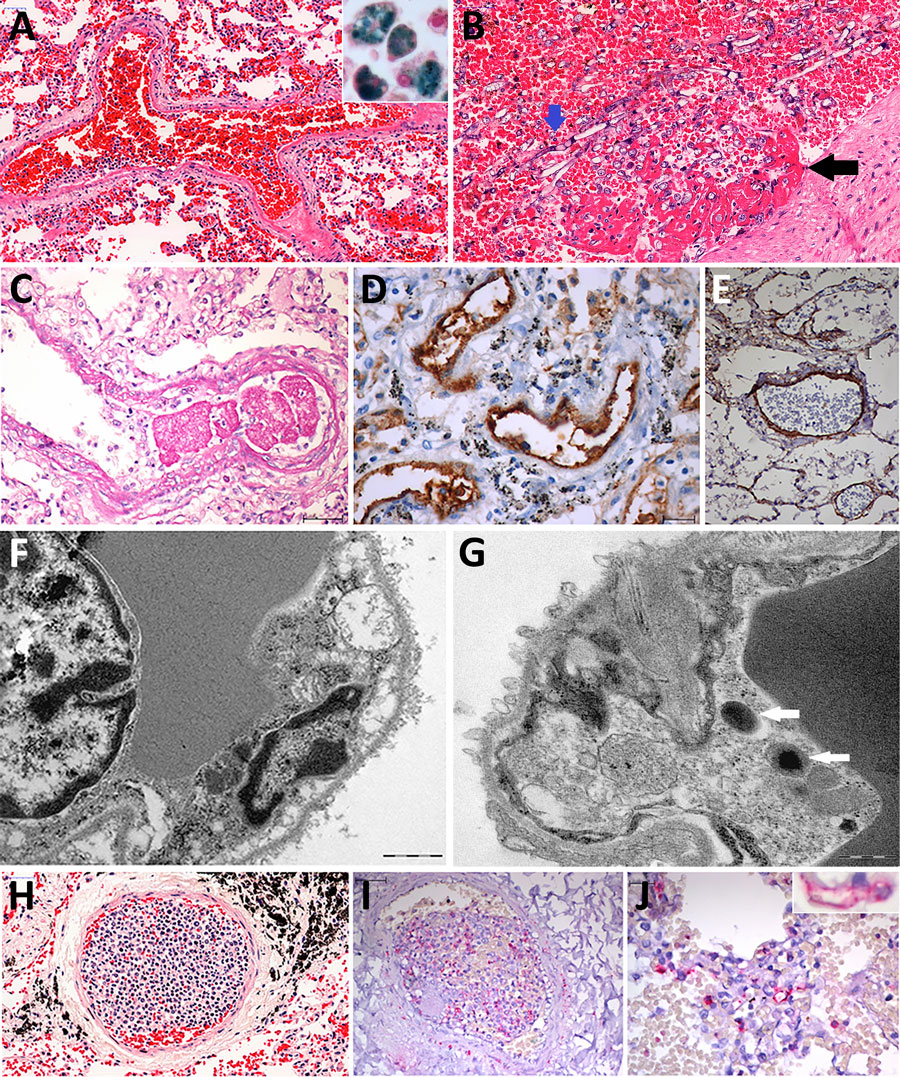
Figure 3. Pulmonary vascular damage in fatal yellow fever cases, 2017–2019 epidemic, São Paulo, Brazil. A) Medium-sized artery with fibrinoid necrosis of the endothelial layer, marginated leukocytes, wall edema, septal congestion, alveolar hemorrhage. Hematoxylin and eosin (HE) stain; scale bar 50 µm. Inset shows group of hemosiderin-laden alveolar macrophages stained for iron. Perls stain; original magnification ´200. B) Pulmonary artery showing angioinvasion by Aspergillus spp. forming fibrinous thrombus on the endothelial vascular layer (black arrow). HE stain; scale bar = 50 µm. C) A small fibrin clot and the artery fibrinoid necrosis and wall edema. Periodic acid–Schiff stain; scale bar = 50 µm. D) Positive detection of VIII coagulation factor in the entire wall of pulmonary arteries. Peroxidase stain; scale bar = 20 µm. E) The VCAM is detected in the endothelial and muscular pulmonary artery layers. Peroxidase stain; scale bar = 20 µm. F) Septal capillaries showing mitochondrial dilation with loss of cristae. Ultrathin section; scale bar = 1 µm. G) Bacilli (arrows) within septal pulmonary vessel. Ultrathin section; scale bar = 500 nm. H) Histologic leukostasis in a septal pulmonary artery, showing immature myeloid cells, lymphocytes, and neutrophils. HE stain; scale bar = 50 µm. I) Intravascular cells expressing yellow fever virus antigens in their cytoplasm. Alkaline phosphatase stain; scale bar = 50 µm. J) The yellow fever virus antigen is detected in the cytoplasm of septal endothelial cells (inset; original magnification ´400) and in interstitial and alveolar inflammatory cells. Alkaline phosphatase stain; scale bar = 20 µm.