Skip directly to site content Skip directly to page options Skip directly to A-Z link Skip directly to A-Z link Skip directly to A-Z link

Disclaimer: Early release articles are not considered as final versions. Any changes will be reflected in the online version in the month the article is officially released.

Volume 32, Number 2—February 2026

Research

Using Routine Surveillance Data to Assess Dengue Virus Transmission Risk in Travelers Returning to the United States

Kristyna Rysava1, Zachary J. Madewell1Comments to Author , Maile B. Thayer, Liliana Sánchez-González, Kamalich Muniz-Rodriguez, Ashley Brown, Julie Thwing, Laura E. Adams, Gabriela Paz-Bailey, and Michael A. Johansson
Author affiliation: University of Warwick, Warwick, UK (K. Rysava); Centers for Disease Control and Prevention, San Juan, Puerto Rico, USA (Z.J. Madewell, M.B. Thayer, L. Sánchez-González, K. Muniz-Rodriguez, L.E. Adams, G. Paz-Bailey, M.A. Johansson); Centers for Disease Control and Prevention, Atlanta, Georgia, USA (A. Brown, J. Thwing)

Main Article

Figure 1

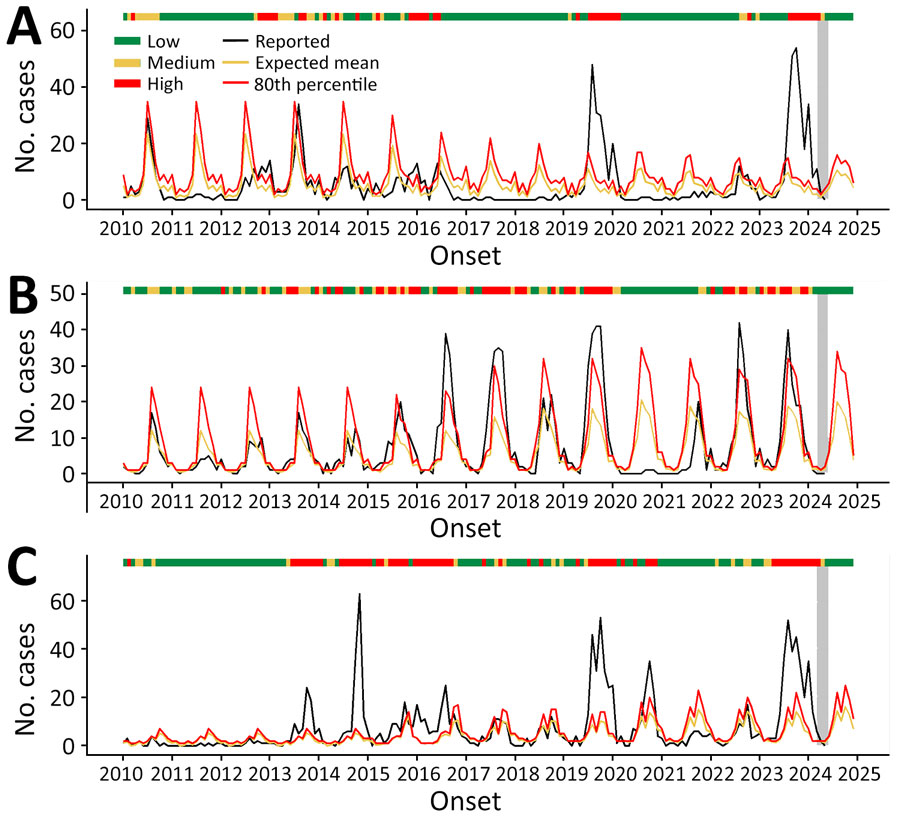
Temporal patterns and modeled transmission classification levels on the basis of percentile thresholds for dengue cases in travelers returning to the United States from the Dominican Republic (A), India (B), and Mexico (C), 2010–2024. Black line represents monthly dengue cases reported in US travelers. Yellow line represents expected mean number of cases on the basis of the fitted model. Red line represents the 80th percentile of the fitted distribution. Risk levels were categorized as low (green bar), medium (yellow bar), or high (red bar). We made those classifications on the basis of modeled case counts and did not incorporate the >10-case count criterion used in the Travel Health Notice classification. The most recent months of reported data at the time of analysis are shaded in gray to indicate periods of incomplete reporting. All 3 countries showed strong seasonal patterns and multiple sustained periods where traveler case counts exceeded the 80th percentile, reflected in frequent high-risk classifications, particularly during recent years (2022–2024).

Figure 1. Temporal patterns and modeled transmission classification levels on the basis of percentile thresholds for dengue cases in travelers returning to the United States from the Dominican Republic (A), India (B), and Mexico (C), 2010–2024. Black line represents monthly dengue cases reported in US travelers. Yellow line represents expected mean number of cases on the basis of the fitted model. Red line represents the 80th percentile of the fitted distribution. Risk levels were categorized as low (green bar), medium (yellow bar), or high (red bar). We made those classifications on the basis of modeled case counts and did not incorporate the >10-case count criterion used in the Travel Health Notice classification. The most recent months of reported data at the time of analysis are shaded in gray to indicate periods of incomplete reporting. All 3 countries showed strong seasonal patterns and multiple sustained periods where traveler case counts exceeded the 80th percentile, reflected in frequent high-risk classifications, particularly during recent years (2022–2024).

Main Article

1These first authors contributed equally to this article.

Page created: January 29, 2026
Page updated: February 15, 2026
Page reviewed: February 15, 2026
The conclusions, findings, and opinions expressed by authors contributing to this journal do not necessarily reflect the official position of the U.S. Department of Health and Human Services, the Public Health Service, the Centers for Disease Control and Prevention, or the authors' affiliated institutions. Use of trade names is for identification only and does not imply endorsement by any of the groups named above.
file_external