Volume 32, Number 3—March 2026
Dispatch
Optimal Specimens and Lesions for Mpox Diagnosis Using Real-Time PCR, South Korea
Dong-Min Kim, Munawir Muhammad, Jin Won Kim, Choon-Mee Kim, Jun-Won Seo, Da Young Kim, Na Ra Yun, Beomgi Lee, Minji Lee, Jeong Hyun Lee, Myung-Min Choi, and Yoon-Seok Chung
Figure 2
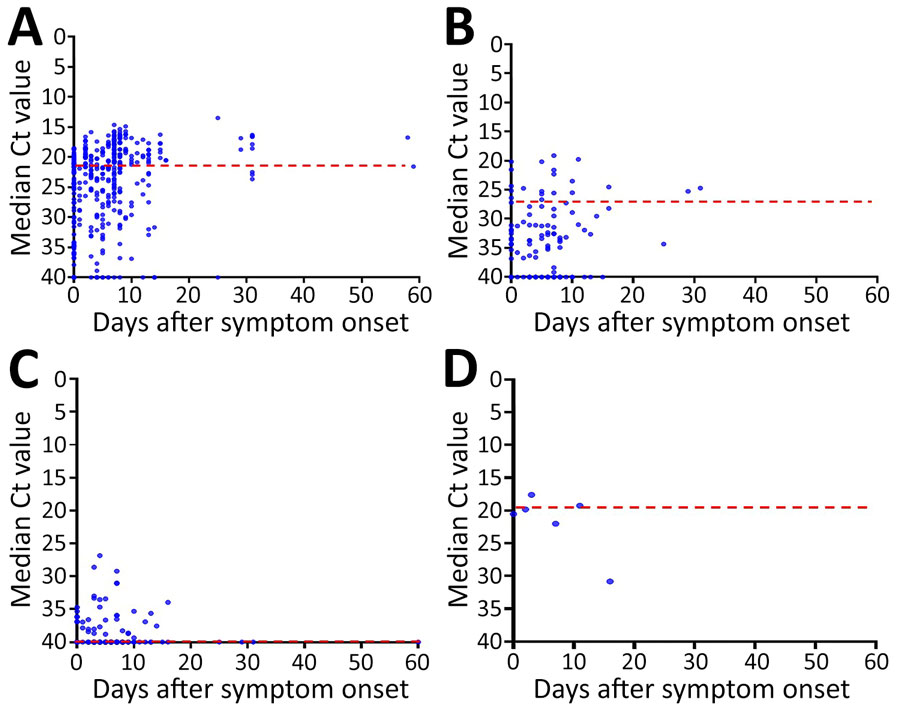
Figure 2. Monkeypox viral loads given as Ct values in patients with mpox, according to sampled sites and time of onset, South Korea, 2022–2023. Blue dots indicate Ct results for each sample. Red dashed lines represent median values. Ct, cycle threshold.
Page created: February 13, 2026
Page updated: March 20, 2026
Page reviewed: March 20, 2026
The conclusions, findings, and opinions expressed by authors contributing to this journal do not necessarily reflect the official position of the U.S. Department of Health and Human Services, the Public Health Service, the Centers for Disease Control and Prevention, or the authors' affiliated institutions. Use of trade names is for identification only and does not imply endorsement by any of the groups named above.