Skip directly to site content Skip directly to page options Skip directly to A-Z link Skip directly to A-Z link Skip directly to A-Z link

Volume 32, Number 3—March 2026

Dispatch

Natural Hendra Virus Infections in Captive Australian Black Flying Foxes, Queensland, Australia

Victoria Boyd, Anjana Karawita, Jianning Wang, Shawn Todd, Sarah Riddell, Rachel Layton, Grace Taylor, Michael L. Kelly, Teegan Allen, Sarah Caruso, Christopher C. Broder, Richard J. Ploeg, Gough G. Au, Gary Crameri, Anthony W. Purcell, and Michelle L. BakerComments to Author 
Author affiliation: Commonwealth Scientific and Industrial Research Organisation, Health and Biosecurity, Geelong, Victoria, Australia (V. Boyd, S. Todd, S. Caruso, M.L. Baker); Commonwealth Scientific and Industrial Research Organisation Australian Animal Health Laboratory, Geelong (A. Karawita, J. Wang, S. Riddell, R. Layton, G. Taylor, M.L. Kelly, T. Allen, R.J. Ploeg, G.G. Au); Uniformed Services University, Bethesda, Maryland, USA (C.C. Broder); Monash University, Clayton, Victoria, Australia (A.W. Purcell)

Main Article

Figure 1

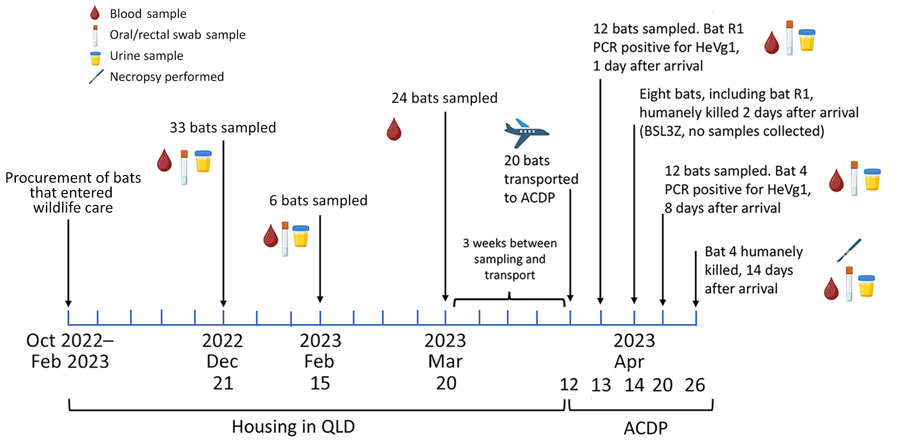
Timeline of events from inclusion of flying foxes in Queensland through to housing at ACDP from study of natural HeV infections in captive Australian black flying foxes, Queensland, Australia. Bats were added to the study as they became available December 2022–February 2023 after entering the care of bat rehabilitators in Queensland due to injuries. Samples collected from bat 4 at necropsy day 14 after arrival at ACDP included lung, liver, kidney, spleen, heart, ileum, large intestine, jejunum, salivary gland, retropharyngeal lymph node, submandibular lymph node, gonad, brain, cerebellum, urine, plasma, nasal wash, and oral and rectal swabs. Samples collected from individual bats are indicated on the timeline and included blood samples for serology and oral/rectal swab and urine samples for PCR. Urine was collected underneath individual cages for PCR testing on all days during the housing period at ACDP. ACDP, Australian Centre for Disease Preparedness; BSL, Biosafety Level; HeV, Hendra virus; HeVg1, HeV genotype 1 variant.

Figure 1. Timeline of events from inclusion of flying foxes in Queensland through to housing at ACDP from study of natural HeV infections in captive Australian black flying foxes, Queensland, Australia. Bats were added to the study as they became available December 2022–February 2023 after entering the care of bat rehabilitators in Queensland due to injuries. Samples collected from bat 4 at necropsy day 14 after arrival at ACDP included lung, liver, kidney, spleen, heart, ileum, large intestine, jejunum, salivary gland, retropharyngeal lymph node, submandibular lymph node, gonad, brain, cerebellum, urine, plasma, nasal wash, and oral and rectal swabs. Samples collected from individual bats are indicated on the timeline and included blood samples for serology and oral/rectal swab and urine samples for PCR. Urine was collected underneath individual cages for PCR testing on all days during the housing period at ACDP. ACDP, Australian Centre for Disease Preparedness; BSL, Biosafety Level; HeV, Hendra virus; HeVg1, HeV genotype 1 variant.

Main Article

Page created: February 27, 2026
Page updated: March 20, 2026
Page reviewed: March 20, 2026
The conclusions, findings, and opinions expressed by authors contributing to this journal do not necessarily reflect the official position of the U.S. Department of Health and Human Services, the Public Health Service, the Centers for Disease Control and Prevention, or the authors' affiliated institutions. Use of trade names is for identification only and does not imply endorsement by any of the groups named above.
file_external