Skip directly to site content Skip directly to page options Skip directly to A-Z link Skip directly to A-Z link Skip directly to A-Z link

Volume 32, Number 3—March 2026

Dispatch

Natural Hendra Virus Infections in Captive Australian Black Flying Foxes, Queensland, Australia

Victoria Boyd, Anjana Karawita, Jianning Wang, Shawn Todd, Sarah Riddell, Rachel Layton, Grace Taylor, Michael L. Kelly, Teegan Allen, Sarah Caruso, Christopher C. Broder, Richard J. Ploeg, Gough G. Au, Gary Crameri, Anthony W. Purcell, and Michelle L. BakerComments to Author 
Author affiliation: Commonwealth Scientific and Industrial Research Organisation, Health and Biosecurity, Geelong, Victoria, Australia (V. Boyd, S. Todd, S. Caruso, M.L. Baker); Commonwealth Scientific and Industrial Research Organisation Australian Animal Health Laboratory, Geelong (A. Karawita, J. Wang, S. Riddell, R. Layton, G. Taylor, M.L. Kelly, T. Allen, R.J. Ploeg, G.G. Au); Uniformed Services University, Bethesda, Maryland, USA (C.C. Broder); Monash University, Clayton, Victoria, Australia (A.W. Purcell)

Main Article

Figure 2

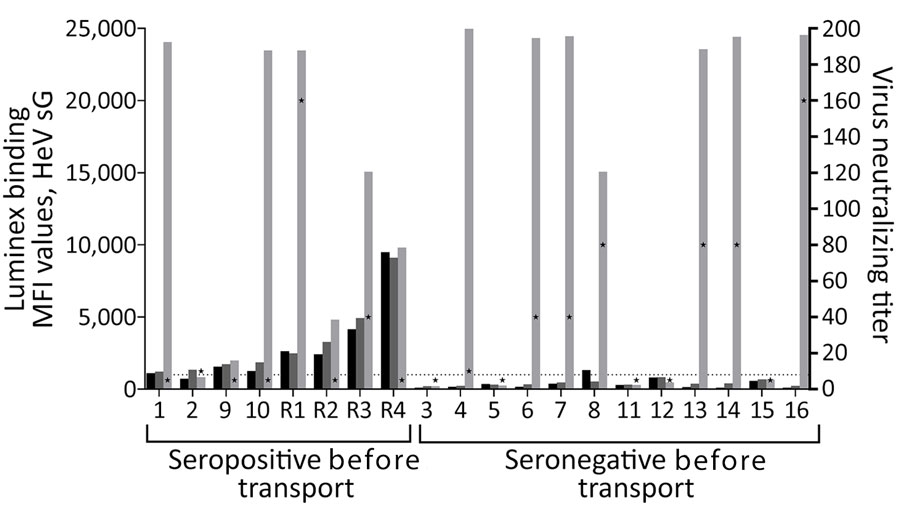
HeV serology of 20 flying foxes following arrival at Australian Centre for Disease Preparedness (ACDP) for a study of natural Hendra virus infections in captive Australian black flying foxes, Queensland, Australia. Detection of antibodies against HeV sG by an in-house Luminex indirect antibody binding serology assay in 20 flying foxes monitored in Queensland in December 2022 and February 2023 (black bars) and March 2023 (dark gray bars) before transport and 1 day after arrival at ACDP (light gray bars). Luminex data displayed as bars (left y-axis) representing MFI. Virus neutralization tests shown as star symbols (right y-axis). Samples with MFI >1000 (dotted line) considered positive. MFI values classified as high (>10,000), medium (4,000–10,000), low (1,000–4,000), and negative (<1,000). Virus neutralization test results were performed only on samples collected 1 day after arrival at ACDP. Bat identification numbers are indicated on the x-axis. All Luminex serologic testing on samples collected in Queensland and ACDP were performed at ACDP on a Bioplex 200 Array system integrated with Bio-Plex Manager Software 6.2 (Bio-Rad Laboratories, https://www.bio-rad.com). MFI, median fluorescence intensity.

Figure 2. HeV serology of 20 flying foxes following arrival at Australian Centre for Disease Preparedness (ACDP) for a study of natural Hendra virus infections in captive Australian black flying foxes, Queensland, Australia. Detection of antibodies against HeV sG by an in-house Luminex indirect antibody binding serology assay in 20 flying foxes monitored in Queensland in December 2022 and February 2023 (black bars) and March 2023 (dark gray bars) before transport and 1 day after arrival at ACDP (light gray bars). Luminex data displayed as bars (left y-axis) representing MFI. Virus neutralization tests shown as star symbols (right y-axis). Samples with MFI >1000 (dotted line) considered positive. MFI values classified as high (>10,000), medium (4,000–10,000), low (1,000–4,000), and negative (<1,000). Virus neutralization test results were performed only on samples collected 1 day after arrival at ACDP. Bat identification numbers are indicated on the x-axis. All Luminex serologic testing on samples collected in Queensland and ACDP were performed at ACDP on a Bioplex 200 Array system integrated with Bio-Plex Manager Software 6.2 (Bio-Rad Laboratories, https://www.bio-rad.com). MFI, median fluorescence intensity.

Main Article

Page created: February 27, 2026
Page updated: March 20, 2026
Page reviewed: March 20, 2026
The conclusions, findings, and opinions expressed by authors contributing to this journal do not necessarily reflect the official position of the U.S. Department of Health and Human Services, the Public Health Service, the Centers for Disease Control and Prevention, or the authors' affiliated institutions. Use of trade names is for identification only and does not imply endorsement by any of the groups named above.
file_external