Volume 32, Number 3—March 2026
Research
Genetically Similar High-Risk Strains of Carbapenemase-Producing Enterobacterales in Humans and Companion Animals, United States
Lingzi Xiaoli, Allison E. James , Anna L. Stahl, Maho Okumura, Stephen D. Cole, Jaclyn M. Dietrich, Molly M. Leeper, Jordan K. Putney, Maroya Spalding Walters, and Richard A. Stanton
, Anna L. Stahl, Maho Okumura, Stephen D. Cole, Jaclyn M. Dietrich, Molly M. Leeper, Jordan K. Putney, Maroya Spalding Walters, and Richard A. Stanton
Figure 3
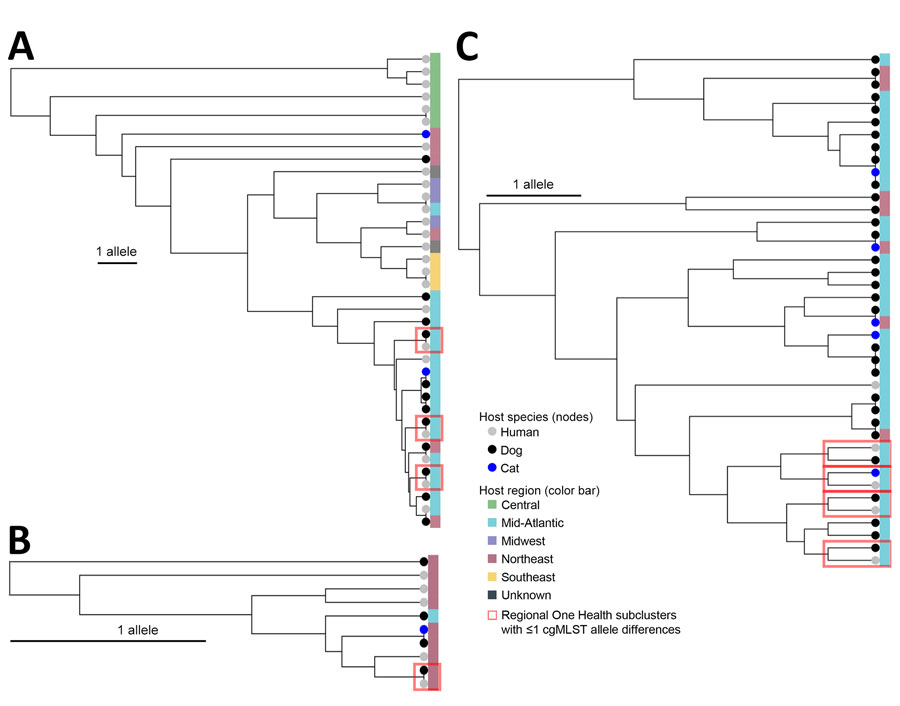
Figure 3. Phylogenetic core-genome multilocus sequence typing trees of Escherichia coli sequence type (ST) 617, Klebsiella pneumoniae ST307, and Enterobacter cloacae ST171 One Health clusters in study of genetically similar high-risk strains of carbapenemase-producing Enterobacterales in humans and companion animals, United States. The tree nodes are colored by host species, and the bands on the right are colored by the region of patient residence. cgMLST, core-genome multilocus sequence typing.
Page created: February 07, 2026
Page updated: March 20, 2026
Page reviewed: March 20, 2026
The conclusions, findings, and opinions expressed by authors contributing to this journal do not necessarily reflect the official position of the U.S. Department of Health and Human Services, the Public Health Service, the Centers for Disease Control and Prevention, or the authors' affiliated institutions. Use of trade names is for identification only and does not imply endorsement by any of the groups named above.