Volume 32, Number 4—April 2026
Etymologia
Anopheles stephensi [ә-nah′-fuhl-ēz ste′-fen-zī]

Cite This Article
Citation for Media
Figure
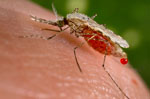
Figure. Female Anopheles stephensi mosquito. Photograph by Jim Gathany, from the Centers for Disease Control and Prevention Public Health Image Library.
In 1901, George Michael James Giles, a lieutenant colonel and physician in the Indian Medical Service, described the Anopheles stephensi mosquito (Figure). He collected the mosquitoes from Ellichpur (currently Amravati district), India, and named the species in honor of John William Watson Stephens, a prominent British parasitologist who first described Plasmodium ovale, one of the human malaria parasites. Morphologically, An. stephensi mosquitoes can be identified by distinctive palpal ornamentation of equal apical and subapical pale bands and speckled appearance, pale and dark scales arranged along the veins of the wings, and dark and speckled pale bands on the hind tarsi.
An. stephensi (family Culicidae, subgenus Cellia) is an urban malaria vector responsible for ≈12% of malaria cases in India annually. After its detection in Africa in 2012, An. stephensi mosquitoes, if not controlled, are projected to put more than 126 million persons at risk for malaria.
Acknowledgment
We are grateful to Anup Anvikar, director of ICMR-National Institute of Malaria Research, Delhi, for providing institutional support.
References
- Liston WG. A year’s experience of the habits of Anopheles in Ellichpur. The description of the species of Anopheles found in Ellichpur during the year. Ind Med Gaz. 1901;36:441–3.PubMedGoogle Scholar
- Sinka ME, Pironon S, Massey NC, Longbottom J, Hemingway J, Moyes CL, et al. A new malaria vector in Africa: Predicting the expansion range of Anopheles stephensi and identifying the urban populations at risk. Proc Natl Acad Sci U S A. 2020;117:24900–8. DOIPubMedGoogle Scholar
- Subbarao SK, Vasantha K, Adak T, Sharma VP, Curtis CF. Egg-float ridge number in Anopheles stephensi: ecological variation and genetic analysis. Med Vet Entomol. 1987;1:265–71. DOIPubMedGoogle Scholar
Figure
Cite This ArticleOriginal Publication Date: March 30, 2026
Related Links
Table of Contents – Volume 32, Number 4—April 2026
| EID Search Options |
|---|
 Advanced Article Search – Search articles by author and/or keyword.
|
 Articles by Country Search – Search articles by the topic country.
|
 Article Type Search – Search articles by article type and issue.
|
Please use the form below to submit correspondence to the authors or contact them at the following address:
Jaspreet Kaur, ICMR-National Institute of Malaria Research, Sector-8, Dwarka, Delhi 110077, India
Top