Skip directly to site content Skip directly to page options Skip directly to A-Z link Skip directly to A-Z link Skip directly to A-Z link

Disclaimer: Early release articles are not considered as final versions. Any changes will be reflected in the online version in the month the article is officially released.

Volume 32, Number 4—April 2026

Research

Evaluation of Effectiveness of Autocidal Gravid Ovitraps for Preventing Zika Virus Infection, Puerto Rico, USA

Zachary J. MadewellComments to Author , Sandra J. Kiplagat, India Kellum, Matthew J. Lozier, Olga Lorenzi, Janice Perez-Padilla, Freddy A. Medina, Jorge L. Muñoz-Jordán, Laura E. Adams, Gabriela Paz-Bailey, Stephen H. Waterman, Roberto Barrera, and Tyler M. Sharp
Author affiliation: Centers for Disease Control and Prevention, San Juan, Puerto Rico, USA (Z.J. Madewell, S.J. Kiplagat, I. Kellum, M.J. Lozier, O. Lorenzi, J. Perez-Padilla, F.A. Medina, J.-L. Muñoz-Jordán, L.E. Adams, G. Paz-Bailey, S.H. Waterman, R. Barrera, T.M. Sharp); US Public Health Service Commissioned Corps, Rockville, Maryland, USA (L.E. Adams, T.M. Sharp)

Main Article

Figure 1

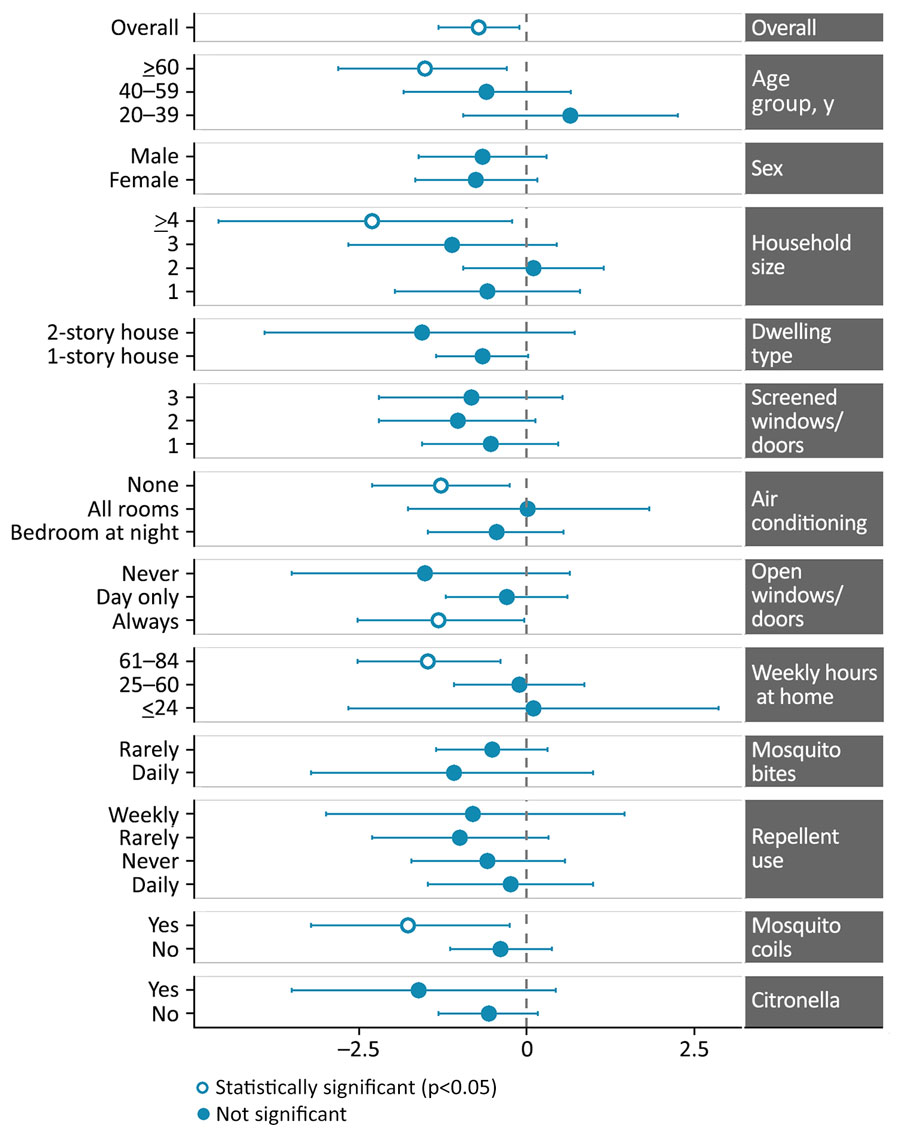
Adjusted prevalence ratios for ZIKV seropositivity by demographic and behavioral characteristic among participants in an evaluation of effectiveness of autocidal gravid ovitraps for preventing Zika virus infection, Puerto Rico, USA. Values left of 0 (corresponding to adjusted prevalence ratio <1) indicate lower ZIKV seroprevalence in intervention communities. log-adjusted prevalence ratios show statistically significant (p<0.05) overall seroprevalence reduction, and specific reductions among older adults (>60 years of age), participants in larger households (>4 persons), those without air conditioning, those who always kept windows or doors open, and those spending >61 hours/week at home. Use of mosquito coils was also associated with reduced ZIKV seropositivity in intervention areas. Error bars represent 95% CIs. ZIKV, Zika virus.

Figure 1. Adjusted prevalence ratios for ZIKV seropositivity by demographic and behavioral characteristic among participants in an evaluation of effectiveness of autocidal gravid ovitraps for preventing Zika virus infection, Puerto Rico, USA. Values left of 0 (corresponding to adjusted prevalence ratio <1) indicate lower ZIKV seroprevalence in intervention communities. log-adjusted prevalence ratios show statistically significant (p<0.05) overall seroprevalence reduction, and specific reductions among older adults (>60 years of age), participants in larger households (>4 persons), those without air conditioning, those who always kept windows or doors open, and those spending >61 hours/week at home. Use of mosquito coils was also associated with reduced ZIKV seropositivity in intervention areas. Error bars represent 95% CIs. ZIKV, Zika virus.

Main Article

Page created: March 04, 2026
Page updated: April 01, 2026
Page reviewed: April 01, 2026
The conclusions, findings, and opinions expressed by authors contributing to this journal do not necessarily reflect the official position of the U.S. Department of Health and Human Services, the Public Health Service, the Centers for Disease Control and Prevention, or the authors' affiliated institutions. Use of trade names is for identification only and does not imply endorsement by any of the groups named above.
file_external