Skip directly to site content Skip directly to page options Skip directly to A-Z link Skip directly to A-Z link Skip directly to A-Z link

Disclaimer: Early release articles are not considered as final versions. Any changes will be reflected in the online version in the month the article is officially released.

Volume 32, Number 4—April 2026

Research

Evaluation of Effectiveness of Autocidal Gravid Ovitraps for Preventing Zika Virus Infection, Puerto Rico, USA

Zachary J. MadewellComments to Author , Sandra J. Kiplagat, India Kellum, Matthew J. Lozier, Olga Lorenzi, Janice Perez-Padilla, Freddy A. Medina, Jorge L. Muñoz-Jordán, Laura E. Adams, Gabriela Paz-Bailey, Stephen H. Waterman, Roberto Barrera, and Tyler M. Sharp
Author affiliation: Centers for Disease Control and Prevention, San Juan, Puerto Rico, USA (Z.J. Madewell, S.J. Kiplagat, I. Kellum, M.J. Lozier, O. Lorenzi, J. Perez-Padilla, F.A. Medina, J.-L. Muñoz-Jordán, L.E. Adams, G. Paz-Bailey, S.H. Waterman, R. Barrera, T.M. Sharp); US Public Health Service Commissioned Corps, Rockville, Maryland, USA (L.E. Adams, T.M. Sharp)

Main Article

Figure 2

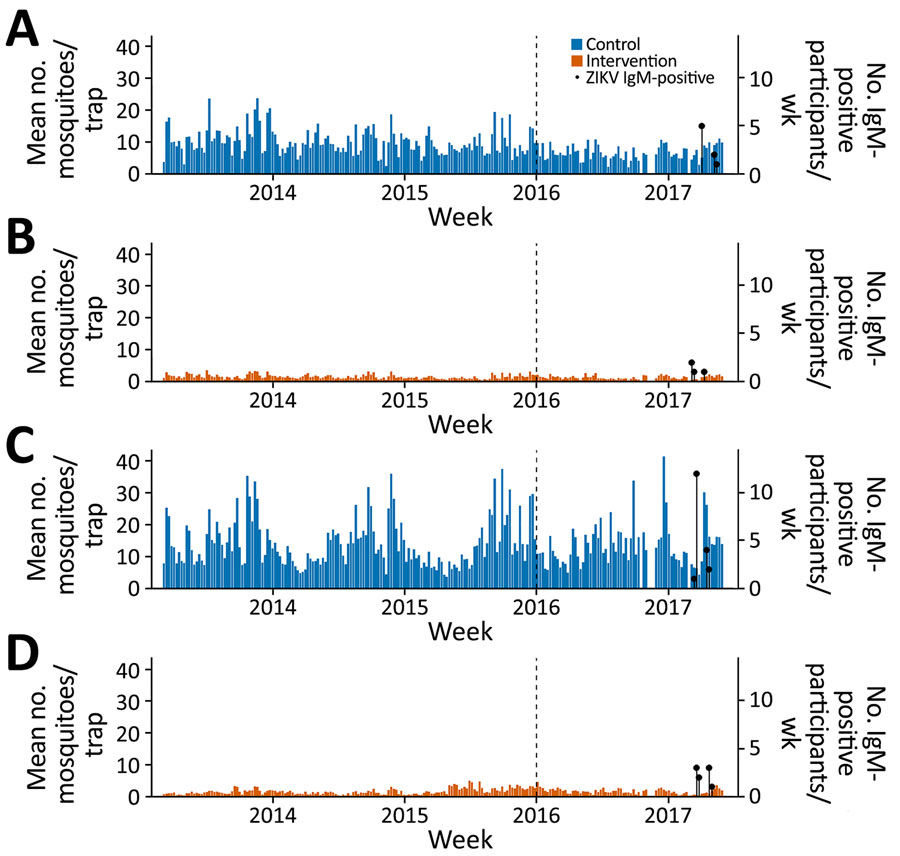
Weekly Aedes aegypti mosquito abundance from an evaluation of effectiveness of autocidal gravid ovitraps (AGOs) for preventing Zika virus infection, Puerto Rico, USA. Mean mosquito counts per surveillance trap are shown weekly for each of the 4 study communities: A) Arboleda; B) La Margarita; C) La Playa; D) Villodas. Intervention communities had AGOs. Black lollipop markers indicate the weekly number of ZIKV IgM–positive participants identified during the 2017 postepidemic serosurvey. Dashed vertical lines indicate first known ZIKV case in Puerto Rico on December 31, 2015. Mosquito abundance remained substantially lower in intervention communities throughout the epidemic period, aligning with the reduced ZIKV seroprevalence observed in those areas. Scales for the y-axes differ substantially to underscore patterns but do not permit direct comparisons. ZIKV, Zika virus.

Figure 2. Weekly Aedes aegypti mosquito abundance from an evaluation of effectiveness of autocidal gravid ovitraps (AGOs) for preventing Zika virus infection, Puerto Rico, USA. Mean mosquito counts per surveillance trap are shown weekly for each of the 4 study communities: A) Arboleda; B) La Margarita; C) La Playa; D) Villodas. Intervention communities had AGOs. Black lollipop markers indicate the weekly number of ZIKV IgM–positive participants identified during the 2017 postepidemic serosurvey. Dashed vertical lines indicate first known ZIKV case in Puerto Rico on December 31, 2015. Mosquito abundance remained substantially lower in intervention communities throughout the epidemic period, aligning with the reduced ZIKV seroprevalence observed in those areas. Scales for the y-axes differ substantially to underscore patterns but do not permit direct comparisons. ZIKV, Zika virus.

Main Article

Page created: March 04, 2026
Page updated: April 01, 2026
Page reviewed: April 01, 2026
The conclusions, findings, and opinions expressed by authors contributing to this journal do not necessarily reflect the official position of the U.S. Department of Health and Human Services, the Public Health Service, the Centers for Disease Control and Prevention, or the authors' affiliated institutions. Use of trade names is for identification only and does not imply endorsement by any of the groups named above.
file_external