Volume 32, Number 4—April 2026
Research
Respirable Aerosol Production and Reduction of Avian Influenza Transmission Risk during Chicken Processing, Bangladesh
Nadia Ali Rimi , Md. Khaled Saifullah, Md. Habibullah Fahad, Kamal Hossain, Rebeca Sultana, Ireen Sultana Shanta, David E. Swayne, Syed Mohammad Golam Mortaza, Md. Giasuddin, Md. Zakir Hassan, Christopher LeBoa, Debashish Biswas, Mahbubur Rahman, Joshua A. Mott, Erin D. Kennedy, and William G. Lindsley1
, Md. Khaled Saifullah, Md. Habibullah Fahad, Kamal Hossain, Rebeca Sultana, Ireen Sultana Shanta, David E. Swayne, Syed Mohammad Golam Mortaza, Md. Giasuddin, Md. Zakir Hassan, Christopher LeBoa, Debashish Biswas, Mahbubur Rahman, Joshua A. Mott, Erin D. Kennedy, and William G. Lindsley1
Figure 1
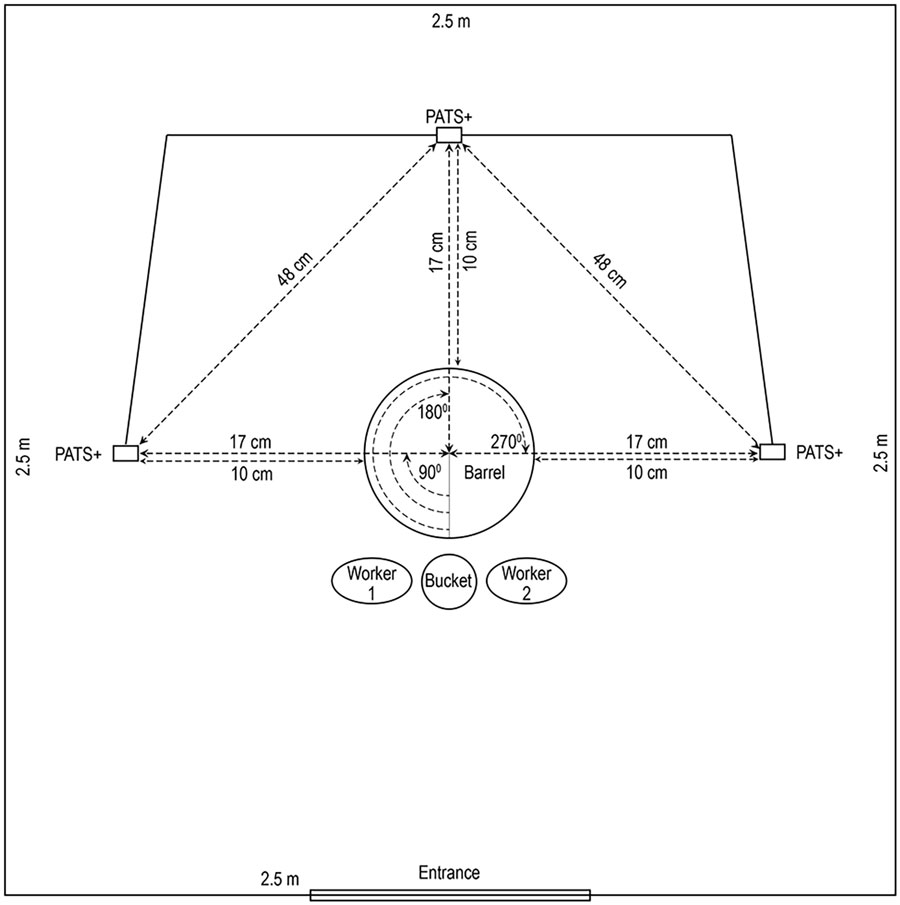
Figure 1. Diagram of placement of equipment and particle monitors inside booth for chicken slaughtering experiments at Bangladesh Livestock Research Institute, Savar, Dhaka, 2020, in study of respirable aerosol production and reduction of avian influenza transmission risk during chicken processing. The PATS+ monitors (Berkeley Air Monitoring Group, https://berkeleyair.com) were positioned at human breathing level (148 cm) in 3 angular positions: left (90°), opposite (180°), and right (270°) relative to the entrance. PATS+, Particle and Temperature Sensor Plus.
1Current affiliation: Virginia Polytechnic Institute and State University, Blacksburg, Virginia, USA.
Page created: March 04, 2026
Page updated: April 15, 2026
Page reviewed: April 15, 2026
The conclusions, findings, and opinions expressed by authors contributing to this journal do not necessarily reflect the official position of the U.S. Department of Health and Human Services, the Public Health Service, the Centers for Disease Control and Prevention, or the authors' affiliated institutions. Use of trade names is for identification only and does not imply endorsement by any of the groups named above.