Volume 32, Number 4—April 2026
Research
Respirable Aerosol Production and Reduction of Avian Influenza Transmission Risk during Chicken Processing, Bangladesh
 , Md. Khaled Saifullah, Md. Habibullah Fahad, Kamal Hossain, Rebeca Sultana, Ireen Sultana Shanta, David E. Swayne, Syed Mohammad Golam Mortaza, Md. Giasuddin, Md. Zakir Hassan, Christopher LeBoa, Debashish Biswas, Mahbubur Rahman, Joshua A. Mott, Erin D. Kennedy, and William G. Lindsley1
Figure 4
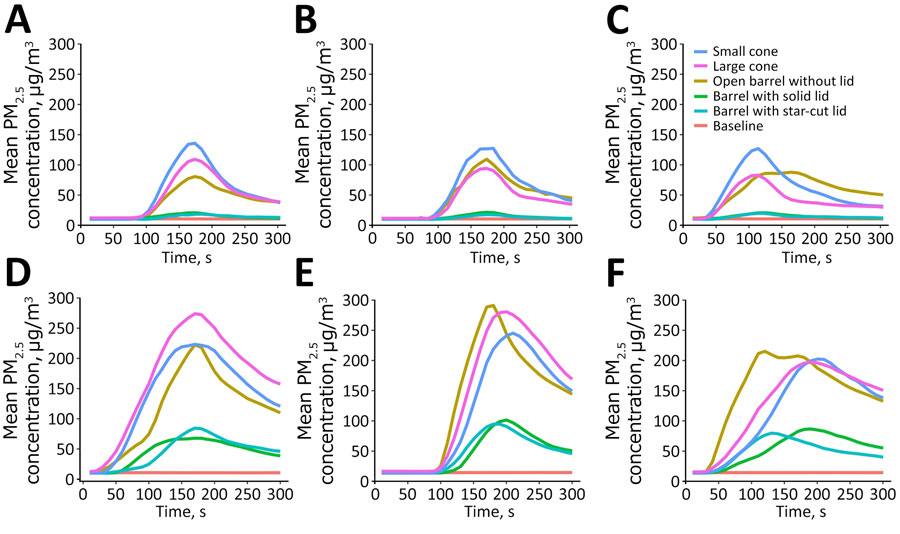
Figure 4. Average PM2.5 mass concentration during single and multiple chicken slaughtering methods in study of respirable aerosol production and reduction of avian influenza transmission risk during chicken processing, Bangladesh Livestock Research Institute, Savar, Dhaka, 2020. Results reported by Particle and Temperature Sensor Plus monitors (Berkeley Air Monitoring Group, https://berkeleyair.com) are shown for each angle position of sensor. A) Single chicken slaughtering; angle 90°. B) Single chicken slaughtering; angle 180°. C) Single chicken slaughtering; angle 270°. D) Multiple chicken slaughtering; angle 90°. E) Multiple chickens slaughtering; angle 180°. F) Multiple chicken slaughtering; angle 270°. PM2.5, particulate matter <2.5 μm in diameter.
1Current affiliation: Virginia Polytechnic Institute and State University, Blacksburg, Virginia, USA.