Skip directly to site content Skip directly to page options Skip directly to A-Z link Skip directly to A-Z link Skip directly to A-Z link

Disclaimer: Early release articles are not considered as final versions. Any changes will be reflected in the online version in the month the article is officially released.

Volume 32, Number 5—May 2026

Research

Updated Genomic Epidemiologic Description of Candida (Candidozyma) auris, United States

Lindsay A. ParnellComments to Author , Amanda Ribeiro Dos Santos, Kaitlin Forsberg, Meghan Lyman, Elizabeth Misas, Lalitha Gade, D. Joseph Sexton, Anastasia P. Litvintseva, and Nancy A. Chow
Author affiliation: Centers for Disease Control and Prevention, Atlanta, Georgia, USA

Main Article

Figure 3

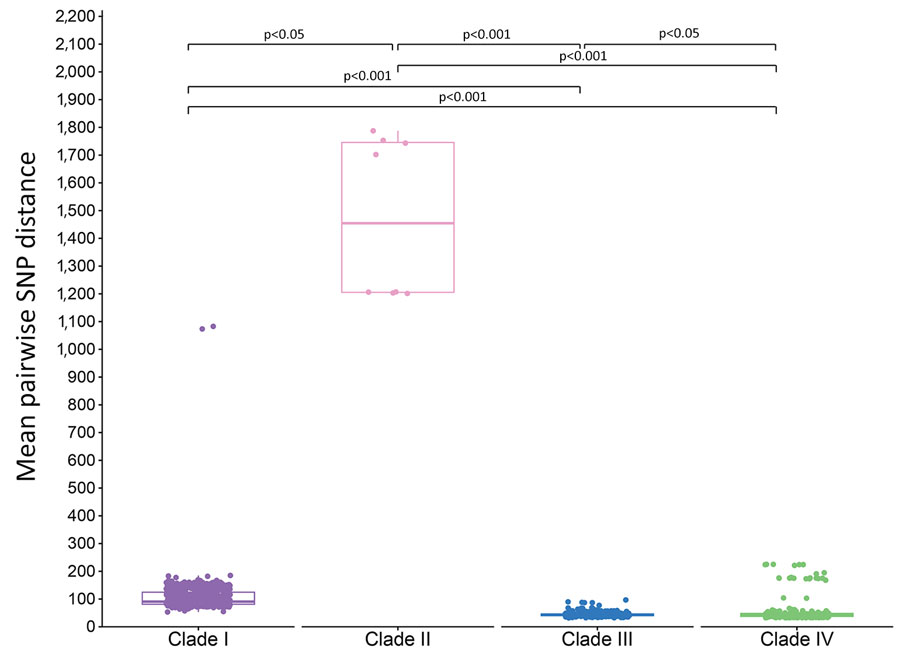
Pairwise SNP distances from study of genomic epidemiologic description of Candida (Candidozyma) auris isolates, by clade, United States. Tukey boxplots summarize pairwise SNP distances within each clade; horizontal line within box indicates the median, upper and lower boundaries indicate interquartile range); whiskers indicate largest and smallest distance value within 1.5 times the interquartile range. Dots correspond to each isolate’s mean pairwise SNP distance within its clade. The Kruskal-Wallis test with posthoc Dunn test indicated significant differences in pairwise SNP distances between all clade pairs. Reference strains used were as follows: clade I, B11205 (GenBank accession no. GCA_016772135.1); clade II, B11220 (GenBank accession no. GCA_003013715.2); clade III, B11221 (GenBank accession no. GCF_002775015.1); clade IV, B11243 (GenBank accession no. GCA_003014415.1). SNP, single-nucleotide polymorphism.

Figure 3. Pairwise SNP distances from study of genomic epidemiologic description of Candida (Candidozyma) auris isolates, by clade, United States. Tukey boxplots summarize pairwise SNP distances within each clade; horizontal line within box indicates the median, upper and lower boundaries indicate interquartile range); whiskers indicate largest and smallest distance value within 1.5 times the interquartile range. Dots correspond to each isolate’s mean pairwise SNP distance within its clade. The Kruskal-Wallis test with posthoc Dunn test indicated significant differences in pairwise SNP distances between all clade pairs. Reference strains used were as follows: clade I, B11205 (GenBank accession no. GCA_016772135.1); clade II, B11220 (GenBank accession no. GCA_003013715.2); clade III, B11221 (GenBank accession no. GCF_002775015.1); clade IV, B11243 (GenBank accession no. GCA_003014415.1). SNP, single-nucleotide polymorphism.

Main Article

Page created: April 01, 2026
Page updated: April 23, 2026
Page reviewed: April 23, 2026
The conclusions, findings, and opinions expressed by authors contributing to this journal do not necessarily reflect the official position of the U.S. Department of Health and Human Services, the Public Health Service, the Centers for Disease Control and Prevention, or the authors' affiliated institutions. Use of trade names is for identification only and does not imply endorsement by any of the groups named above.
file_external