Volume 32, Number 5—May 2026
Research
Updated Genomic Epidemiologic Description of Candida (Candidozyma) auris, United States
Lindsay A. Parnell , Amanda Ribeiro Dos Santos, Kaitlin Forsberg, Meghan Lyman, Elizabeth Misas, Lalitha Gade, D. Joseph Sexton, Anastasia P. Litvintseva, and Nancy A. Chow
, Amanda Ribeiro Dos Santos, Kaitlin Forsberg, Meghan Lyman, Elizabeth Misas, Lalitha Gade, D. Joseph Sexton, Anastasia P. Litvintseva, and Nancy A. Chow
Figure 6
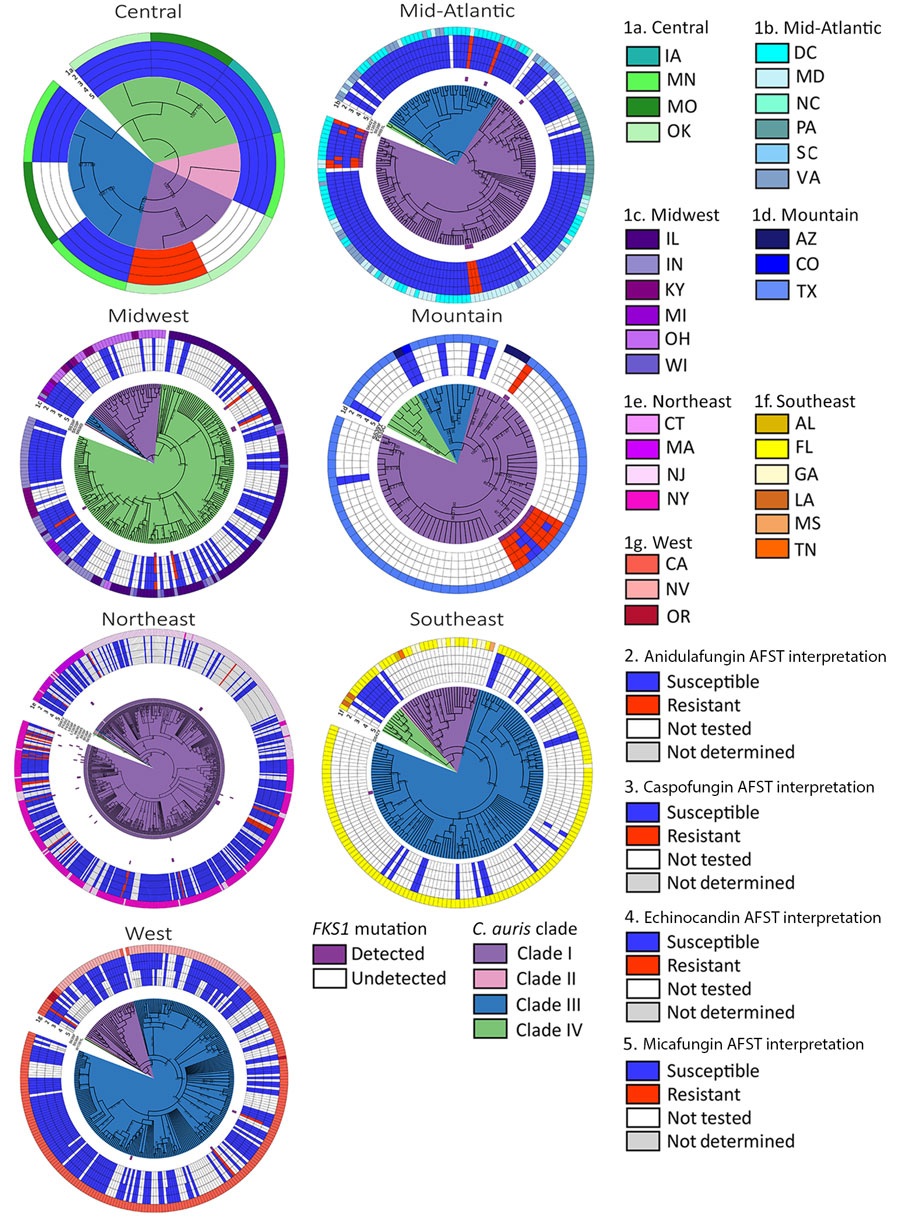
Figure 6. Midpoint-rooted maximum-likelihood phylogenetic trees of sequenced isolates, by region, from study of genomic epidemiologic description of Candida (Candidozyma) auris, United States, using clade-specific references. Clades are distinguished on the phylogenetic trees. Branch lengths are annotated with bootstrap support values (Shimodaira-Hasegawa–like approximate likelihood ratio test//ultrafast bootstrap approximation), where Shimodaira-Hasegawa–like approximate likelihood ratio test is >80 and ultrafast bootstrap approximation is >95. AFST, antifungal susceptibility testing.
Page created: April 01, 2026
Page updated: May 06, 2026
Page reviewed: May 06, 2026
The conclusions, findings, and opinions expressed by authors contributing to this journal do not necessarily reflect the official position of the U.S. Department of Health and Human Services, the Public Health Service, the Centers for Disease Control and Prevention, or the authors' affiliated institutions. Use of trade names is for identification only and does not imply endorsement by any of the groups named above.