Skip directly to site content Skip directly to page options Skip directly to A-Z link Skip directly to A-Z link Skip directly to A-Z link

Disclaimer: Early release articles are not considered as final versions. Any changes will be reflected in the online version in the month the article is officially released.

Volume 32, Number 5—May 2026

Research

Updated Genomic Epidemiologic Description of Candida (Candidozyma) auris, United States

Lindsay A. ParnellComments to Author , Amanda Ribeiro Dos Santos, Kaitlin Forsberg, Meghan Lyman, Elizabeth Misas, Lalitha Gade, D. Joseph Sexton, Anastasia P. Litvintseva, and Nancy A. Chow
Author affiliation: Centers for Disease Control and Prevention, Atlanta, Georgia, USA

Main Article

Figure 1

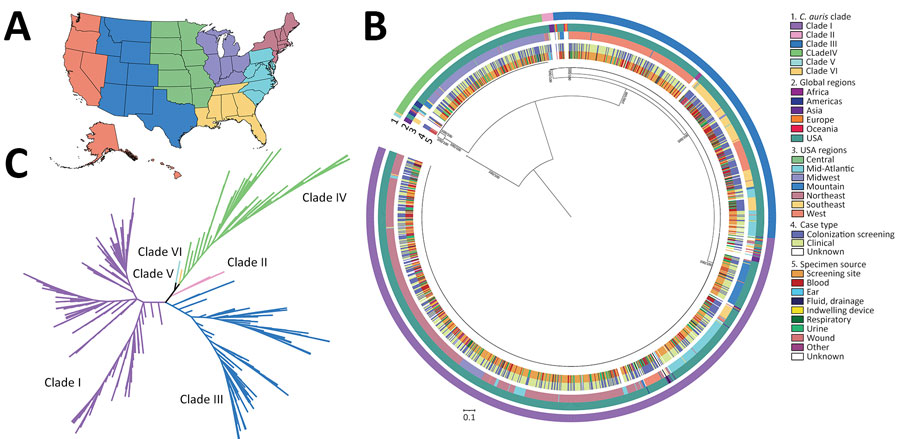
Phylogenetic characterization of sequenced isolates from study of genomic epidemiologic description of Candida (Candidozyma) auris in the United States. A) US map showing regions where sequenced cases originated, as defined by the Centers for Disease Control and Prevention Antimicrobial Resistance Laboratory Network (colors defined in section 3 of key at right). B) Maximum-likelihood phylogenetic tree, rooted at the midpoint, represents cases sequenced from the United States (n = 1,535) and various global regions (n = 75). C) Genetic relationships among cases represented as an unrooted phylogenetic tree colored by clade. All US cases cluster within clades I–IV. The phylogenetic trees were inferred from 421,678 whole-genome single nucleotide polymorphisms. Bootstrap support values between major clades were 100, as determined by the IQ-TREE SH-aLRT/UFboot methods.

Figure 1. Phylogenetic characterization of sequenced isolates from study of genomic epidemiologic description of Candida (Candidozyma) auris in the United States. A) US map showing regions where sequenced cases originated, as defined by the Centers for Disease Control and Prevention Antimicrobial Resistance Laboratory Network (colors defined in section 3 of key at right). B) Maximum-likelihood phylogenetic tree, rooted at the midpoint, represents cases sequenced from the United States (n = 1,535) and various global regions (n = 75). C) Genetic relationships among cases represented as an unrooted phylogenetic tree colored by clade. All US cases cluster within clades I–IV. The phylogenetic trees were inferred from 421,678 whole-genome single nucleotide polymorphisms. Bootstrap support values between major clades were 100, as determined by the IQ-TREE SH-aLRT/UFboot methods.

Main Article

Page created: April 01, 2026
Page updated: April 23, 2026
Page reviewed: April 23, 2026
The conclusions, findings, and opinions expressed by authors contributing to this journal do not necessarily reflect the official position of the U.S. Department of Health and Human Services, the Public Health Service, the Centers for Disease Control and Prevention, or the authors' affiliated institutions. Use of trade names is for identification only and does not imply endorsement by any of the groups named above.
file_external