Skip directly to site content Skip directly to page options Skip directly to A-Z link Skip directly to A-Z link Skip directly to A-Z link

Volume 32, Number 5—May 2026

Dispatch

Severe Respiratory Illness and Death Associated with Outbreak of Human Rhinovirus B14 among Older Adults, France, 2024

Julien Andreani, Céline Boschi, Anne Decoppet, Jeremy Delerce, Gwilherm Penant, Aylin Karadeniz, Clio Grimaldier, Priscilla Jardot, Laure Zangoli, Maud Mandy, Nicole Vigroux, Florent Polesso, Sophie Edouard, Philippe Cano, Jean-Christophe Lagier, Bernard La ScolaComments to Author , and Philippe ColsonComments to Author 
Author affiliation: Institut hospitalo-universitaire Méditerranée Infection, Marseille, France (J. Andreani, C. Boschi, J. Delerce, G. Penant, A. Karadeniz, C. Grimaldier, P. Jardot, S. Edouard, J.-C. Lagier, B. La Scola, P. Colson); Aix-Marseille University, Marseille (J. Andreani, C. Boschi, J. Delerce, S. Edouard, J.-C. Lagier, B. La Scola, P. Colson); Assistance Publique-Hôpitaux de Marseille, Marseille (J. Andreani, C. Boschi, G. Penant, A. Karadeniz, C. Grimaldier, P. Jardot, J.-C. Lagier, B. La Scola, P. Colson); Agence Régionale de la Santé Provence-Alpes Côte d’Azur, Marseille (A. Decoppet, P. Cano); Centre Hospitalier Intercommunal de Brignoles–Le Luc, Brignoles, France (L. Zangoli, M. Mandy, F. Polesso); Laboratoire de Biologie Médicale Eurofins, Garéoult, France (N. Vigroux)

Main Article

Figure 3

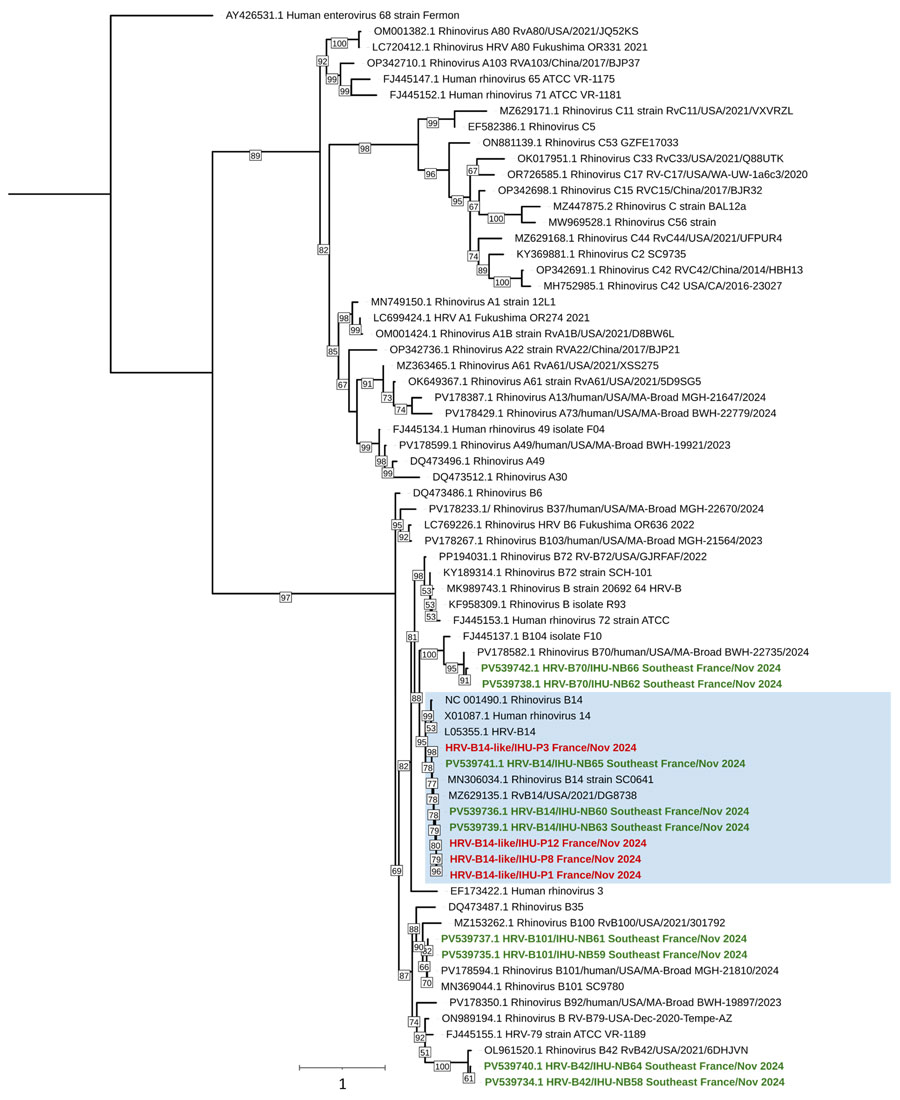
Phylogenetic tree of HRV-B sequences circulating in Marseille during severe respiratory illness and death associated with outbreak of HRV-B14 among older adults, France, 2024. Viral protein 1–encoding gene sequence alignment was performed by using MUSCLE (https://www.ebi.ac.uk/Tools/msa/muscle) with standard parameters for nucleotide sequences. Blue background indicates the HRV-B14 sequences; red font indicates sequences obtained from the cluster of cases among older adults; green font indicates sequences obtained from other HRV RNA–positive samples detected in our laboratory during the same timeframe as the outbreak. All others sequences were downloaded from GenBank; accession numbers are indicated. The sequence obtained from patient P6 does not appear in this tree because it was a partial sequence and does not align with the genome region used in this analysis. The IQ-TREE software was used to build the tree with the general time-reversible model plus empirical base frequencies plus FreeRate model with 10 rate categories model identified as the most suitable by the best-fit model research module according to the Bayesian information criterion. A total of 10,000 ultra-fast bootstrap replicates were performed. Scale bar indicates nucleotide substitutions per site. HRV, human rhinovirus.

Figure 3. Phylogenetic tree of HRV-B sequences circulating in Marseille during severe respiratory illness and death associated with outbreak of HRV-B14 among older adults, France, 2024. Viral protein 1–encoding gene sequence alignment was performed by using MUSCLE (https://www.ebi.ac.uk/Tools/msa/muscle) with standard parameters for nucleotide sequences. Blue background indicates the HRV-B14 sequences; red font indicates sequences obtained from the cluster of cases among older adults; green font indicates sequences obtained from other HRV RNA–positive samples detected in our laboratory during the same timeframe as the outbreak. All others sequences were downloaded from GenBank; accession numbers are indicated. The sequence obtained from patient P6 does not appear in this tree because it was a partial sequence and does not align with the genome region used in this analysis. The IQ-TREE software was used to build the tree with the general time-reversible model plus empirical base frequencies plus FreeRate model with 10 rate categories model identified as the most suitable by the best-fit model research module according to the Bayesian information criterion. A total of 10,000 ultra-fast bootstrap replicates were performed. Scale bar indicates nucleotide substitutions per site. HRV, human rhinovirus.

Main Article

Page created: March 19, 2026
Page updated: May 07, 2026
Page reviewed: May 07, 2026
The conclusions, findings, and opinions expressed by authors contributing to this journal do not necessarily reflect the official position of the U.S. Department of Health and Human Services, the Public Health Service, the Centers for Disease Control and Prevention, or the authors' affiliated institutions. Use of trade names is for identification only and does not imply endorsement by any of the groups named above.
file_external