Skip directly to site content Skip directly to page options Skip directly to A-Z link Skip directly to A-Z link Skip directly to A-Z link

Disclaimer: Early release articles are not considered as final versions. Any changes will be reflected in the online version in the month the article is officially released.

Volume 32, Number 5—May 2026

Research Letter

Borrelia turicatae in Ticks from Animals in a Public Park, Aguascalientes, Mexico

Edwin Vázquez-Guerrero1, Gustavo Paniagua-Campos1, Alexander R. Kneubehl, Paulina Estrada de los Santos, Job E. Lopez, and J. Antonio IbarraComments to Author 
Author affiliation: Instituto Politécnico Nacional, Mexico City, Mexico (E. Vázquez-Guerrero, G. Paniagua-Campos, P. Estrada-de los Santos, J.A. Ibarra); Baylor College of Medicine, Houston, Texas, USA (A.R. Kneubehl, J.E. Lopez)

Main Article

Figure 2

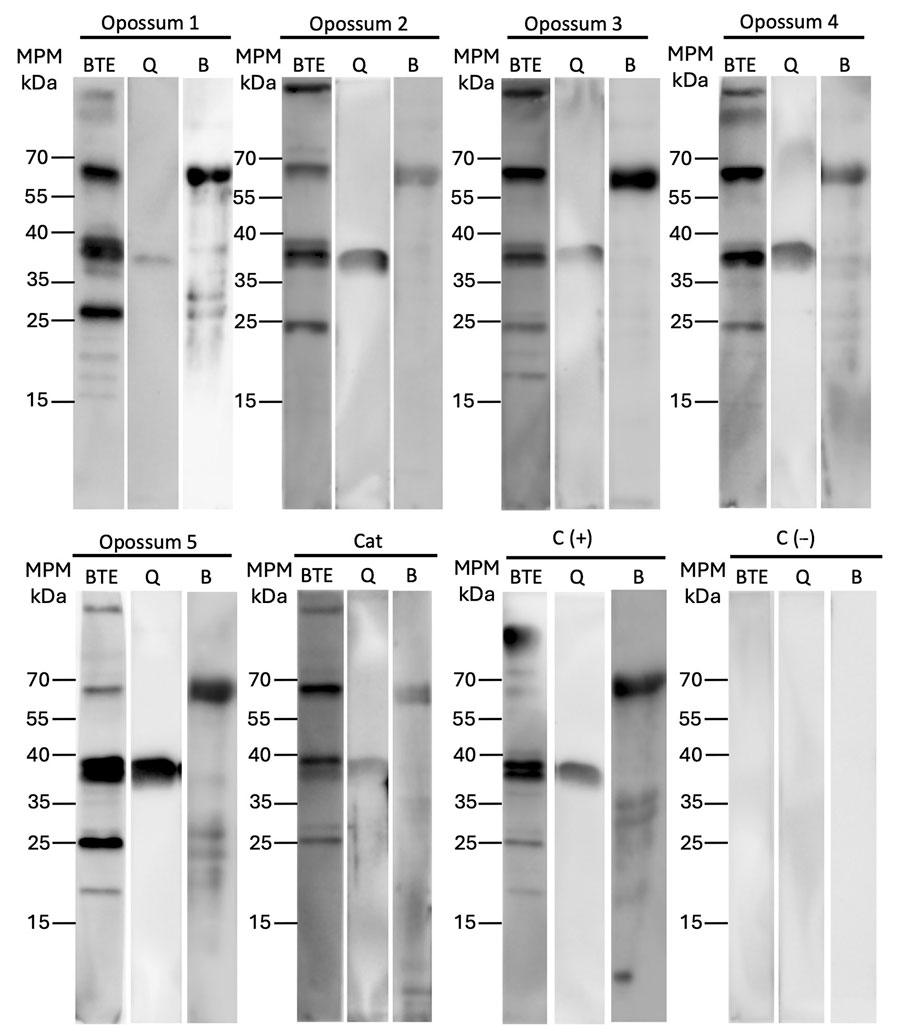
Immunoblot results assessing antibody responses in study of Borrelia turicatae in ticks from animals in a public park, Aguascalientes, Mexico. Images show responses in opossums and a feral cat captured in La Pona Park, along with mouse controls. C (+) is an immunoblot using a serum sample from a positive control mouse infected with B. turicatae. C (–) is from a negative control (serum from a nonexposed mouse). We used recombinant horseradish peroxidase protein A/G (Thermo Fisher Scientific, https://www.thermofisher.com) as the secondary ligand for the detection of both opossum and cat antibodies. BTE, B. turicatae protein extracts; Q, recombinant GlpQ; B, B. turicatae recombinant BipA.

Figure 2. Immunoblot results assessing antibody responses in study of Borrelia turicatae in ticks from animals in a public park, Aguascalientes, Mexico. Images show responses in opossums and a feral cat captured in La Pona Park, along with mouse controls. C (+) is an immunoblot using a serum sample from a positive control mouse infected with B. turicatae. C (–) is from a negative control (serum from a nonexposed mouse). We used recombinant horseradish peroxidase protein A/G (Thermo Fisher Scientific, https://www.thermofisher.com) as the secondary ligand for the detection of both opossum and cat antibodies. BTE, B. turicatae protein extracts; Q, recombinant GlpQ; B, B. turicatae recombinant BipA.

Main Article

1These authors contributed equally to this article.

Page created: April 13, 2026
Page updated: April 28, 2026
Page reviewed: April 28, 2026
The conclusions, findings, and opinions expressed by authors contributing to this journal do not necessarily reflect the official position of the U.S. Department of Health and Human Services, the Public Health Service, the Centers for Disease Control and Prevention, or the authors' affiliated institutions. Use of trade names is for identification only and does not imply endorsement by any of the groups named above.
file_external