Volume 32, Number 5—May 2026
Dispatch
Replication Efficiency of Contemporary Highly Pathogenic Avian Influenza A(H5N1) Virus Isolates in Human Nasal Epithelium Model

Figure 1
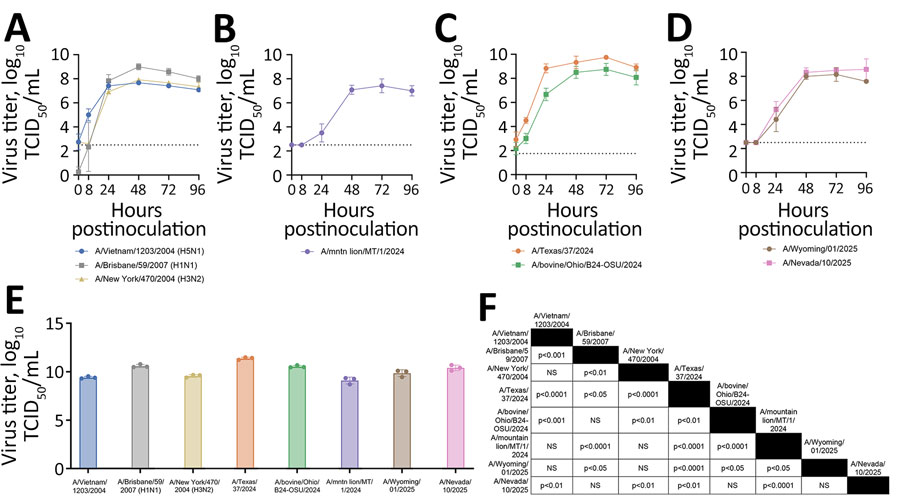
Figure 1. Replication of seasonal and highly pathogenic avian influenza (HPAI) A viruses in human nasal epithelium cultures in study of replication efficiency of contemporary HPAI H5N1 virus isolates in human nasal epithelium model. A–D) Virus replication in historical (A) and HPAI H5N1 genotype clade 2.3.4.4b B3.13 (B), B3.6 (C), and D1.1 (D) virus strains. We inoculated Mattek EpiNasal cultures (https://www.mattek.com) with a multiplicity of infection of 0.1 TCID50 per cell. We harvested apical supernatant at 0, 8, 24, 48, 72, and 96 hours postinoculation and titered on MDCK cells. Data points and error bars represent the geometric mean +SD of 3 biologic replicates from a single donor; dashed line indicates lower limit of detection. E) Area under the curve of data from 0–96 hours postinoculation as shown in panels A–D. Error bars indicate SD. F) Statistical analysis of data in panel E performed using 1-way analysis of variance with multiple comparisons (Tukey). NS, not significant; TCID50, 50% tissue culture infectious dose.
1These authors contributed equally to this article.
2Current affiliation: LSU Health, Shreveport, Louisiana, USA.