Skip directly to site content Skip directly to page options Skip directly to A-Z link Skip directly to A-Z link Skip directly to A-Z link

Disclaimer: Early release articles are not considered as final versions. Any changes will be reflected in the online version in the month the article is officially released.

Volume 32, Number 6—June 2026

Research

Association of Frailty and Frailty Trajectory with Risk for Respiratory Infectious Diseases

Jin Yang1, Hao Yan1, Huan Chen, Dan Liu, Zhihao Li, and Chen MaoComments to Author 
Author affiliation: School of Public Health, Southern Medical University, Guangzhou, China; National Institute of Health Data Science of China, Southern Medical University, Guangzhou

Main Article

Figure 1

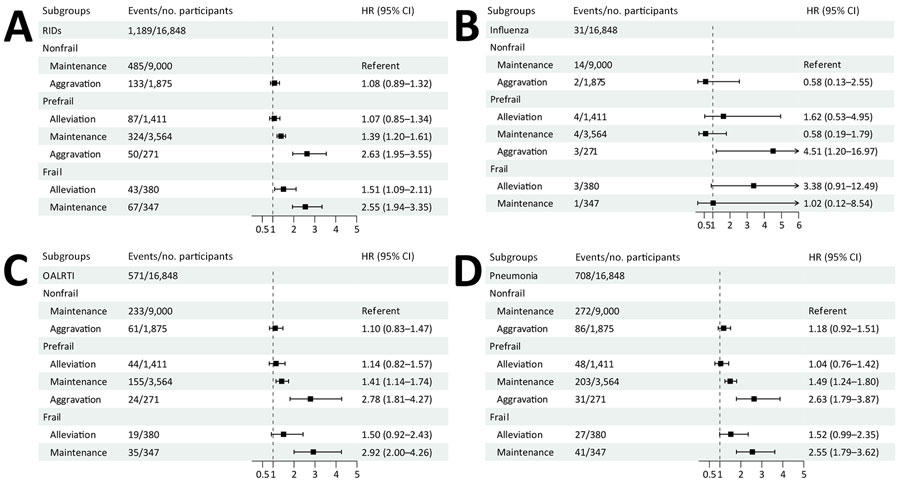
Longitudinal baseline and follow-up associations of frailty index with risk for RIDs. Forest plots show the trajectory of frailty index associated with incident RIDs (A), influenza (B), OALRTI (C), and pneumonia (D). Squares indicate point estimates of HRs; error bars indicate 95% CI; dotted vertical lines indicate null effect. Analyses were adjusted for age, sex, ethnicity, education level, Townsend deprivation index, smoking status, alcohol consumption status, cumulative dietary risk factor score, PM2.5 (exposure to particulate matter <2.5 mm), nitrogen dioxide and nitrogen oxide levels, body mass index category, sleep duration, sleeplessness, and daytime dozing. HR, hazard ratio; OALRTI, other acute lower respiratory tract infection; RIDs, respiratory infectious diseases.

Figure 1. Longitudinal baseline and follow-up associations of frailty index with risk for RIDs. Forest plots show the trajectory of frailty index associated with incident RIDs (A), influenza (B), OALRTI (C), and pneumonia (D). Squares indicate point estimates of HRs; error bars indicate 95% CI; dotted vertical lines indicate null effect. Analyses were adjusted for age, sex, ethnicity, education level, Townsend deprivation index, smoking status, alcohol consumption status, cumulative dietary risk factor score, PM2.5 (exposure to particulate matter <2.5 mm), nitrogen dioxide and nitrogen oxide levels, body mass index category, sleep duration, sleeplessness, and daytime dozing. HR, hazard ratio; OALRTI, other acute lower respiratory tract infection; RIDs, respiratory infectious diseases.

Main Article

1These first authors contributed equally to this article.

Page created: April 22, 2026
Page updated: May 18, 2026
Page reviewed: May 18, 2026
The conclusions, findings, and opinions expressed by authors contributing to this journal do not necessarily reflect the official position of the U.S. Department of Health and Human Services, the Public Health Service, the Centers for Disease Control and Prevention, or the authors' affiliated institutions. Use of trade names is for identification only and does not imply endorsement by any of the groups named above.
file_external