Skip directly to site content Skip directly to page options Skip directly to A-Z link Skip directly to A-Z link Skip directly to A-Z link

Disclaimer: Early release articles are not considered as final versions. Any changes will be reflected in the online version in the month the article is officially released.

Volume 32, Number 6—June 2026

Dispatch

Placental Vascular Pathology Associated with Congenital Lymphocytic Choriomeningitis Virus Infection, Philadelphia, Pennsylvania, USA

Abin Abraham, Rebecca L. Linn, Dustin D. Flannery, and Scott M. GordonComments to Author 
Author affiliation: Children’s Hospital of Philadelphia, Philadelphia, Pennsylvania, USA (A. Abraham, R.L. Linn, D.D. Flannery, S.M. Gordon); University of Pennsylvania Perelman School of Medicine, Philadelphia (R.L. Linn, D.D. Flannery, S.M. Gordon)

Main Article

Figure 1

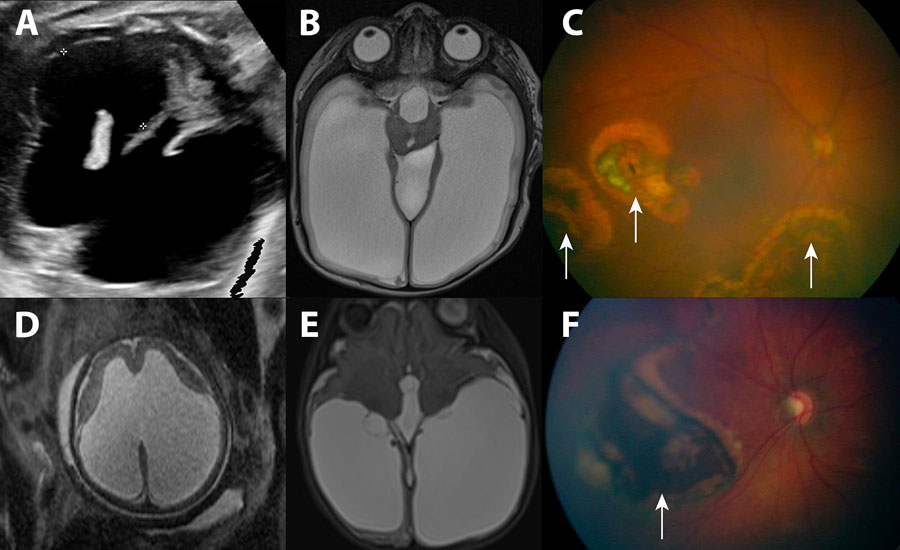
Imaging findings for ventriculomegaly and chorioretinitis associated with congenital lymphocytic choriomeningitis virus infection, Philadelphia, Pennsylvania, USA. A–C) Case 1; D–F) case 2. A) Routine ultrasonography at 36 weeks’ gestation, demonstrating severe cerebral ventriculomegaly in the fetus (black space between markers on the anatomic right and the unmarked black space on the anatomic left). B) Postnatal (38 weeks 4 days’ gestation) brain magnetic resonance imaging of newborn confirmed severe cerebral ventriculomegaly (large, white, fluid-filled spaces bilaterally and in the center of the image). C) Fundoscopic examination of newborn, revealing multiple areas of chorioretinitis (arrows). D) Routine ultrasonography at 36 weeks’ gestation, demonstrating severe cerebral ventriculomegaly in the fetus. E) Postnatal (38 weeks 5 days’ gestation) brain magnetic resonance imaging of newborn confirmed severe cerebral ventriculomegaly. F) Fundoscopic examination of newborn, revealing a large area of chorioretinitis (arrow).

Figure 1. Imaging findings for ventriculomegaly and chorioretinitis associated with congenital lymphocytic choriomeningitis virus infection, Philadelphia, Pennsylvania, USA. A–C) Case 1; D–F) case 2. A) Routine ultrasonography at 36 weeks’ gestation, demonstrating severe cerebral ventriculomegaly in the fetus (black space between markers on the anatomic right and the unmarked black space on the anatomic left). B) Postnatal (38 weeks 4 days’ gestation) brain magnetic resonance imaging of newborn confirmed severe cerebral ventriculomegaly (large, white, fluid-filled spaces bilaterally and in the center of the image). C) Fundoscopic examination of newborn, revealing multiple areas of chorioretinitis (arrows). D) Routine ultrasonography at 36 weeks’ gestation, demonstrating severe cerebral ventriculomegaly in the fetus. E) Postnatal (38 weeks 5 days’ gestation) brain magnetic resonance imaging of newborn confirmed severe cerebral ventriculomegaly. F) Fundoscopic examination of newborn, revealing a large area of chorioretinitis (arrow).

Main Article

Page created: April 23, 2026
Page updated: May 01, 2026
Page reviewed: May 01, 2026
The conclusions, findings, and opinions expressed by authors contributing to this journal do not necessarily reflect the official position of the U.S. Department of Health and Human Services, the Public Health Service, the Centers for Disease Control and Prevention, or the authors' affiliated institutions. Use of trade names is for identification only and does not imply endorsement by any of the groups named above.
file_external