Skip directly to site content Skip directly to page options Skip directly to A-Z link Skip directly to A-Z link Skip directly to A-Z link

Disclaimer: Early release articles are not considered as final versions. Any changes will be reflected in the online version in the month the article is officially released.

Volume 32, Number 7—July 2026

Research

Molecular Epidemiology of Skin-Dwelling Filariae and Risk Factors for Mansonella streptocerca Infection, Gabon

Capucine Marie Sicard, Mara Fischer, Chiara Wizemann, Marilen Bartling, Linda Martin, Miriam Rodi, Juliana Inoue, Sabrina Valeria Sinopoli, Esther Mehmel, Andrea Kreidenweiss, Pierre Blaise Matsiegui, Michael Ramharter, Selidji Todagbe Agnandji, and Jana HeldComments to Author 
Author affiliation: Institute of Tropical Medicine Tübingen, University Hospital Tübingen, Tübingen, Germany (C.M. Sicard, M. Fischer, C. Wizemann, M. Bartling, L. Martin, M. Rodi, J. Inoue, S.V. Sinopoli, A. Kreidenweiss, J. Held); Bernhard-Nocht Institute for Tropical Medicine, Hamburg, Germany (E. Mehmel, A. Kreidenweiss, M. Ramharter); Centre de Recherches Médicales de la Ngounié, Fougamou, Gabon (P.B. Matsiegui); German Center for Infection Research, Partner Sites Hamburg-Lübeck-Borstel-Riems, Hamburg (M. Ramharter); Centre de Recherches Médicales de Lambaréné (CERMEL), Lambaréné, Gabon (M. Ramharter, S.T. Agnandji, J. Held); Institute for Medical Microbiology, University Hospital Münster, Münster, Germany (S.T. Agnandji); German Center for Infection Research (DZIF), partner site Tübingen, Tübingen (A. Kreidenweiss, J. Held)

Main Article

Figure 2

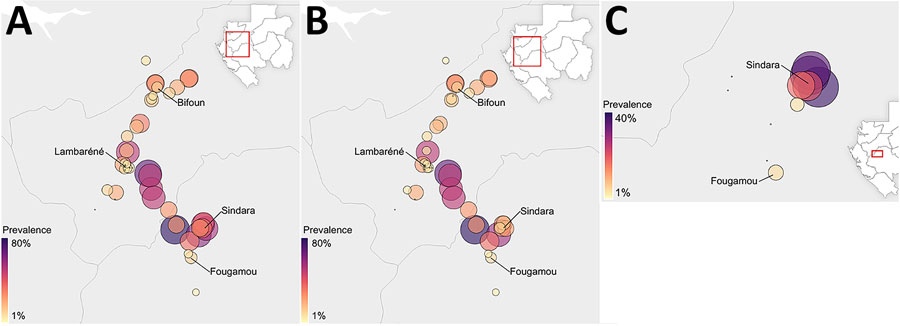
Geographic distribution of skin-dwelling filariae in central Gabon in study of molecular epidemiology of skin-dwelling filariae and risk factors for Mansonella streptocerca infection, Gabon. A) Overall filarial DNA prevalence; B) distribution of M. streptocerca nematodes; and C) distribution of O. volvulus nematodes, showing a focal hotspot around Sindara. Each circle represents 1 sampling area; size and color correspond to prevalence. Inset maps show locations of corresponding area in Gabon.

Figure 2. Geographic distribution of skin-dwelling filariae in central Gabon in study of molecular epidemiology of skin-dwelling filariae and risk factors for Mansonella streptocerca infection, Gabon. A) Overall filarial DNA prevalence; B) distribution of M. streptocerca nematodes; and C) distribution of O. volvulus nematodes, showing a focal hotspot around Sindara. Each circle represents 1 sampling area; size and color correspond to prevalence. Inset maps show locations of corresponding area in Gabon.

Main Article

Page created: May 14, 2026
Page updated: June 09, 2026
Page reviewed: June 09, 2026
The conclusions, findings, and opinions expressed by authors contributing to this journal do not necessarily reflect the official position of the U.S. Department of Health and Human Services, the Public Health Service, the Centers for Disease Control and Prevention, or the authors' affiliated institutions. Use of trade names is for identification only and does not imply endorsement by any of the groups named above.
file_external